

HotelTransfers
What This Charter Is
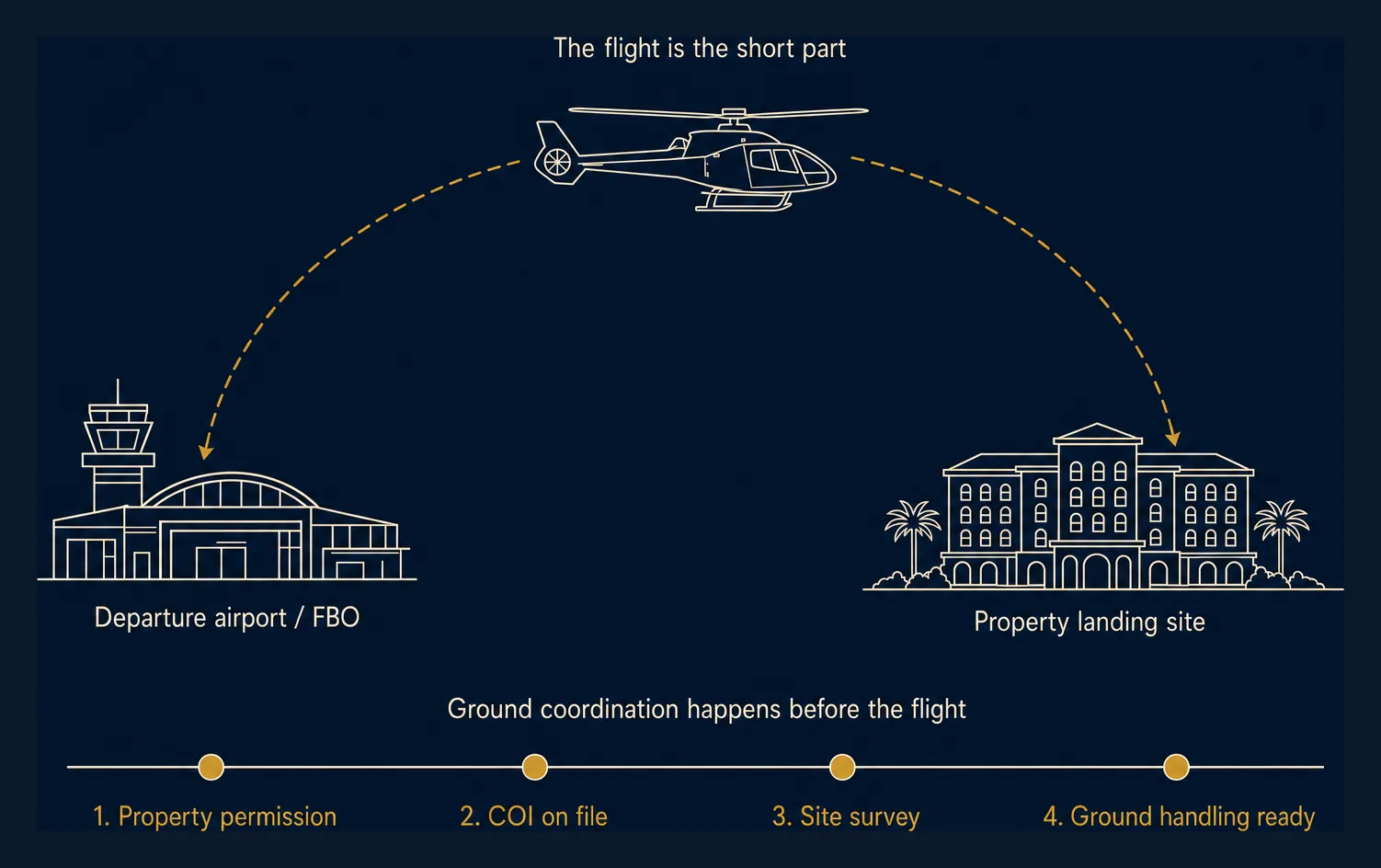
A hotel transfer is a helicopter charter with a hotel, resort, or event venue at one end of the flight. Sometimes that means landing on the property itself, on a helipad or approved ground. More often it means landing at the closest heliport or airport that can receive the flight, then a short ground leg to the front door. Either way, the flying is the easy part. The work that defines this charter happens with the property: permission to land, proof of insurance, a site suitability check, and people ready on the ground when the aircraft arrives. Get those four settled and the transfer runs itself; skip any of them and there is no transfer. If the trip chains an airline flight into the leg, that connection follows the pattern in Airport Transfers.
Who Uses It and Why
Hotel transfers are usually arranged by planners working backward from a fixed commitment. Executive assistants and corporate travel planners book them when a principal’s schedule cannot absorb a long drive from the nearest airport. Event and conference planners use them to move speakers, executives, and attendee groups between an off-site landing site and a venue, sometimes in repeated shuttle rotations across a day. Private individuals book the same service for a celebration stay or a family arrival that deserves a direct connection. The common thread: the property is the endpoint, and someone has to make the landing work before anyone flies.
How a Typical Flight Works
A hotel transfer starts on the ground, not in the air:
- Booking and site question. You give the operator the property address; the first question is not the flight but whether and where the helicopter can land.
- Property permission. The operator (or you, with the operator’s guidance) contacts the property. Landing approval is the property owner’s call; no blanket federal rule grants a right to land at a hotel.
- Insurance paperwork. Venues commonly require a certificate of insurance (COI) from the operator’s liability coverage, naming the property, before they approve a landing. The coverage amount a venue asks for varies by property and by the size of the operation.
- Site suitability check. The operator assesses approach and departure paths, obstructions, surface condition, and how passengers will be kept clear of the aircraft. For a site that has never received a helicopter, this may involve photos, a local contact, or a visit.
- The flight. The short part. You depart from an airport or FBO, fly direct, and land at the property or the agreed nearby site.
- Ground handling. Luggage comes off, passengers are escorted clear, and hotel or venue staff take over. A good operator coordinates this handoff in advance.
Aircraft Typically Used
The trade here runs between economy and margin. A light single-engine helicopter is the default for one to three passengers with ordinary luggage: the most economical class to charter and the least demanding on landing room, which matters at a property site. Light and medium twin-engine helicopters cost more and answer three specific pressures: a larger party, heavier luggage, or a route that argues for a second engine, such as night legs or overwater approaches to a coastal resort. Note that luggage drives the selection more often than headcount: a party of four with a week of resort baggage can outgrow the aircraft that would carry the same four people to a day meeting. The operator sizes the aircraft to passenger count, baggage, and landing site, in that order.

Planning Considerations
Weather
Hotel transfers carry a fixed-date problem. Check-in days, conferences, and event start times do not move when the weather does. A helicopter cannot outfly a grounded system, so a fixed-date transfer deserves a ground backup plan booked alongside it. Seasonal patterns matter too: summer afternoon thunderstorms and low winter ceilings can both close the window you planned around.
Landing Sites
This is the section that decides whether your transfer happens as imagined. Two realistic arrangements:
- Landing on-property. Some resorts and rural properties have a helipad or grounds the owner will approve. The operator still has to confirm the site: approach and departure paths clear of trees, wires, and buildings; a surface that will take the aircraft without throwing loose debris; and a plan for keeping guests and bystanders separated from the rotor disc. The property will typically want a COI before saying yes, and the answer can still be no.
- Landing nearby with a ground transfer. The fallback, and frequently the better plan: the nearest heliport or airport that already accepts helicopters, plus a short car leg. It removes the permission question, the insurance negotiation, and the site risk, at the cost of a few minutes on the ground.
Be candid about the urban case. Most city hotels cannot permit a rooftop or on-site landing at all: the roof was never built or certified for it, neighbors and noise ordinances weigh in, and local heliport rules vary from one jurisdiction to the next. Even where a landing is physically possible, noise leads many properties to decline. The wider rules on where helicopters can go are covered in Heliports & Landing Zones.
Luggage and Passengers
Declare your baggage honestly when you book. Helicopter baggage capacity is limited by space and weight, and resort trips are the worst case: formal wear, sports equipment, and a week of suitcases add up fast. If the luggage will not fit with the passengers, options include a larger aircraft, a second rotation, or sending bags ahead by car. Passengers also get a safety briefing on approaching and leaving the aircraft on the day.
Lead Time
A transfer to a property that already hosts helicopters can come together quickly. A first-time landing at a new site cannot: permission, the COI, and the site check each take time, and the property may move slowly, so plan on weeks rather than days. Event logistics multiply this. Multi-shuttle operations, where one aircraft runs repeated rotations between an off-site landing site and a venue for a conference or group arrival, need a schedule, a ground team, and a weather fallback worked out well in advance.
Cost Factors
The variables behind any charter quote are laid out in What a Charter Costs. What moves the number on a hotel transfer: aircraft class, total flight time including the legs to position the aircraft to and from its base, any site fee the property charges, ground handling and car transfers at each end, and waiting time when the aircraft stays for the return or works an event shuttle schedule. A same-day round trip with the aircraft waiting costs very differently from two one-way legs days apart.
Frequently Asked Questions
Can a helicopter land at any hotel?
No. Landing approval is the property owner’s decision, and many properties, especially urban hotels, cannot or will not permit it. The realistic fallback is the nearest heliport or airport plus a short ground leg.
What is a COI and why does the hotel want one?
A certificate of insurance is proof from the operator’s insurer that liability coverage is in force, issued naming the property; venues commonly require it before approving a landing. Legitimate charter operators carry liability insurance under their Part 135 operation, and the COI is how the property verifies it. Part 135 is explained in FAR Part 135 for Charter Customers.
How far ahead should I arrange a hotel transfer?
For a property with an established helipad, short notice can work. For a first-time landing site, start weeks out: permission, insurance, and the site check each run on the property’s clock, not yours. Event shuttles need longer still.
What happens if weather cancels the flight on the day?
You fall back to ground transport, so a backup car plan is worth booking alongside any fixed-date transfer. Operator weather policies and delay patterns are covered in Weather, Delays & Scheduling.
Can one helicopter move a whole event group?
Yes, in rotations: the aircraft shuttles between an off-site landing site and the venue, moving the group in waves. Treat it as its own small logistics operation: schedule, ground crew, passenger manifest, and a weather plan.
Related Charters
- Airport Transfers: when the endpoint is an airline connection rather than a property.
- Corporate & Executive Travel: the general case of point-to-point business flying on your schedule.
- Site Visits & Facility Tours: landing at plants, projects, and remote facilities, where site coordination runs even deeper.
- VIP & Discreet Travel: when privacy and low-profile handling drive the booking.
- Executive & Business Charters: how the executive charters differ and which one fits your trip.