
VIP&DiscreetTravel
What This Charter Is
VIP and discreet travel is a helicopter charter booked for one outcome above all others: control over who sees the passenger move. The traveler may be a public figure, an executive in a sensitive period, a public official, or anyone whose movements attract attention. The aircraft is the same machine any business charter uses. What changes is everything around it: the departure point, the passenger handling, and how few people hold the schedule.
Privacy is the driver, and it sorts the pages. Routine business travel on your own schedule is Corporate & Executive Travel; when the event itself is the point of the trip, that arrival problem belongs to Sporting Events & Concerts.
Who Uses It and Why
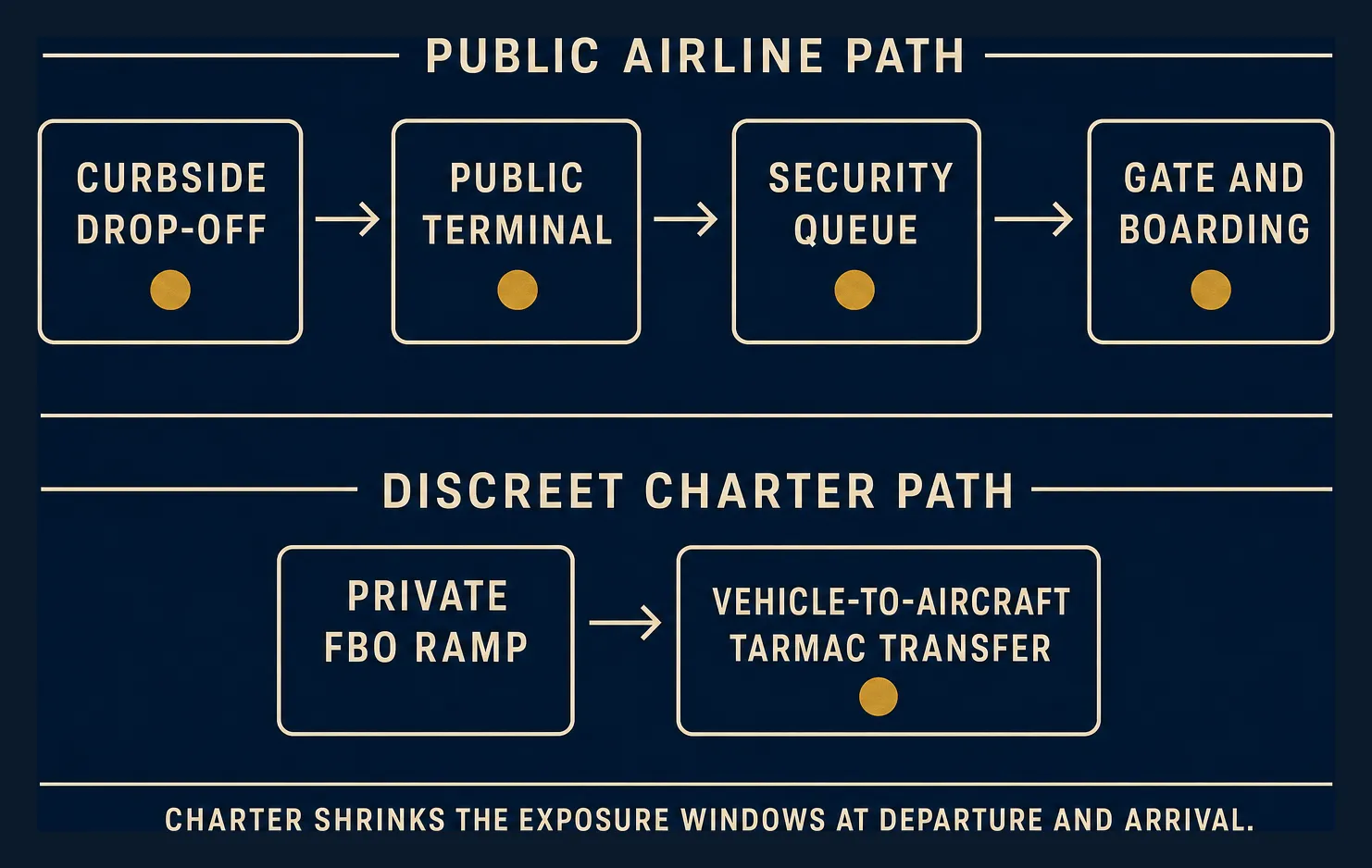
Bookings usually come from people who plan movements for a living: executive protection agents, security details, chiefs of staff, executive assistants, and family offices. Their principals share a problem: commercial travel concentrates exposure. A public terminal means a curbside arrival, a check-in hall, a security queue, a gate area: dozens of chances to be photographed, approached, or simply logged.
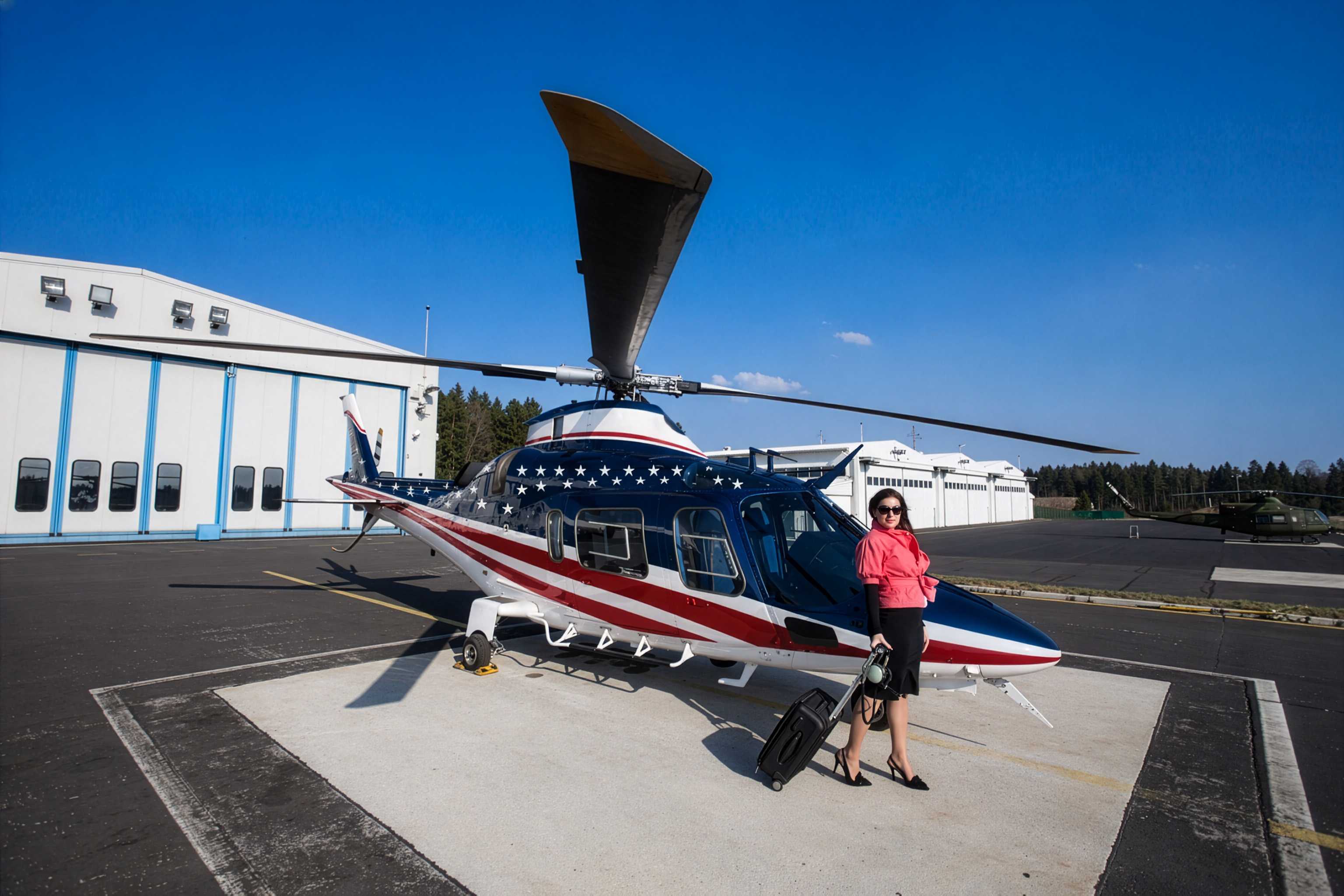
A helicopter charter attacks that problem where a traveler is most visible: departure and arrival. The passenger drives into a private facility and steps directly into the aircraft, shrinking public exposure from an hour or more to a few minutes. That reduction, repeated at both ends, is the core of what this charter buys.
How a Typical Flight Works
A discreet movement is planned around a small set of levers.
Private terminals and low-profile FBOs. Most airports have fixed-base operators, private terminals serving general and charter aviation; departing from one removes the passenger from the airline terminal’s public flow. Where an airport has several, a detail planning a sensitive movement will often prefer the quieter one over the flagship. Vehicle-to-aircraft tarmac access, the car pulling up beside the helicopter, is a standard FBO service, though the policy is the airport’s to set and varies from field to field.
Direct tarmac transfer. The choreographed version: the vehicle enters the secure side of the field at a prearranged gate and time, the aircraft is staged and ready, and the passenger walks from car door to cabin door. No lobby, no waiting area, no lingering on the ramp; the same sequence runs in reverse on arrival.
Manifests and scheduling. On a Part 135 charter, the passenger manifest is an operator record, not a public filing; who is flying and when it leaves stays inside the operator’s books. Operators still verify passenger identity, and which security program applies depends on the operation and the aircraft. Booking through a detail or office rather than in the principal’s own name keeps the reservation chain narrow.
Coordination with security details. Where a protection detail is involved, the operator becomes one node in its plan: an advance visit to the departure and landing sites, timing agreed so ground vehicles and aircraft never wait visibly on each other, and a direct line between pilot and detail leader. If the detail is armed, carriage of firearms aboard a charter aircraft depends on federal rules, the law of every state the flight touches, and the operator’s own policy. Raise it early, not on the ramp.
What a Charter Cannot Do for Your Security
This is the part worth reading twice, because it is where expectations go wrong.
Flight tracking is public. Most aircraft in most controlled airspace broadcast their position continuously through ADS-B, and that data is aggregated by public tracking sites. The FAA’s LADD program, Limiting Aircraft Data Displayed, lets an aircraft owner ask that their tail number be withheld from the public feeds the FAA supplies. That raises the bar against casual tracking. It does not remove the aircraft from independent receiver networks, and it does nothing about anyone simply watching the ramp. Treat LADD as friction, not a cloak.
Airspace rules apply to everyone. Temporary flight restrictions, including the VIP movement restrictions under 14 CFR 91.141 that protect senior officials, bind every aircraft in the sky, charter or not. A discreet charter near a protected movement can find itself delayed, rerouted, or grounded with no discretion to waive it. No operator can promise otherwise.
A helicopter reduces exposure; it does not create anonymity. What the aircraft genuinely does is compress the two most visible segments of a trip into minutes, on ground the operator controls, at times the passenger chooses. Anyone treating a charter as a way to move in secret is buying the wrong thing, and an honest operator will say so.
Aircraft Typically Used
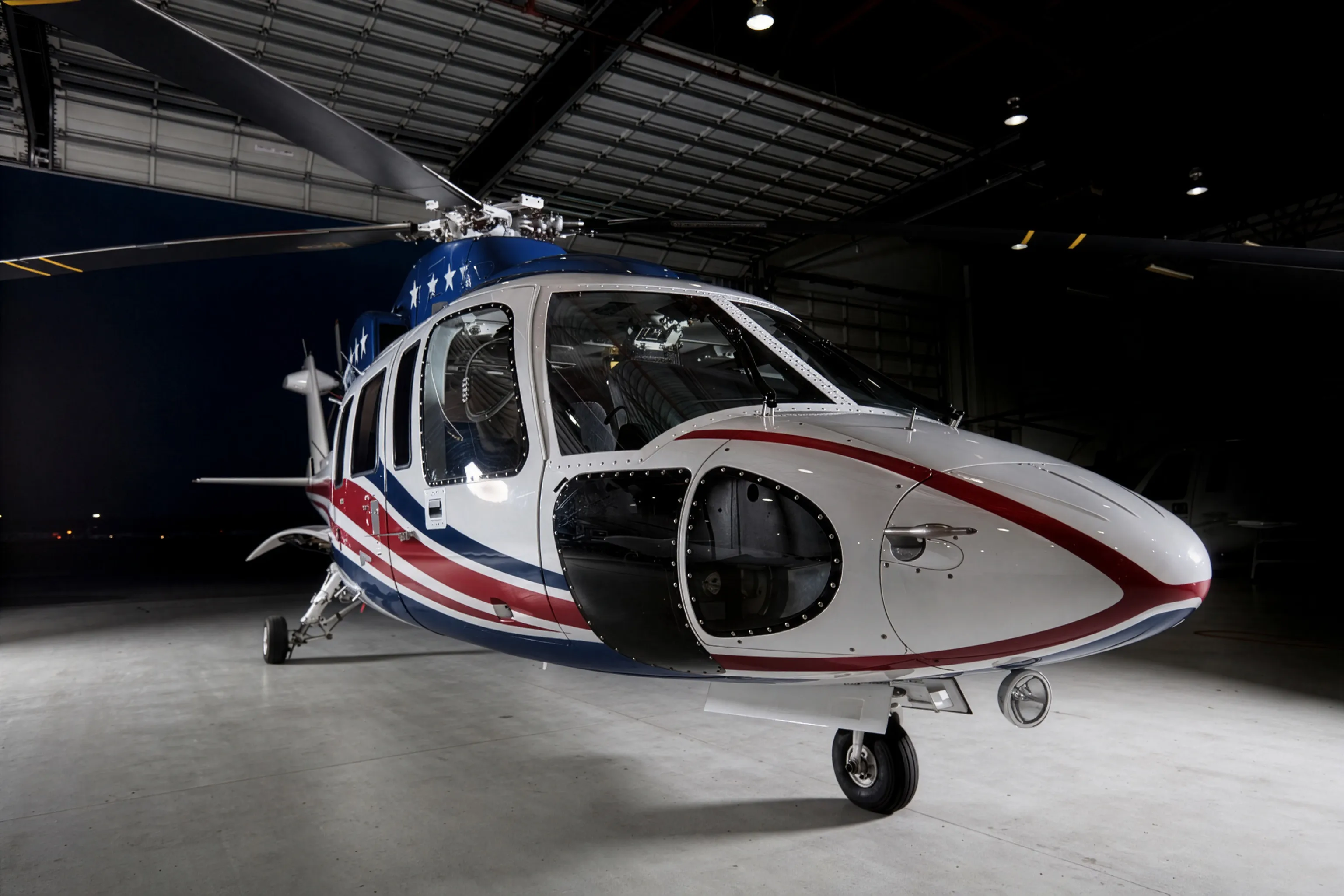
The trade favors capability over economy here, because the mission usually carries more than a passenger. Discreet movements lean toward twin-engine executive helicopters: types in the class of the AgustaWestland A109 at the lighter end and the Sikorsky S-76 at the medium end. What the twin buys is specific: a second engine over built-up areas and at night, a cabin that seats a principal plus a detail in quiet surroundings, and a baggage hold for more than a day trip’s luggage. A light single can manage a short hop at lower cost, but once a detail, its equipment, and a night or urban routing enter the picture, the twin is the default. For class trade-offs, see the Helicopter Class Comparison Guide.
Planning Considerations
Weather
Weather rules this flying as firmly as any other, and discretion cuts no ice with a thunderstorm. Sensitive movements should carry a ground backup plan: the more fixed the timing, the more a delay costs. The Weather, Delays & Scheduling FAQ covers the patterns.
Landing Sites
The most discreet arrival is often not an airport but a private helipad, a corporate or hospital pad by arrangement, or a landing zone coordinated in advance at the destination property. Each trades exposure against coordination effort and needs operator approval. The rules of thumb are in Heliports & Landing Zones.
Luggage and Passengers
Cabin and baggage space on executive twins is finite, and a detail with equipment adds up fast. Give an honest headcount and bag count at booking, detail members included, so weight and seating are settled before the day.
Lead Time
Discretion rewards planning. Site visits, FBO coordination, tarmac access, and security-program questions take longer to set up than a standard charter. Off-peak departures, early morning or after dark, keep the ramp quiet. Book days ahead, earlier where a detail needs to walk the route first.
Cost Factors
Aircraft class is the largest lever: a medium twin costs more to operate than a light one. Positioning matters: a helicopter that flies empty to reach your FBO bills that leg. Waiting time, crew duty limits, landing and facility fees, and any after-hours or short-notice premium all feed the total; discreet movements mostly add coordination, site visits and staged timing rather than hardware. For the full framework, see What a Charter Costs: Framework, Not Quotes.
Frequently Asked Questions
Can the flight be kept off tracking websites?
Partly. LADD keeps a tail number off the FAA-fed public displays, but independent receivers still pick up ADS-B broadcasts. Assume the flight is observable and plan the ground segments accordingly.
Can we drive straight to the helicopter?
Usually, yes. Tarmac access is a standard FBO service, subject to the airport’s security rules, and must be arranged in advance.
Who knows we are flying?
The operator, the crew, the FBO, and air traffic control. The manifest is an internal operator record, not a public document.
Can our security detail fly with us?
Yes, and it is common. Seat them in the headcount from the start. If detail members are armed, raise it with the operator at booking: carriage of firearms involves federal rules, the law of the states the flight touches, and the operator’s own policy.
Is a helicopter more discreet than a chartered jet?
A jet from a private terminal is already low-exposure mid-trip. The helicopter’s edge is at the ends: landing near the actual origin or destination cuts the most visible ground segments.
Related Charters
- Corporate & Executive Travel: the general case, when schedule rather than privacy drives the booking.
- Airport Transfers: single-leg connections between an airline flight and the city.
- Hotel Transfers: property pickups and drop-offs with landing-site coordination.
- Multi-City Roadshows: sequenced days where the aircraft stays with the party.
- Site Visits & Facility Tours: landing at the destination itself, often on private property.
- Executive & Business Charters: how the executive charters differ and which one fits your trip.