

ExpressCargo&CourierCharters
What This Charter Is
An express cargo charter moves a small, urgent consignment inside a helicopter’s cabin or baggage compartment, directly from pickup to recipient, with no network in between. The benchmark case is the AOG part: a component an airline or repair station needs right now because an aircraft is on the ground and every parked hour costs money. The same pattern covers signed legal or financial documents that cannot wait for a courier network, non-EMS medical supplies moving between facilities, and time-critical freight headed to a site with no practical road or runway access.
Scope is specific, and it matters for planning. The cargo rides inside the aircraft, within its published weight and balance limits. Cargo slung beneath the helicopter on a longline is a different discipline with different aircraft and different crews. Medical supplies here mean cargo only: no patients, no medical crew, no air-ambulance configuration. And when the urgent thing to move is a person rather than a package, that is Time-Critical & Priority Charters.
These flights operate under FAR Part 135, the federal framework for on-demand air carriers, which covers the carriage of cargo for hire as well as passengers. What that means on your side of the transaction is in FAR Part 135 for Charter Customers in Plain-English.
Who Uses It and Why
The booking usually comes from someone whose job is measured in downtime. AOG and maintenance coordinators at airlines, MRO shops, and corporate flight departments are the most established users; moving a grounded-aircraft part by air is standard industry practice. Couriers and logistics managers book helicopters when a consignment misses every ground cutoff and the contract does not forgive it. Hospital and laboratory supply coordinators move time-sensitive materials between facilities. Film and production unit managers move drives, props, and equipment between locations on a shooting schedule. Industrial site operators, from mines to offshore facilities, use these flights for parts and supplies that a supply boat or a two-day drive cannot deliver on time.
The decision driver is almost always one of two things. Either ground transport is too slow for the deadline, or the destination simply has no road or runway that works. When both are true, the helicopter is often the only option, not the expensive one.
How a Typical Flight Works
The defining feature of an express cargo charter is how little handling the consignment sees, which is exactly what a custody-conscious shipper is buying. The sequence looks like this:
- Pickup handoff. The sender meets the aircraft at the departure point, an airport, heliport, or a suitable private site, and hands the consignment over directly. On a courier-escorted flight, your courier rides along and keeps custody the whole way. On an unescorted flight, the pilot accepts the shipment and is the single custodian in flight.
- Load and secure. The consignment is loaded into the cabin or baggage compartment and secured before departure.
- Direct flight. No hubs, no sorting facilities, no transfers between vehicles. The helicopter flies from pickup to destination in one leg whenever range allows.
- Site landing. The aircraft lands at the recipient’s site if a suitable landing area exists, or at the nearest airport or heliport if it does not.
- Delivery handoff. The consignment is handed to the named recipient, closing the custody chain.
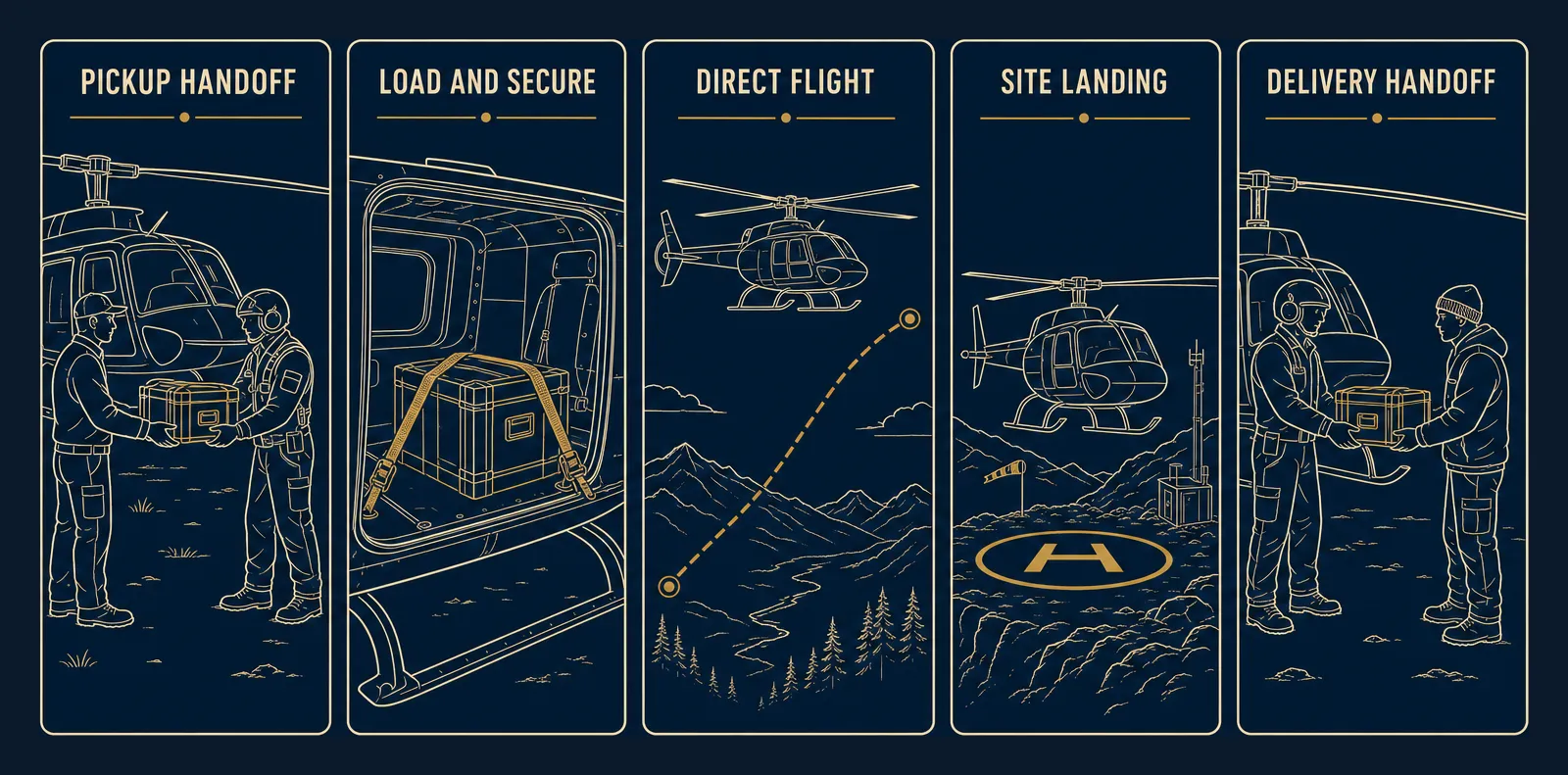
One aircraft, minimal touchpoints, custody continuity from sender to recipient. That is the entire value proposition, and it is why this charter competes with same-day air freight and ground couriers rather than with scheduled cargo networks.
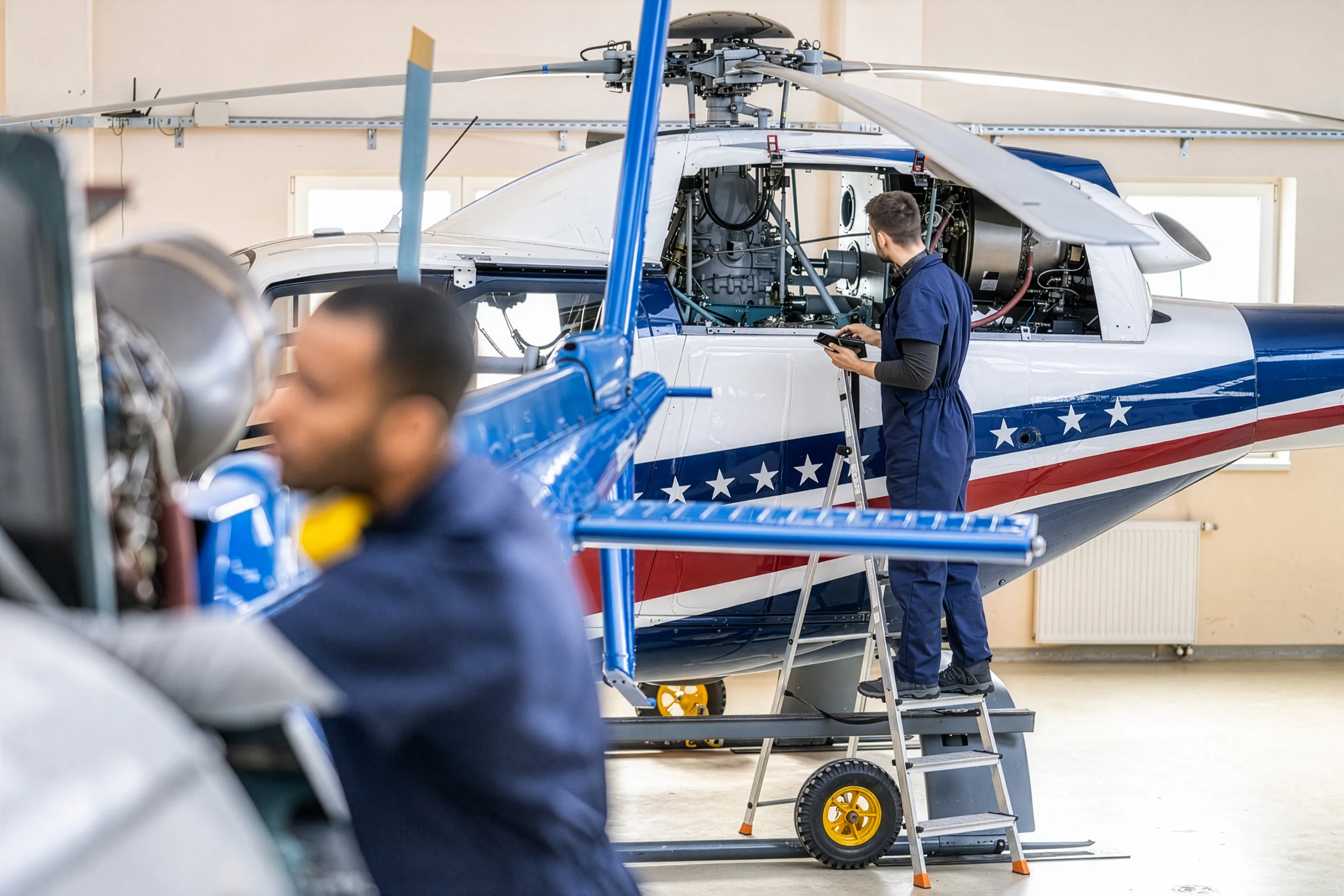
Lead time depends on the arrangement. An ad-hoc callout means locating an available aircraft and crew, which can take from under an hour to several hours depending on the time of day and where the nearest suitable aircraft happens to be. A pre-arranged standing agreement, common with operators who regularly serve an airline, hospital network, or industrial site, cuts that to a dispatch call against pre-agreed terms.
Aircraft Typically Used
Cargo capacity is never a single number. Payload trades directly against fuel, so the same helicopter carries less on a long leg than on a short one, and the ranges below are planning ranges rather than specifications.
- Light single-engine helicopters. The workhorse for documents, small parts, and compact boxes. Usable payload after pilot and fuel typically runs to a few hundred pounds. The real limit is usually geometry rather than weight: cabin door openings and baggage compartment dimensions stop plenty of consignments that weigh almost nothing.
- Light twin-engine helicopters. More cabin volume, more payload, and a second engine, which some recipients and some sites require for overwater or urban legs. Payload sits above the light singles and still in the hundreds of pounds.
- Medium twin-engine helicopters. The top of the charter cargo range: roomier cabins, larger doors, and payloads that can reach four figures on a short leg. They cost more per hour, and on longer legs the fuel takes the payload margin back.
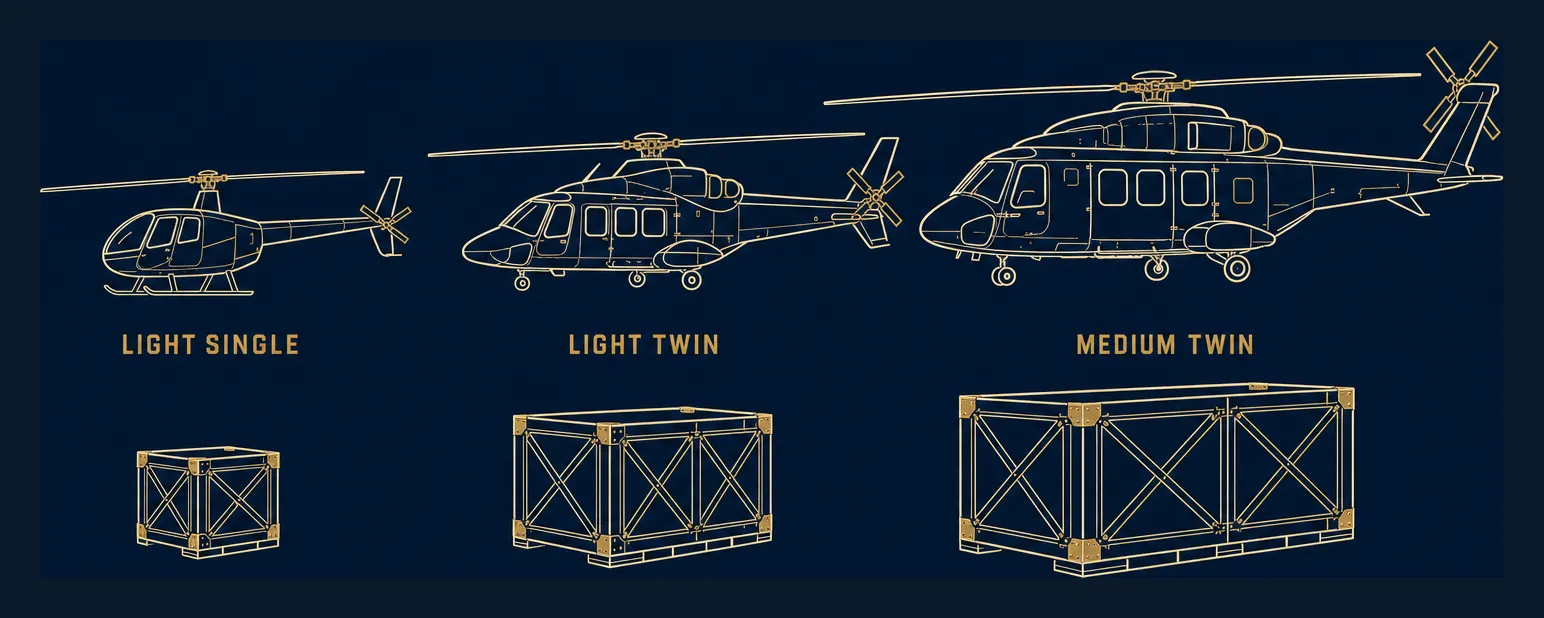
The Helicopter Class Comparison Guide covers these classes in charter terms. The operator makes the final call on whether your consignment fits a given aircraft on a given day, because the answer depends on fuel load, routing, and weather, not just the box.
Planning Considerations
Weight, Volume, Loading, and Securing
Give the operator the consignment’s exact weight, dimensions, and packaging when you book; estimates cost time later. Weight and balance is the operator’s legal responsibility on every flight, and Part 135 requires a written load manifest before takeoff on multi-engine aircraft, so the crew will verify what you declare rather than take it on trust. Cargo is secured with nets, straps, and tie-down points in the cabin or compartment; the operator loads and secures, and nothing flies loose. Hazardous materials are a hard planning point: dangerous goods rules (49 CFR Parts 171-180) apply to charter cargo, and many common urgent shipments, lithium batteries, aerosols, chemical samples, some medical supplies, carry restrictions or paperwork requirements. Declare anything questionable up front. Discovering it at the aircraft is how urgent flights become cancelled flights.
Landing Sites
The helicopter’s advantage is landing where the recipient actually is, but that advantage has conditions. Off-airport landing requires landowner permission and a suitable site: a clear area free of obstacles, with workable approach and departure paths, assessed by the pilot. Industrial plants, hospitals, and remote facilities often have established helipads or known landing areas; a first-time site needs coordination before the flight is booked, not while it circles. The full picture is in Heliports & Landing Zones: Where Helicopters Can Actually Go.
Weather
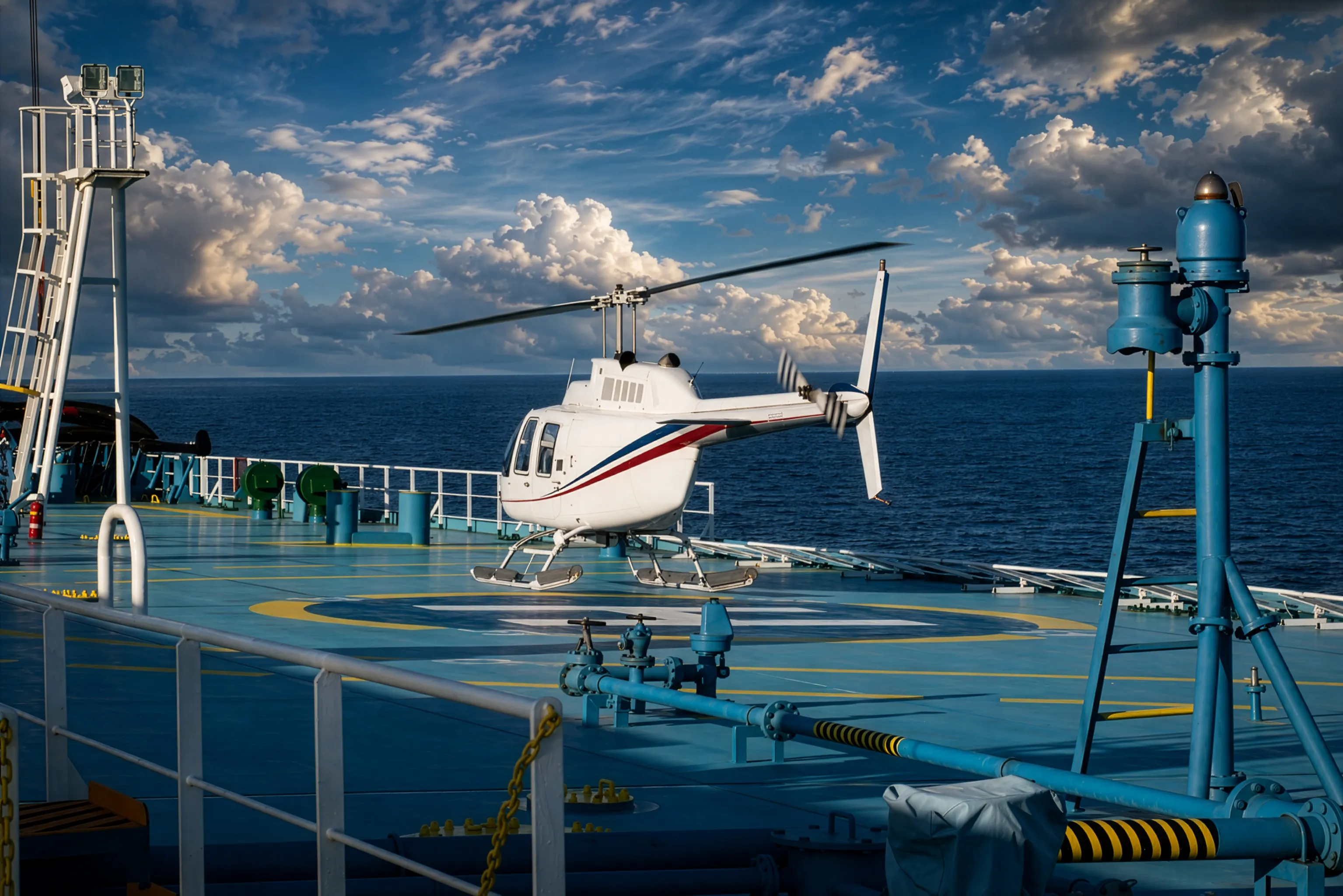
The same weather rules that govern every charter apply here, and urgency does not change them. Low ceilings, icing, and thunderstorms can ground a helicopter while ground couriers keep moving. If the consignment is truly immovable, plan a ground backup for the weather case, and read Weather, Delays & Scheduling FAQ before assuming a helicopter guarantees a deadline.
Lead Time
Ad-hoc charters move fastest when the operator already knows you. Recurring senders get standing arrangements with pre-agreed terms. One-time senders should expect the callout process: aircraft location, crew availability, site assessment at both ends, and any hazmat review. The more of that you hand over complete on the first call, the faster wheels-up.
Cost Factors
The framework behind any charter quote is in What a Charter Costs: Framework, Not Quotes. What drives the cost of an express cargo charter:
- Aircraft class. The smallest helicopter that safely carries the consignment the full distance is almost always the right one.
- Distance and deadhead. You pay for positioning legs: getting the empty aircraft to the pickup and home again after delivery. A nearby based aircraft changes the economics completely.
- Standby time. If the aircraft waits at either end, that time is billable.
- Urgency and after-hours callout. Night, weekend, and short-notice dispatches carry premiums across the industry.
Frequently Asked Questions
Can a helicopter carry my part if it is heavy but small?
Maybe. Weight is only one limit; door opening and compartment dimensions stop more consignments than the scale does. Give the operator exact weight and dimensions, and let them match the aircraft.
Does someone have to ride with the cargo?
No. Many express cargo flights run with the pilot as sole custodian. A courier escort is an option when your chain-of-custody or insurance requirements demand a dedicated handler end to end.
Can the helicopter land at our plant, dock, or job site?
Often, yes, with landowner permission and a site the pilot judges suitable: clear area, safe approach paths, no conflicts with obstacles or operations. Coordinate the site before booking, and see the landing zones resource.
When is a helicopter the wrong answer?
Three common cases. The cargo is too heavy or bulky for any charter helicopter cabin, which is external-load territory and a different kind of operation entirely. Weather grounds the helicopter while a truck could still drive, so an immovable deadline needs a ground backup. And when a nearby airport serves both ends, a fixed-wing charter is usually faster and cheaper for the same consignment. A good operator will tell you which case you are in.
Can you fly batteries, chemicals, or medical shipments?
Sometimes, under dangerous goods rules with the right packaging and paperwork, and sometimes not at all. Declare the contents exactly when you book, and expect the operator to ask for the shipping paperwork before they accept it.
Related Charters
- Time-Critical & Priority Charters: the same urgency and direct-flight logic applied to moving people instead of cargo.
- Aerial Surveys: helicopters chartered as working platforms for observation and data collection.
- Real Estate & Land Inspection: site access and inspection flying, often to the same remote properties cargo charters serve.
- Specialized & Utility Charters: how the working-platform charters differ and which one fits your job.