
AirportTransfers
What This Charter Is
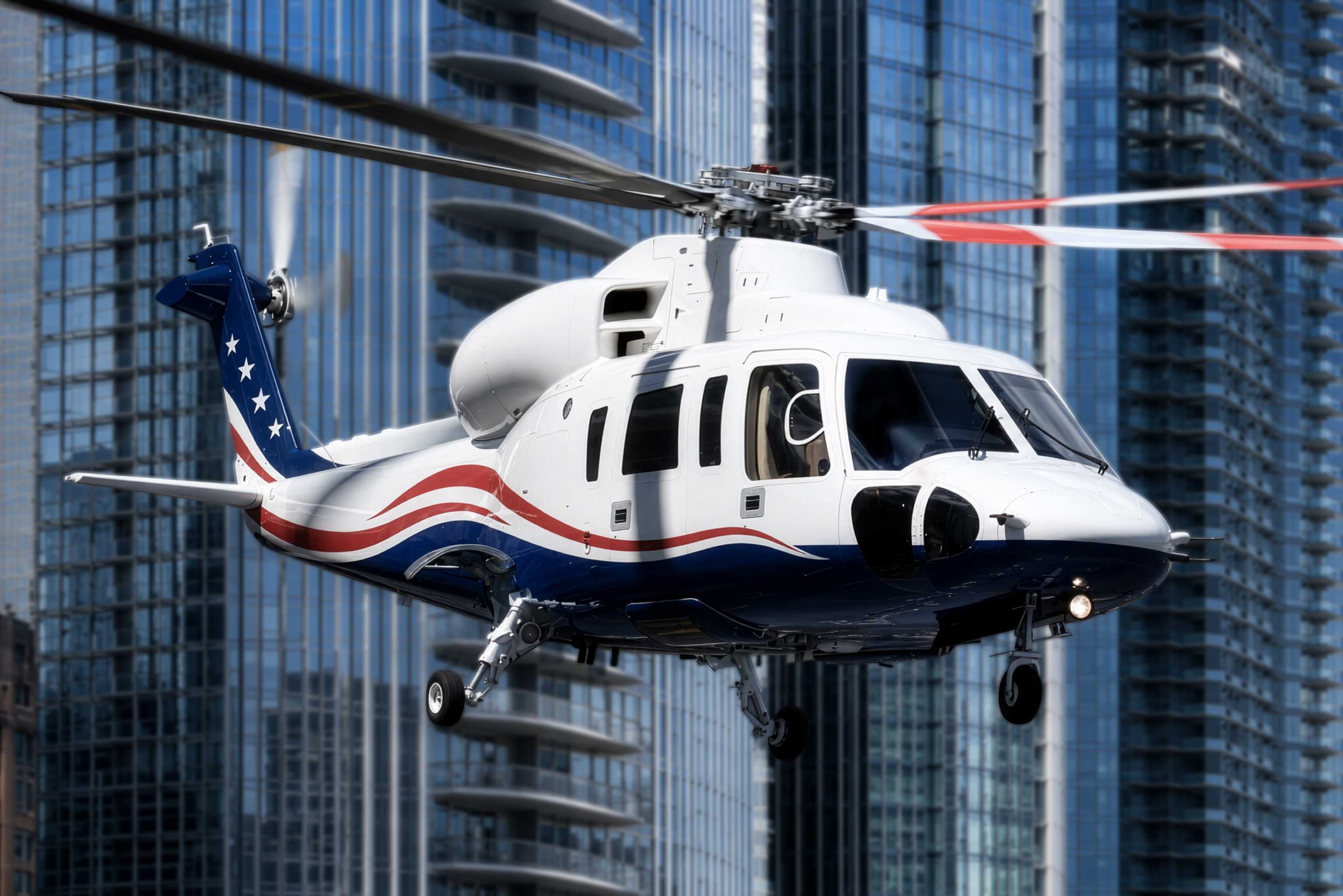
An airport transfer is the shortest charter most operators fly: one leg connecting an airline flight to a city center, a meeting site, or wherever the day actually begins. The helicopter lifts over the congestion the taxi line and the highway would put you in and sets down minutes from the destination. The purchase is precise: it removes the least predictable segment of the trip, the ground leg between the airport and the city, and replaces it with a flight time you can plan a meeting around.
The booking covers the whole aircraft and a professional crew, operating under FAR Part 135, the federal framework for on-demand air carriers. What that framework means for the customer is in FAR Part 135 for Charter Customers in Plain-English.
Who Uses It and Why
The typical booking comes from an executive assistant or corporate travel planner working backward from a meeting that cannot start late. The traveler is usually a senior executive, a deal team, or a visitor whose host wants the day to run on rails. Private travelers book the same leg when a connection is tight or when the airport sits far from where they are staying.
The shared problem is variance, not distance. A drive that takes forty minutes on a good day takes two hours on a bad one, and bad days cluster around peak arrival banks. The helicopter removes the variance: a short urban hop flies in roughly the same minutes on a bad day as on a good one.
How a Typical Transfer Works
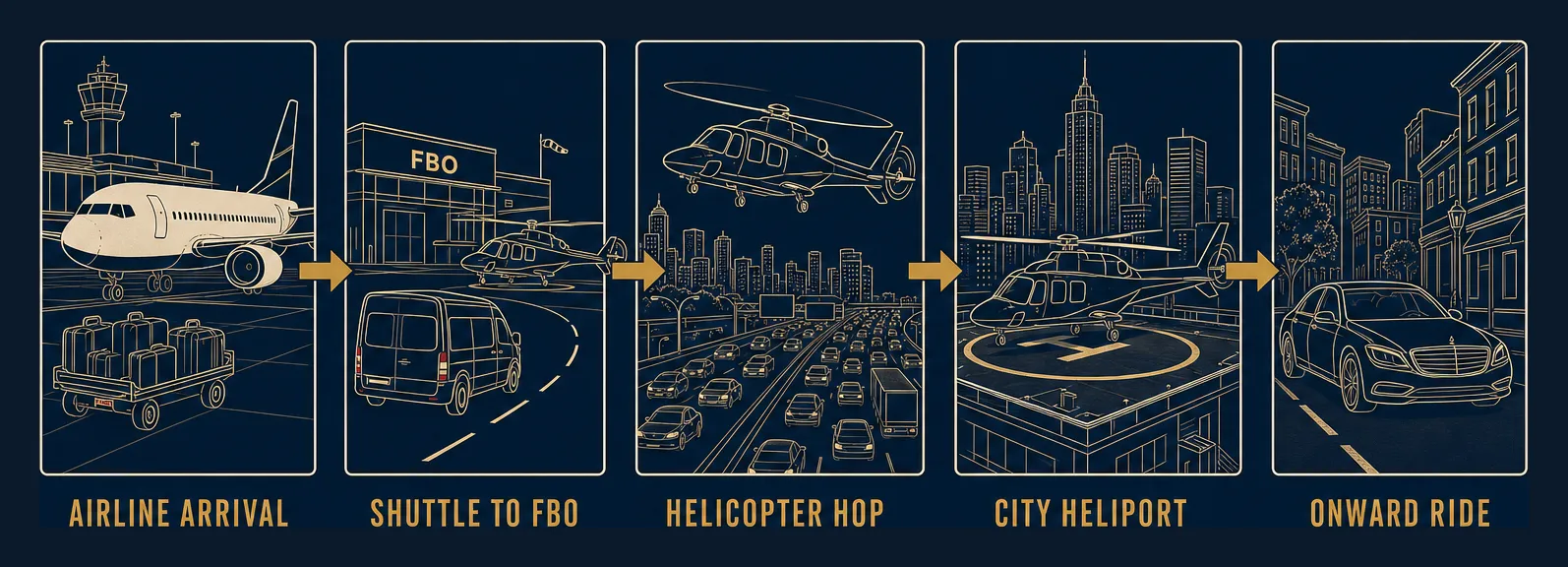
The choreography matters more than the flying, and most of it happens before your airline flight touches down.
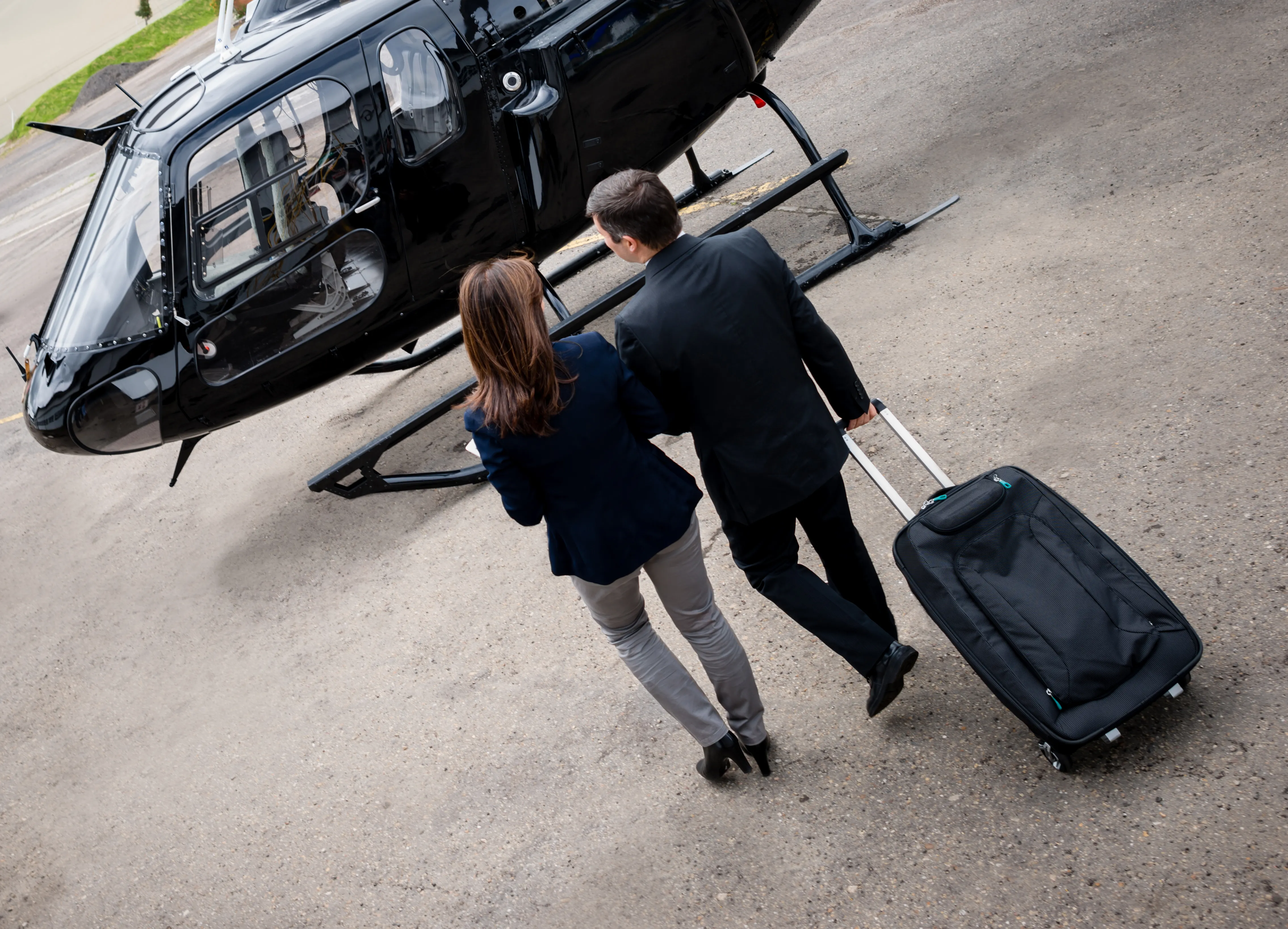
Meeting the aircraft. At most US airports, general aviation operates out of an FBO, a fixed-base operator that serves as the private aviation terminal. After you collect your bags, an FBO shuttle or a short walk brings you from the airline terminal to the FBO, where the helicopter waits on the ramp. A few airports have a helipad closer to the terminals than the FBO ramp, but that is the exception, and it is worth confirming when you book rather than assuming.
Luggage. Your bags travel with you from baggage claim to the FBO, and the crew loads them into the helicopter’s baggage compartment. There is no separate checked-luggage system, one reason transfers run fast. The constraint is volume and weight, covered below.
Timing and delays. When you book, you provide the inbound airline flight number. The operator tracks the flight and positions the helicopter to be ready when you clear the terminal, not at a fixed clock time. If the airline leg runs late, the helicopter waits. This is routine, but it depends on the flight number being accurate and on you telling the operator if you change flights.
Aircraft Typically Used
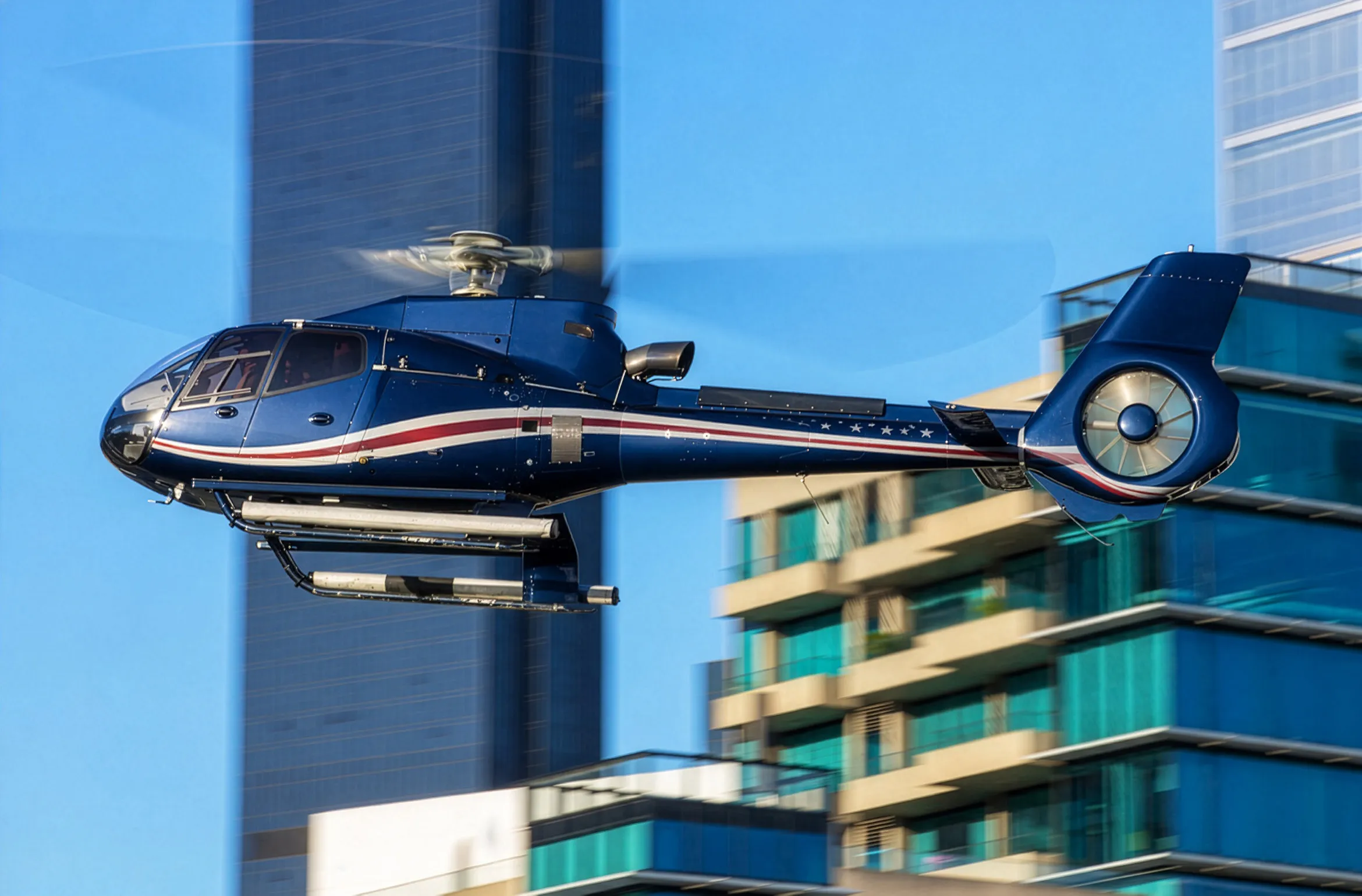
Two classes dominate transfer work, and the choice is a straight trade of cost against capacity and policy. The light single-engine helicopter is the economical option: two to four passengers with modest luggage, right-sized for a solo traveler or a pair. The twin-engine executive helicopter buys more with the higher hourly rate: four to eight passengers, a quieter and roomier cabin, more baggage capacity, and the engine redundancy many corporate travel policies require over built-up areas. If a travel policy governs the trip, it often makes the decision before economics do. Larger parties split across two aircraft or move up a class. The full comparison is in the Helicopter Class Comparison Guide.
Planning Considerations
Weather
A transfer is short, but it is still a flight, and the weather that delays airlines can ground helicopters: low ceilings, poor visibility, thunderstorms, and icing. Reputable operators will not fly below their weather minimums; the practical question is what the backup plan is. For most transfers the answer is simple: the ground option is still there. Build the car-service fallback into the plan for any meeting that truly cannot slip. Seasonal and day-of patterns are covered in Weather, Delays & Scheduling FAQ.
Landing Sites
The airport end is almost always straightforward: an FBO ramp or an airfield helipad. The city end is the variable. Downtown heliports exist in many US cities but not all, operating hours and reservation requirements differ, and some destinations have no useful public landing site. Where a helicopter can and cannot legally set down is its own subject; see Heliports & Landing Zones. The Heliport Atlas maps every operational pad in the country, so you can see for yourself what the city end offers. Confirm both ends of the leg before assuming the transfer exists.
Luggage and Passengers
Helicopters on short transfer legs carry less luggage than the airline flight you just left. Light helicopters in particular limit both total baggage weight and bag size, the exact figures depend on the aircraft and how many people are aboard, and soft-sided bags load far better than hard cases. If your party travels with trade-show cases, golf clubs, or a week of checked bags each, tell the operator at booking. The fix may be a larger aircraft, a second aircraft, or sending the bulk luggage by road while passengers fly.
Lead Time
Transfers are among the easiest charters to arrange, and regular operators can often confirm on short notice. Still, city-end heliport reservations, crew duty limits, and aircraft positioning take time, and holidays and major events tighten availability. A few days ahead is comfortable; same-day requests are often workable but leave less room to solve luggage or landing-site surprises.
When a Helicopter Is the Wrong Answer
Candor matters: transfers are the charter most often booked when a car would do. If the airport sits close to your destination and traffic is predictable, ground transport wins on cost and simplicity. If your party or luggage exceeds what one helicopter can lift, a pair of cars is cheaper and easier than a pair of aircraft. If the weather forecast is genuinely bad, the helicopter does not make the trip more reliable; it makes it more cancelable, and a meeting that cannot move deserves a plan that cannot be grounded. And if the real problem is a tight same-day airline connection, no helicopter fixes the airline’s schedule. Book the transfer when the ground leg is the risk. Skip it when it is not.
Cost Factors
Charter quotes are built from a handful of variables, laid out in What a Charter Costs: Framework, Not Quotes. What drives a transfer’s cost specifically: aircraft class, since a twin costs more per hour than a light single; flight time and any repositioning leg; landing and facility fees at the city heliport; waiting time if the crew holds for a delayed inbound flight; and party size: an extra passenger is nearly free on an aircraft already chartered, while an extra aircraft roughly doubles the bill. Transfers are short flights, so the fixed costs of having aircraft and crew ready dominate over minutes in the air.
Frequently Asked Questions
How early does the helicopter arrive relative to my airline flight?
The operator tracks your inbound flight and positions the helicopter to be ready when you clear the terminal. The one input that matters is the correct flight number.
What happens if my airline flight is delayed?
The helicopter waits, within crew duty limits. On a long delay the operator will tell you how late they can hold and what the fallback is.
Can the helicopter pick me up at the airline terminal?
Almost never. Pickups happen at the airport’s FBO or an airfield helipad, reached by shuttle or a short walk from baggage claim; plan on a few minutes of ground movement.
How much luggage can I bring?
Less than the airline allowed. Light helicopters have firm weight and size limits that vary by aircraft, and soft-sided bags are strongly preferred. Give the operator an honest bag count at booking and let them size the aircraft to it.
Is a transfer worth it for a short airport-to-city distance?
Often not. It earns its cost when the ground leg is long, unreliable, or both, and loses to a car service when the drive is short and predictable.
Related Charters
- Hotel Transfers: pickup or drop-off at a hotel, resort, or event property.
- Corporate & Executive Travel: recurring point-to-point business flying beyond a single transfer leg.
- Multi-City Roadshows: several stops in one day with the aircraft staying with the party.
- Site Visits & Facility Tours: the destination is a plant, project, or remote facility.
- VIP & Discreet Travel: privacy and low-profile handling drive the booking.
- Executive & Business Charters: how the executive charters differ and which one fits your trip.