
Charter market
TheHamptons&LongIsland
About This Market
The Hamptons are a chain of villages, hamlets, beaches, and estates at the far eastern end of Long Island, functioning as New York City’s summer backyard. For helicopter charter this is one of the most concentrated leisure markets in the country, and it is strongly seasonal: demand originates almost entirely in Manhattan and the surrounding metro area, and it flows in one direction at a time. Out on Friday, back on Sunday.
The people flying are weekend travelers avoiding the drive, second-home owners commuting to their own houses, and event and wedding parties moving guests between venues scattered across the East End. The core value of the charter is simple. The road trip from Manhattan to the East End is long and famously congested in summer, and the helicopter replaces it with a short flight along the island or over the water. Everything else about this market, its facilities, its noise rules, and its rhythms, follows from that single exchange.
Heliports and FBOs
The East End’s landing landscape is thinner than its demand; three clusters matter:
- East Hampton. The town airport sits close to the villages at the heart of the market and handles both fixed-wing traffic and helicopters. Its public-versus-private status has been contested for years, and the litigation around it has repeatedly changed what charter helicopters may do there. Confirm access with your operator at booking time rather than trusting an older article, because this is the single detail in this market most likely to have moved since it was written.
- Southampton area. Landing options exist on the Southampton side of the South Fork, including helipad facilities serving the western Hamptons, though the list of what is open to charter traffic is shorter than the list of what exists. These suit travelers bound for Southampton, Water Mill, or Bridgehampton who want to avoid backtracking east and back.
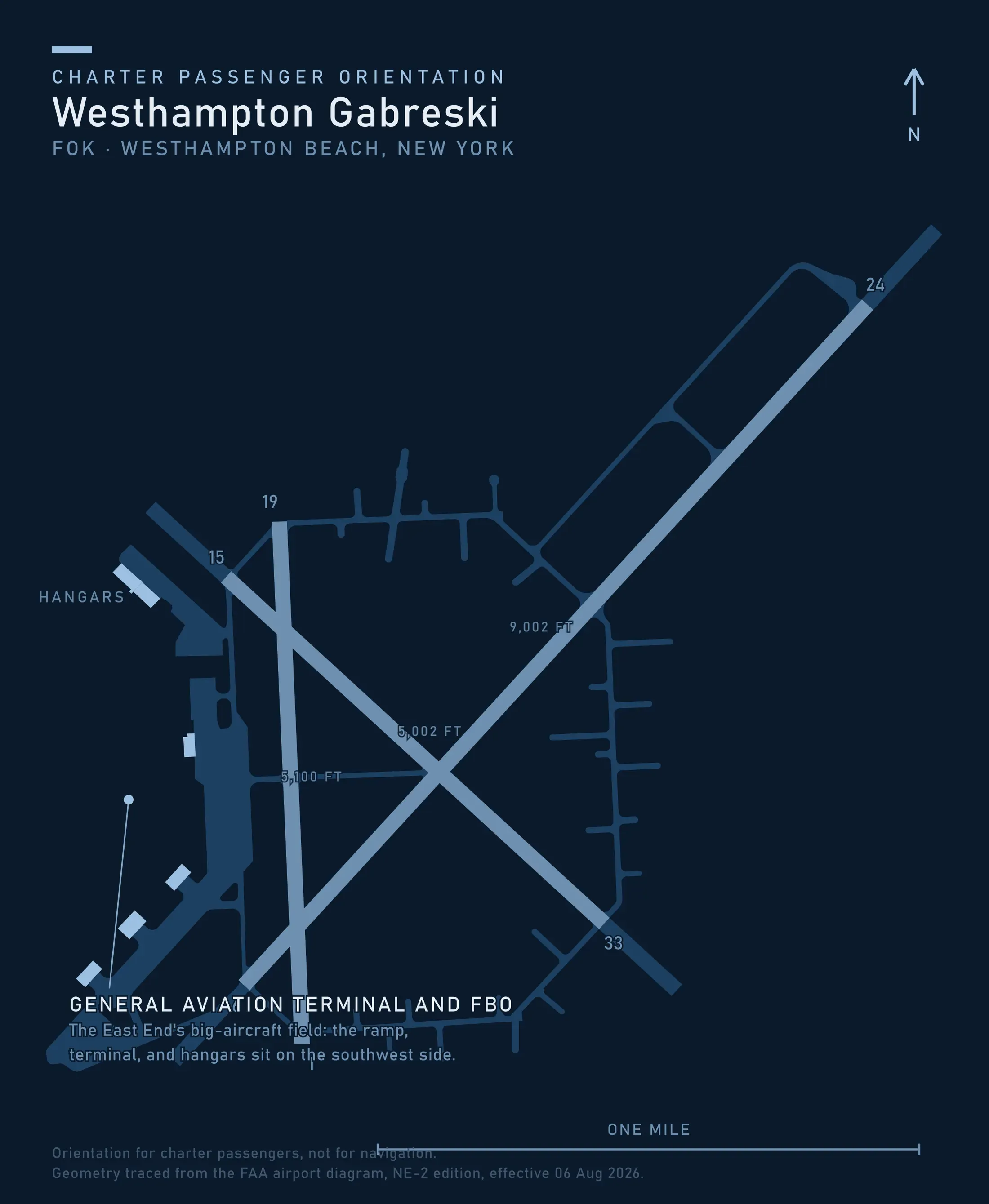
- Westhampton area. Farther west, the Westhampton area offers airport-based alternatives with more conventional fixed-base services and fewer access questions. The trade-off is a longer ground leg to the eastern villages, which can still beat peak summer traffic.
No facility operator is named here because arrangements change; operators who fly this corridor weekly know which pads are currently usable and which require advance permission.
Noise Sensitivity Shapes Operations
The East End is one of the most noise-sensitive helicopter environments in the United States. Communities here have pushed back on helicopter traffic for years, and the result is an operating environment shaped by curfews and voluntary noise-abatement practices whose specifics differ by facility and change from season to season. In practical terms this affects when flights can arrive and depart, which routes pilots prefer over the water and at what altitudes, and how much schedule flexibility actually exists on a Friday evening.
Two takeaways for a customer. First, fly with an operator that already works this corridor; local knowledge of abatement expectations is part of what the charter buys. Second, expect less late-evening flexibility than an unconstrained market would offer. The general mechanics of where a helicopter can legally land are covered in Heliports & Landing Zones; the East End specifics above are the layer this market adds on top.
Typical Routes and Flight Times
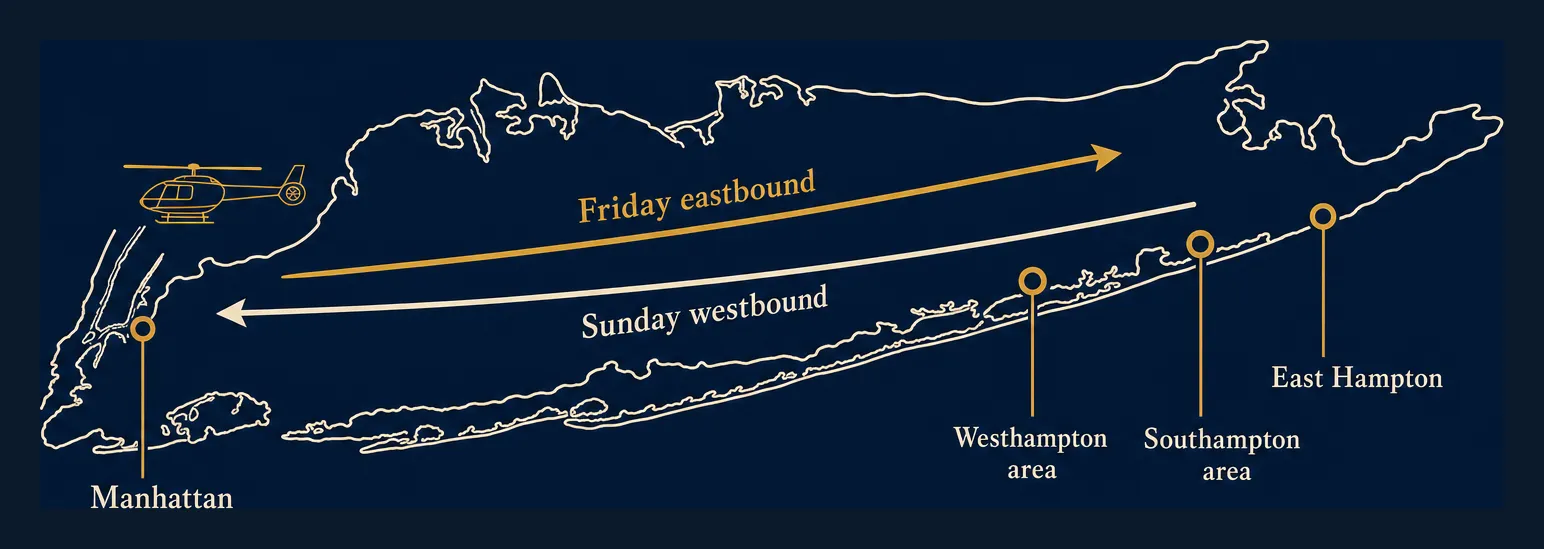
The defining route is the corridor from the Manhattan heliports east to the Hamptons landing points; the Manhattan end of that corridor belongs to the New York City market page. Most flights run the length of Long Island, either along the island itself or over Long Island Sound and the Atlantic, with weather, traffic, and noise-abatement preferences deciding which on the day.
The flight time is the market’s whole argument. The air leg runs well under an hour against a summer drive measured in hours, and on the worst Fridays the gap is wider still. Westhampton-area landings shorten the air leg further, at the cost of a longer car leg at the far end.
The rhythm is famous. Friday afternoon and early evening run eastbound as Manhattan empties toward the beaches. Sunday afternoon and evening run westbound as the weekend reverses. Holiday weekends stretch both windows. If your schedule can flex even a few hours off the peak of the peak, availability usually improves with it.
Seasonal Patterns
This market has a hard on-switch and a hard off-switch. The season runs roughly from Memorial Day to Labor Day, with the strongest demand on summer Friday and Sunday afternoons and on holiday weekends. Within that window, demand compresses into narrow bands: a landing facility and an aircraft can be fully committed for a few hours a week and nearly idle the rest of the time. That compression is why prime summer weekend slots book out early, and why lead time matters more in this market.
Outside the season the East End quiets down quickly. Charters still run for second-home owners, events, and off-season weekends, but schedule pressure eases and operators become more flexible. Shoulder-season weekends in late spring and early fall sit between the two states and are often the easiest way to try this market.
Weather is the standing caveat in every season. Coastal fog, summer thunderstorms, and strong winds all delay or cancel flights here, and fog on the East End can sit long after the city end is clear. A backup ground plan is not pessimism in this market; it is standard practice.
Which Charter Types Dominate Here
Weekend getaways. The defining use of this market: hiring the whole aircraft to move a household or a group between the city and the East End for a weekend, luggage included. It is the Weekend Getaways charter in its purest habitat.
Leisure flying. Celebrations, North Fork winery visits, and event weekends generate point-to-point leisure charters throughout the season, often combined with the getaway trip that brought the party east.
Transfers from New York City. For travelers arriving by airline who want to reach the East End without the drive, the airport-connection charter described in Airport Transfers extends naturally into a longer transfer leg out to the Hamptons.
Related Pages
- Destinations overview: all charter markets.
- New York City: the western end of this corridor.
- Martha’s Vineyard & Nantucket: the next summer market east, out past the end of the Sound.
- Newport & Narragansett Bay: the summer market at the other end of the same over-water run.
- Weekend Getaways: the charter type this market is built around.
- Airport Transfers: connecting an airline arrival to the East End.
- Heliports & Landing Zones: where helicopters can actually land.
Heliports near the Hamptons & Long Island
The FAA records 31 heliports within 50 miles of the Hamptons & Long Island in the current cycle. One is public use; the rest start with the owner’s permission. Your operator makes that arrangement before the flight is confirmed.
Heliports only. Airports are a separate class of facility and are not counted here, and in many markets the charter itself works from one.