
Reference
Weather,Delays&SchedulingFAQ
Overview
Weather is the single largest source of uncertainty in any helicopter charter, and it works differently than most travelers expect. Some days that ground airliners are perfectly flyable for a helicopter. Other days that look calm and sunny from the ground are not flyable at all. The two things worth understanding before you book are how the go/no-go decision actually gets made, and what typically happens to your booking when the answer is no.
Weather is the single most common reason a charter moves or does not happen, and it is the part of the process customers understand least. For the questions to ask an operator before booking, see the Charter Planning Checklist. For the rules the operator is working inside, see FAR Part 135 for Charter Customers in Plain-English.
How the Weather Call Gets Made
Key terms in plain language
- VFR (visual flight rules). Flying by looking outside: the pilot navigates and stays clear of clouds and terrain by visual reference. Most helicopter charter operations run VFR-only, because many charter helicopters and their operators are not equipped or certified for instrument flight.
- IFR (instrument flight rules). Flying by reference to cockpit instruments, which allows legal flight in cloud and poor visibility. Some twin-engine charter helicopters and operators are IFR-equipped, but they are the minority of the charter fleet.
- Ceiling. The height of the lowest broken or overcast cloud layer. A low ceiling is the most common reason a VFR helicopter cannot go.
- Visibility. How far the pilot can see. Fog, haze, heavy rain, and snow all reduce it.
- Icing. Ice forming on the airframe and rotor blades in visible moisture near freezing temperatures. Most light helicopters carry no de-ice equipment, so forecast icing is usually a hard stop.
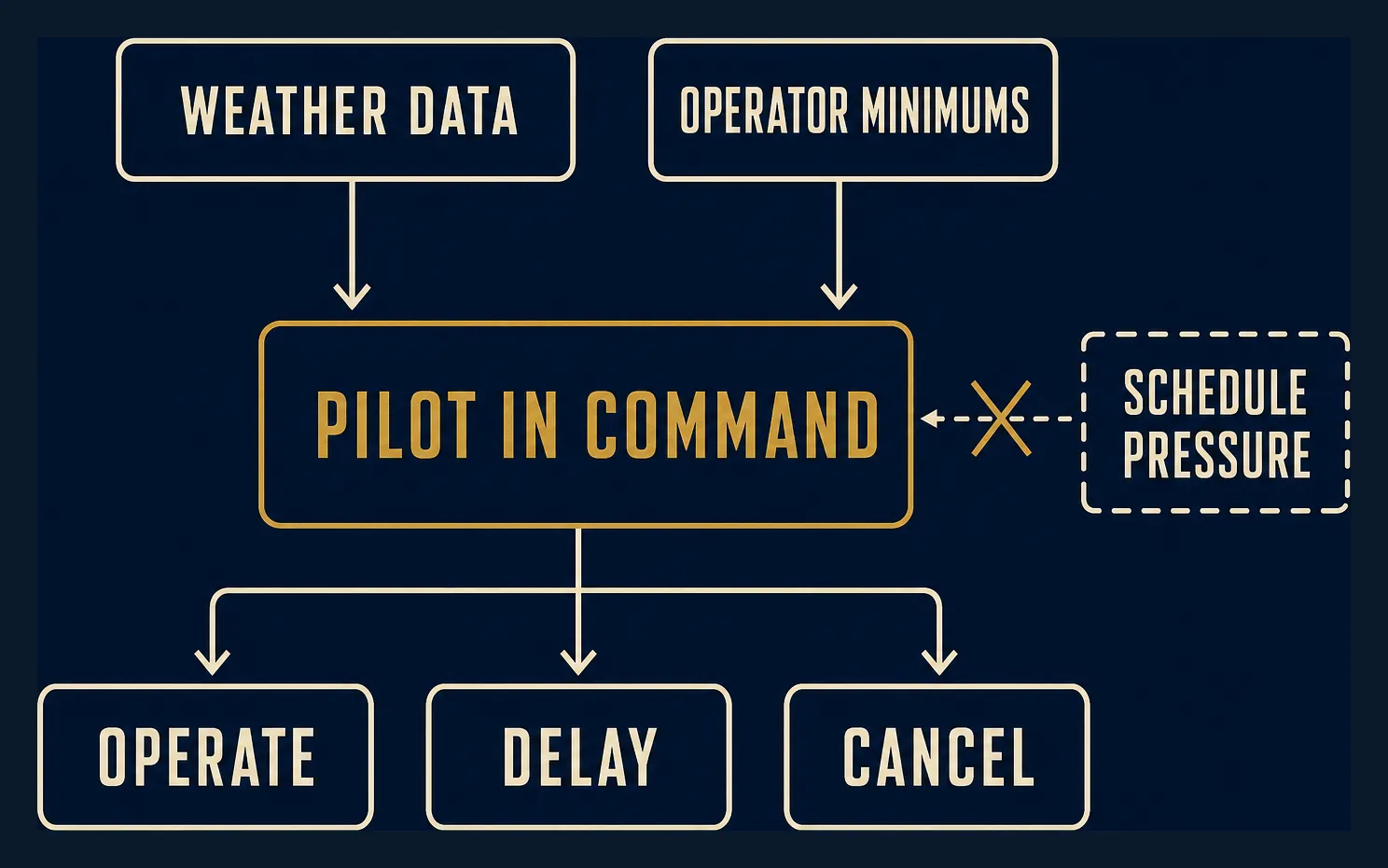
- Go/no-go. The final decision to operate, delay, or cancel a flight. It belongs to the pilot in command, not the customer.
Regulations set exact VFR weather minimums by airspace class and by time of day, and individual operators layer their own, often stricter, limits on top. The numbers differ enough by airspace and aircraft that the useful thing to know is structural: a hard floor exists, it is not negotiable, your pilot applies it on the day, and no amount of booking notice moves it.
How the go/no-go call works
Every charter flight in the United States operates under FAR Part 135, and under those rules the pilot in command has final authority over whether a flight operates. The decision combines weather forecasts, real-time observations, the operator’s own minimums, and the pilot’s judgment of the specific route and day. One input is notably absent from that list: how badly you need to be somewhere.
More sensitive in some ways, less in others
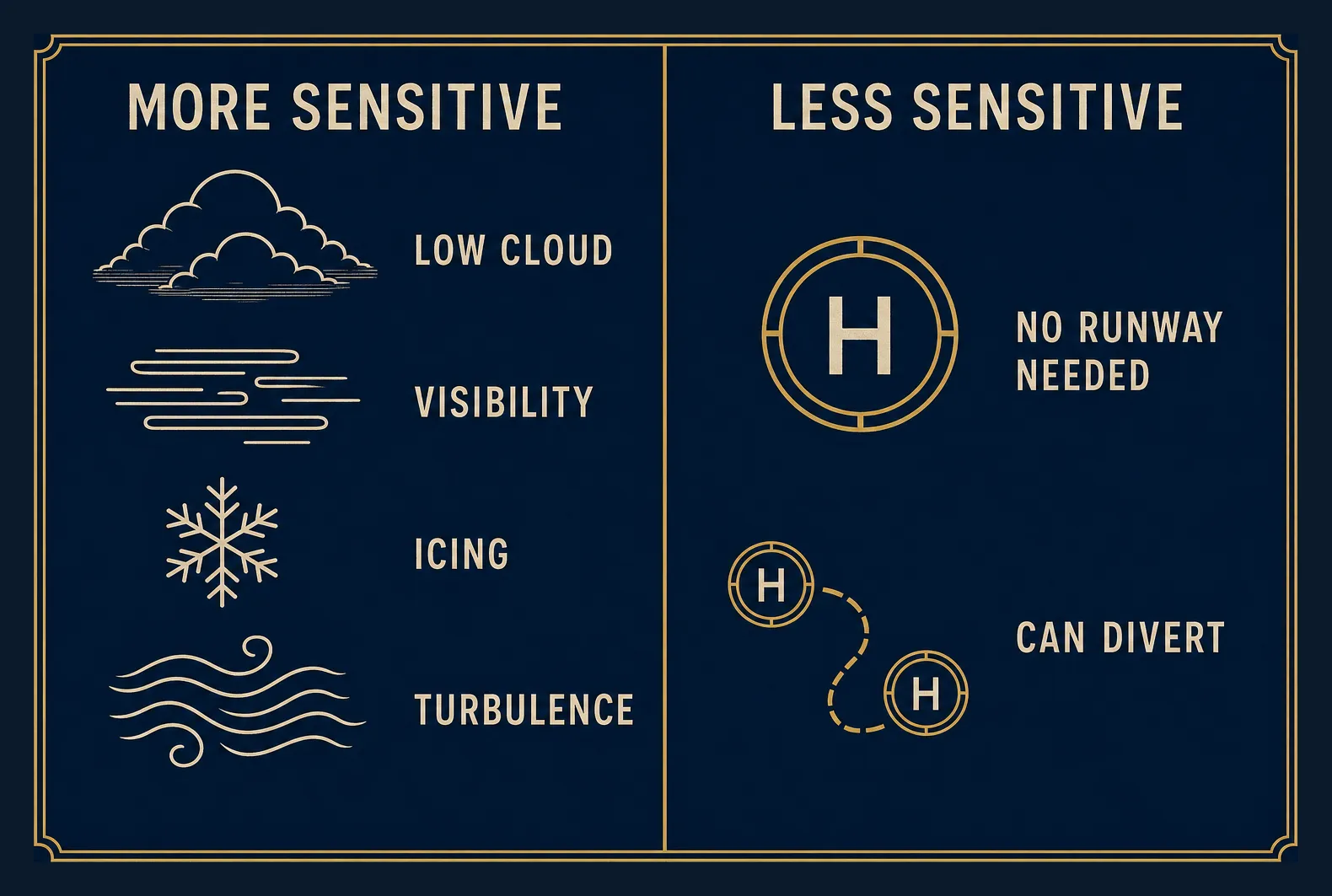
Compared with an airline flight, a helicopter charter is exposed to weather in both directions. It is more vulnerable to low cloud, poor visibility, icing, and bumpy air at low altitude, the regime helicopters fly in. It is far less dependent on infrastructure at the destination: no runway is required, and if one landing site is unusable the pilot can often divert to another nearby.
Common Questions
Will my charter fly in rain?
Usually, yes. Rain by itself rarely cancels a helicopter flight. What cancels flights is what often comes with rain: low cloud, poor visibility, embedded thunderstorms, or icing conditions. A showery day with a high ceiling and good visibility is commonly flyable. A dry day under a low overcast may not be.
What is the difference between VFR and IFR, and why should I care?
A VFR flight stays legal by keeping the pilot’s required distance from clouds and maintaining required visibility. An IFR flight can proceed through cloud and low visibility on instruments. Most helicopter charters are VFR-only, so cloud and visibility set the practical limits of your flight even when the aircraft itself is perfectly capable. If your trip has a hard deadline in a season known for low ceilings or fog, it is worth asking the operator whether they run IFR-equipped aircraft before you count on the flight.
Is a helicopter more weather-limited than an airline?
Both, depending on the weather. Airlines fly above most weather and dispatch with de-ice equipment, radar, and instrument approaches, so they tolerate low ceilings, icing, and poor visibility far better than a VFR helicopter. But airliners need runways, and when the runway or its approaches are the problem, everything stops. A helicopter can wait for a short gap in the weather, use a different landing site, or land closer to where you actually need to be. It trades tolerance for flexibility.
Who decides whether we fly, and can I ask them to push it?
The pilot in command decides, supported by the operator’s forecasts, observations, and company minimums. You can and should share how important the trip is, because it helps the operator plan alternatives: earlier departure, a different route, a backup day. What schedule pressure cannot do is change the answer. A professional operator will not be offended by the question, but the answer will still be driven by the weather and the minimums, not the meeting.
What kinds of weather actually cancel a helicopter charter?
The recurring culprits are low ceilings, poor visibility from fog or precipitation, forecast icing in cloud or precipitation, thunderstorms along the route, and strong or gusty winds, particularly for landings at confined or elevated sites. Turbulence at low altitude matters more to a helicopter than to an airliner at cruise, and it can make a flight legally possible but practically miserable. High or gusty winds also affect some landing sites more than the flight itself.
What happens to my booking if weather cancels the flight?
Policies vary by operator, so treat this as the common pattern, not a guarantee. When the operator cancels for weather, the flight is typically rescheduled at no penalty or refunded if rescheduling does not work, because the cancellation was not the customer’s choice. Weather is generally treated differently from mechanical cancellations and very differently from cancellations the customer initiates, which usually fall under the operator’s standard cancellation terms. The place to confirm the actual policy is the charter agreement before you sign it, and the Charter Planning Checklist includes it in the questions to ask.
Is a mechanical cancellation treated the same as weather?
Commonly, no. A weather cancellation is the aircraft staying on the ground because conditions are outside minimums; the industry pattern is reschedule or refund. A mechanical cancellation is the operator’s side of the bargain, and operators typically work harder to recover it: substituting another aircraft, repositioning a replacement, or refunding when recovery is impossible. Neither pattern is universal, and the contract language controls.
How much warning will I get?
Less than you would like, by nature of the problem. Operators watch forecasts for days and will often flag a marginal day 24 to 48 hours out, but the final call frequently waits for current observations, sometimes the morning of the flight. Build your plans around that reality rather than expecting certainty the evening before.
Building Buffer Into Important Trips
If the trip genuinely matters, plan as if the weather answer could be no:
- Fly the day before. For fixed-date events, arriving the prior day converts a weather cancellation from a disaster into an inconvenience.
- Keep a ground fallback. Know the drive time and have a car service option identified. A helicopter that cannot fly still leaves you the road.
- Prefer morning departures. In many regions, fog and low ceilings burn off as the day warms, but afternoon thunderstorm risk grows, especially in summer. Ask the operator which pattern applies to your route and season.
- Tell the operator what is immovable. Operators can often suggest a backup landing site, an earlier slot, or a weather-check call time if they know which part of the itinerary cannot slip.
Some occasions need more than a general weather plan. For proposals and celebrations, where the date itself carries the value, see Special Occasions & Proposals. For games and concerts, where event timing and temporary flight restrictions pile on their own constraints, see Sporting Events & Concerts.
Related Pages
- Charter Planning Checklist: the questions to ask an operator before booking, including cancellation terms.
- What a Charter Costs: Framework, Not Quotes: how charter pricing works, without numbers.
- FAR Part 135 for Charter Customers in Plain-English: the regulatory frame behind the go/no-go call.
- Heliports & Landing Zones: Where Helicopters Can Actually Go: the diversion and alternate-site options behind weather flexibility.