
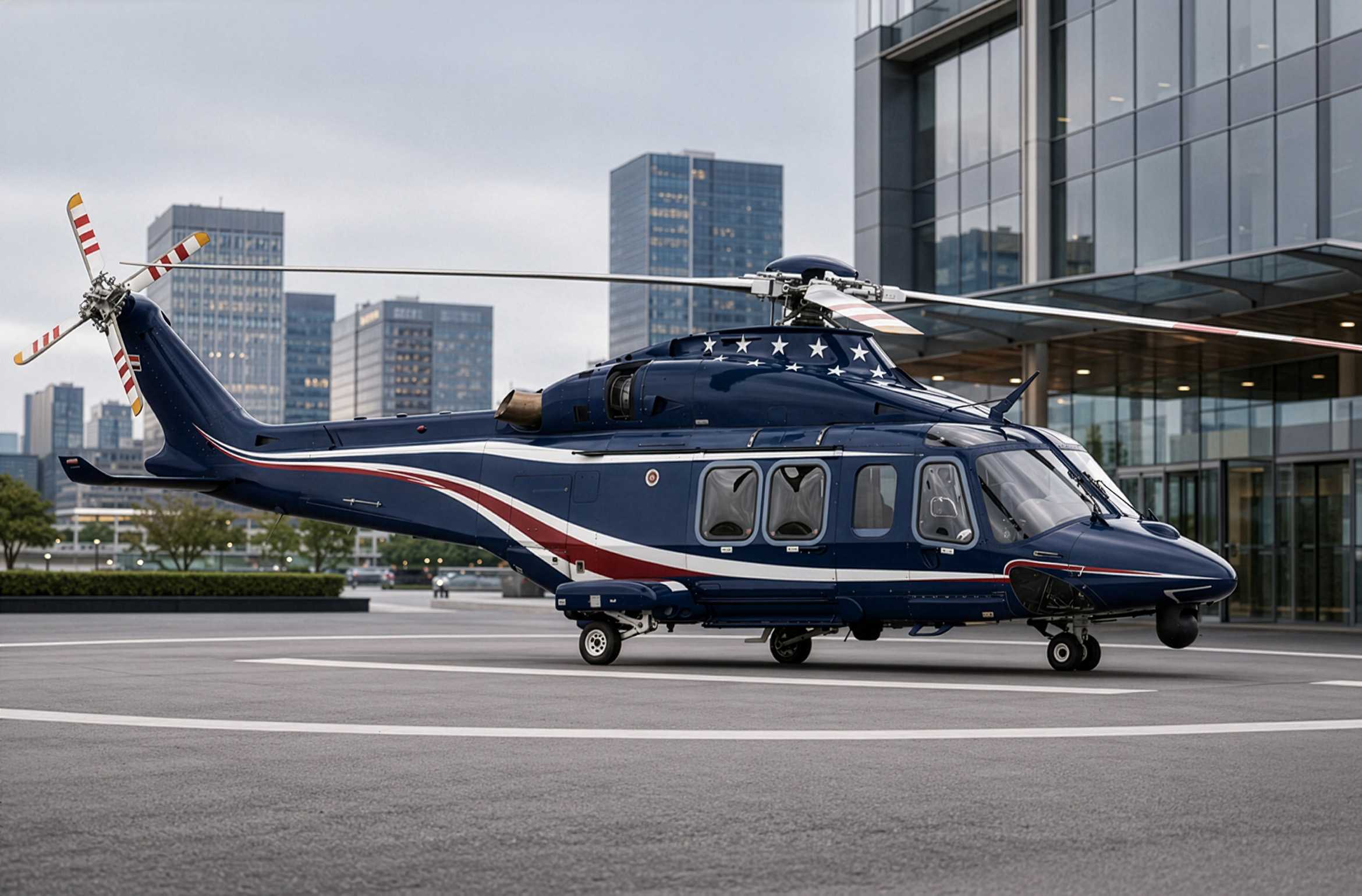
Charter market
SouthernCalifornia
About This Market
Southern California is the sprawl market of American helicopter charter. The Los Angeles basin alone spreads across a metro area so large that two points inside it can be a genuine journey apart, and the region’s chronic freeway congestion makes ground travel times long and, worse, unpredictable. That combination is the core charter argument here: a helicopter converts a cross-basin drive that might take anywhere from under an hour to most of an afternoon into a short, consistent flight. Nowhere in the country is the time-savings case for a helicopter charter more straightforward, and nowhere is it more tied to beating traffic rather than covering distance for its own sake.
The customer mix reflects the region’s economy. Corporate travel planners and executive assistants book cross-town and airport-connection legs for executives whose days cannot absorb freeway variance. The entertainment industry is a structural presence: production coordinators, studio executives, and talent move between lots, offices, airports, and locations on tight schedules. VIPs and public figures use helicopters for the privacy of avoiding ground exposure as much as for speed. And leisure flyers charter for coastal transfers and for mountain and desert getaways that sit hours away by road. The result is one of the deepest charter markets in the United States.
Heliports and FBOs
The market is a network of nodes rather than a single hub, and knowing the nodes is most of knowing the market.
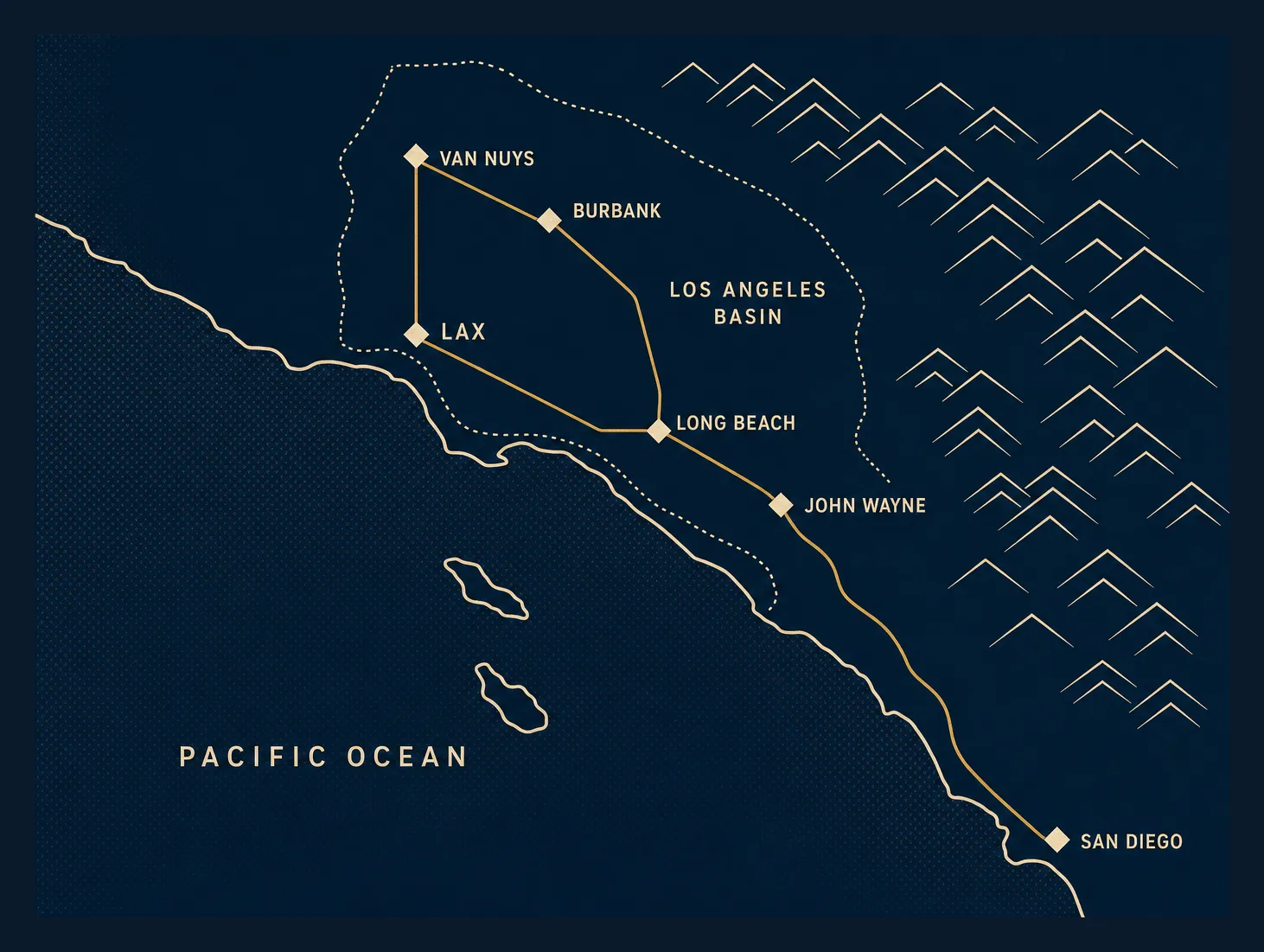
Los Angeles International (LAX) is the region’s primary airline gateway and the anchor for airport-connection charters. Helicopter operations work through the airport’s general aviation facilities, and the handoff from an airline arrival to a helicopter is routine there.
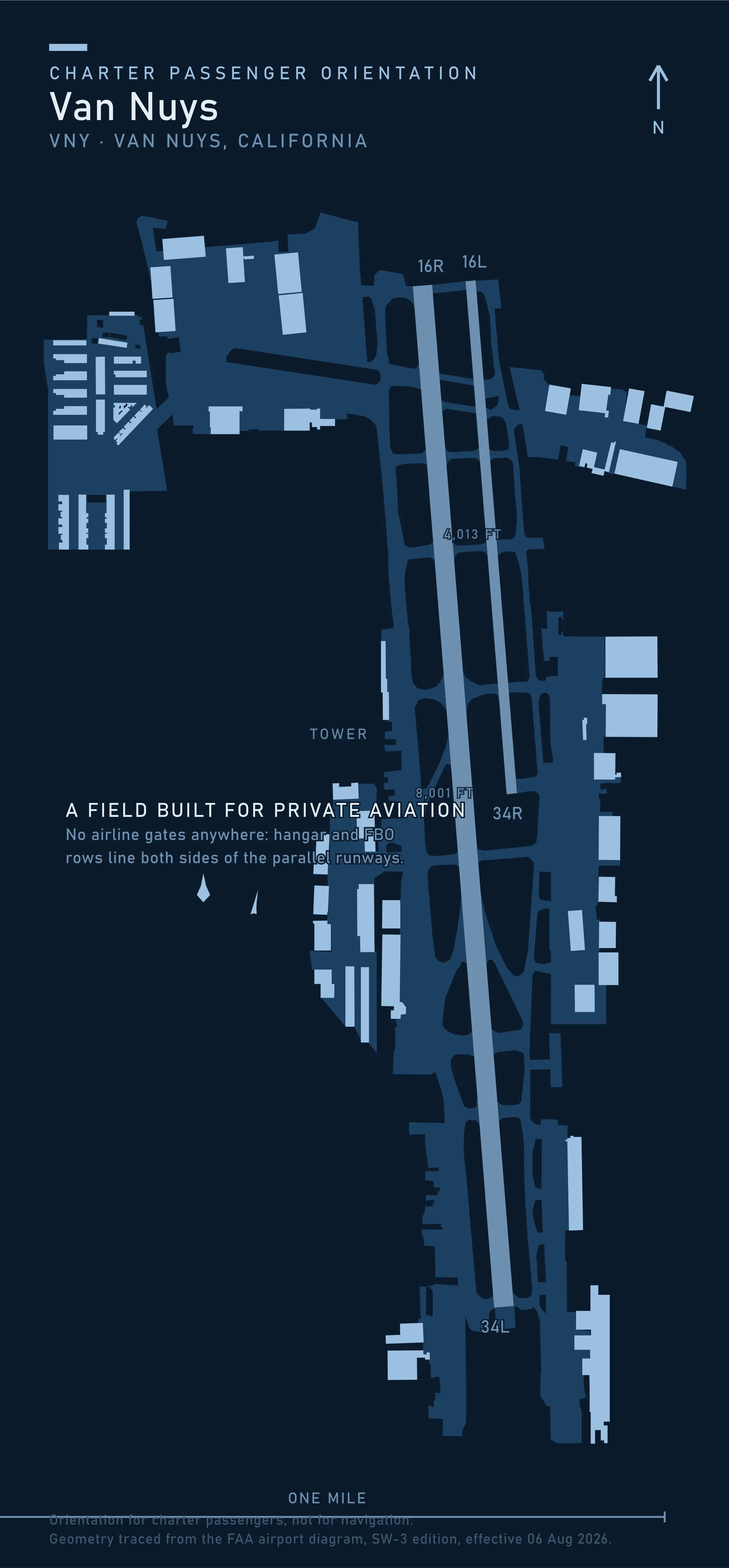
Van Nuys is the LA basin’s business-aviation center of gravity and one of the busiest general aviation airports in the country. Most corporate and VIP charter activity in the basin flows through its FBOs, and for many business trips it functions as the de facto front door to Los Angeles.
Burbank serves the San Fernando Valley, the studios, and the northern basin, and is a common alternative to LAX for both airline connections and charter departures. Long Beach covers the southern basin and the ports corridor. John Wayne in Orange County is the primary business-aviation field for the county’s corporate centers and coastal communities, and it operates under some of the strictest noise and curfew rules of any airport in the country, which shapes when a charter can arrive or leave. Farther south, the San Diego area has its own network of airports and FBOs serving that metro’s charter demand.
Beyond the airports, the region has a layer of rooftop and private heliports, particularly in downtown Los Angeles and at corporate and studio properties. Access is typically by prior arrangement, and hours, weight limits, and permissions vary site by site. The general rules about where helicopters can legally land are covered in Heliports & Landing Zones; the market-level point is that a useful charter itinerary here almost always starts and ends at one of the airports above, with private sites as the exception.
Typical Routes and Flight Times
Routes in this market fall into a few qualitative corridors.
Basin cross-town moves. The signature Southern California charter: Van Nuys or Burbank to downtown, the Westside, or Long Beach, replacing freeway legs whose ground times are notoriously long and unpredictable. These are short hops, and their value is the consistency of flight time against the variance of the drive.
LAX connections. Transfers between LAX and the basin’s business districts, heliports, or other airports, timed against an airline arrival. The helicopter removes the most unreliable segment of the trip.
LA to coastal resorts and San Diego. Longer legs down the coastal corridor to Orange County beaches, resort communities, and the San Diego area. The helicopter flies the coast in a fraction of the time a drive takes, and that drive routinely stretches well beyond two hours in traffic.
Mountain and desert getaways. Legs from the basin to mountain resorts and desert destinations, where the helicopter turns a half-day drive into a short scenic transfer.
Airspace over the basin is among the most complex in the country, but for the customer that complexity sits with the operator and the flight crew; experienced local operators route through it as a matter of daily practice.
Seasonal Patterns
Southern California offers one of the mildest year-round flying climates in the country, and the charter market runs in every season. The weather pattern visitors actually encounter is the marine layer: low clouds and fog that form along the coast overnight and into the morning, often clearing by midday. When it peaks in late spring, locals call it June gloom. The practical effect is that morning coastal departures sometimes wait for the burn-off, while midday and afternoon slots tend to be more dependable through the late spring and early summer months when the layer is thickest.
Fall brings the region’s two real flying considerations. Santa Ana wind events push strong, dry, gusty winds from inland toward the coast, and operators factor them into go/no-go decisions while they last. The same dry conditions define wildfire season, which can affect flying through smoke, reduced visibility, and airspace restrictions around fire areas. Both are episodic rather than constant, and a straight-talking operator will raise them before you do.
Which Charter Types Dominate Here
Corporate and executive travel is the market’s backbone. Cross-basin point-to-point legs, airport connections, and multi-stop days all serve the same purpose: keeping an executive’s schedule intact against freeway variance. The charter type itself is covered in Corporate & Executive Travel.
VIP and discreet travel thrives here because of who lives and works in the region. Entertainment-industry figures, athletes, and public individuals charter to move without ground exposure, and the basin’s FBOs and private heliports support low-profile handling. See VIP & Discreet Travel.
Leisure flying rounds out the market: coastal transfers, flights to mountain and desert getaways, and chartered sightseeing over the coastline and the city. All of it is whole-aircraft charter; what defines a scenic charter as a type lives in Scenic & Sightseeing Charters.
Related Pages
- Destinations: the other US charter markets and what defines each one.
- San Diego & Coronado: the market at the south end of this coast, where geography rather than traffic makes the case.
- Big Sur Coastline: the same coastline four hundred miles north, where a sanctuary floor sets the altitude.
- Lake Tahoe: the state’s other market, where terrain and a lake with no crossing set the pattern instead.
- Corporate & Executive Travel: the charter type that anchors this market.
- VIP & Discreet Travel: privacy-driven charter work, a Southern California specialty.
- Scenic & Sightseeing Charters: the charter type behind the region’s leisure flying.
Heliports near Southern California
The FAA records 173 heliports within 50 miles of Southern California in the current cycle. Not one is public use, so every landing here starts with the owner’s permission. Your operator makes that arrangement before the flight is confirmed.
Heliports only. Airports are a separate class of facility and are not counted here, and in many markets the charter itself works from one.