
Payload · September 30, 2026 · 16 minute read
Helicoptercharterluggagelimits:weight,volumeandbalance
A helicopter charter has no fixed luggage allowance. People, fuel and bags share one weight limit, the hold has its own volume and its own placarded maximum, and heavy items have to sit where the aircraft stays in balance. Whichever of the three runs out first sets your allowance for that flight. Send every passenger’s weight and every bag’s size and weight, and the operator can give you the real number.
Why a per-passenger bag allowance does not transfer to a helicopter
Airlines quote a bag allowance per passenger because on a large aircraft the bags are a small share of the total load, so a fixed figure per person leaves plenty of margin.
On a light helicopter the margins are thin enough that luggage becomes arithmetic. The aircraft’s maximum takeoff weight is fixed. Subtract what the helicopter itself weighs, equipped and ready, and what remains is the useful load: pilot, fuel, passengers and bags all come out of that one figure. A heavy passenger leaves less for bags. A long leg that needs more fuel leaves less for both. A per-person allowance would be wrong in one direction or the other on almost every flight.
That is why a good operator answers “how much luggage can we bring?” with questions of their own: how many people, how much they weigh, where you are going, and what the bags are. Your answers let them run the numbers for the actual aircraft on the actual day.
The three limits that decide your allowance
Three separate limits apply, and any one of them can be the one that stops a bag.
| Limit | What sets it | What it means for you |
|---|---|---|
| Weight | Maximum takeoff weight, minus the aircraft, pilot and fuel | Total pounds of people and bags the flight can carry |
| Volume | The size of the hold and its door | How many bags physically fit, whatever they weigh |
| Balance | The center of gravity range and each compartment’s placarded limit | Where heavy items can ride, and how much each compartment accepts |
On a full light single the weight limit usually binds first. On a light twin with a small party, volume often binds before weight does. On a medium twin with a full cabin on a long leg, weight comes back into play. Balance rarely stops a whole trip, but it decides which bag goes in which compartment and sometimes which seat each passenger takes.
Seats and luggage trade against each other differently in each helicopter class, which is why the class on your quote matters as much as the passenger count.
How the weight budget works
Every helicopter has a certificated maximum takeoff weight, published in its flight manual. Nothing about the flight may take the aircraft above it, and on a hot or high day the pilot may have to plan below it, because the helicopter needs more power to hover in thin air.
From that ceiling the operator subtracts, in order:
- The aircraft. Its empty weight as equipped, including fixed items such as seats, interior fittings and required equipment.
- The pilot. Or two pilots, where the flight needs them.
- Fuel. Enough for the leg, plus the reserve the rules require. Under 14 CFR 135.209, a helicopter flying under visual flight rules must carry fuel for the first intended landing plus at least 20 more minutes at normal cruise, considering wind and forecast weather. Operators often carry more than the minimum, especially when weather could force a diversion.
What is left is payload: the pounds available for passengers and everything they bring.
Here is how that plays out, in round numbers for a hypothetical light single-engine helicopter. They describe no particular model, and the real figures come from the operator for the aircraft you are quoted.
| Line | Short leg | Longer leg |
|---|---|---|
| Useful load (weight available after the empty aircraft) | 2,100 lb | 2,100 lb |
| Pilot | 190 lb | 190 lb |
| Fuel for the leg plus reserve | 500 lb | 900 lb |
| Left for passengers and bags | 1,410 lb | 1,010 lb |
| Five passengers at 180 lb each | 900 lb | 900 lb |
| Left for luggage | 510 lb | 110 lb |
The same five people and the same aircraft go from roomy to a small bag each, and the only thing that changed is fuel. Jet A, the kerosene that turbine helicopters burn, weighs roughly 6.7 pounds per US gallon, so every extra 15 minutes of flying costs noticeable pounds of luggage.
In practice the luggage row can be smaller still. The bag weight has to fit within each compartment’s placarded limit, which may be well under what the weight budget alone would allow.
When carrying more fuel pushes the luggage allowance to zero
The longer leg in the table is where executive trips run into trouble. A full cabin, a leg long enough to need most of the fuel tank, and a warm afternoon can leave no luggage allowance at all.
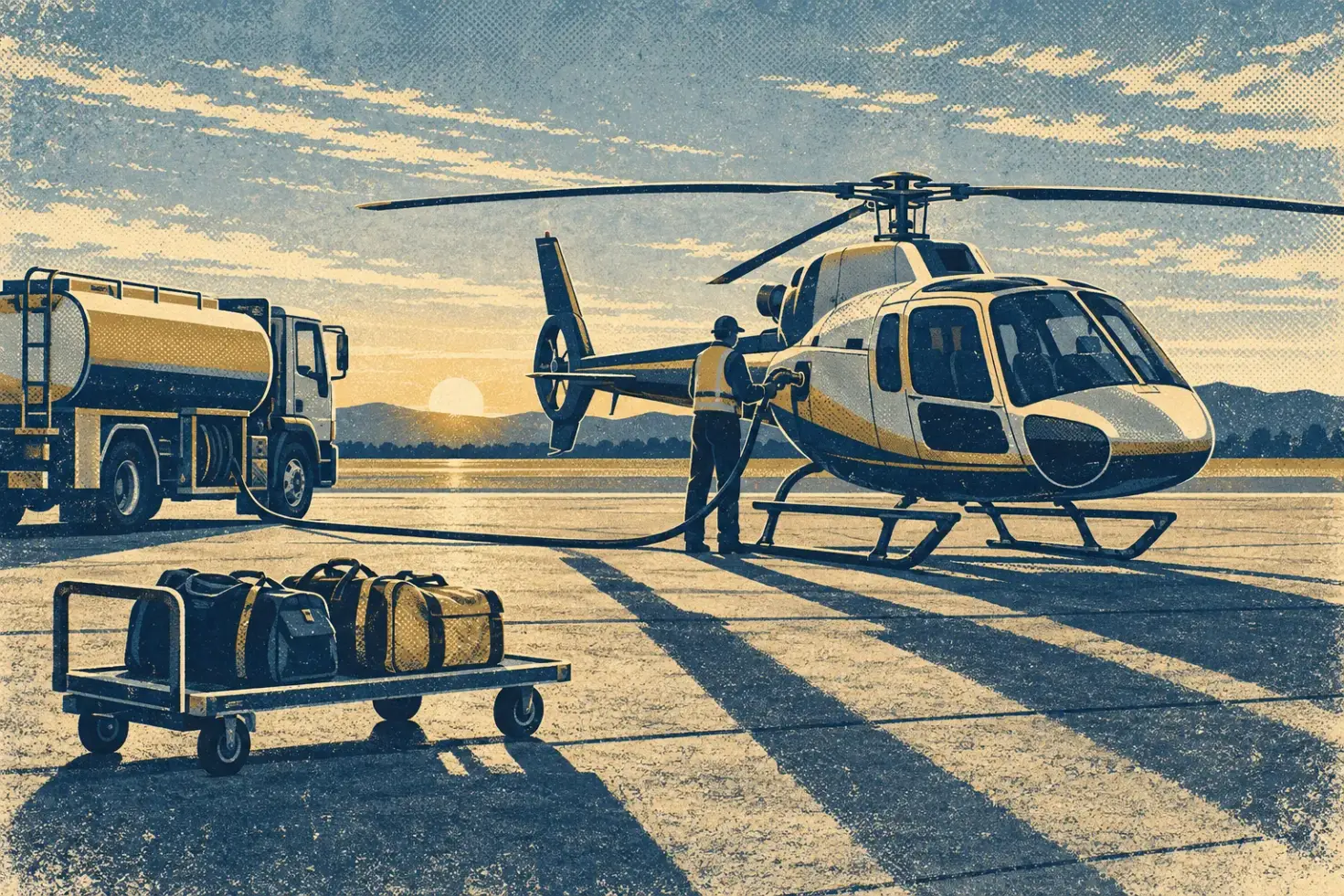
The operator has several ways to make the numbers work, and each has a cost you should weigh before accepting it:
- A fuel stop. Taking off with less fuel and refueling partway frees weight for bags. It adds time on the ground and depends on fuel being available at a suitable airport along the route.
- Fewer passengers on the aircraft. One seat left empty frees that person’s weight. Someone travels another way or on a second aircraft.
- Bags by road. A driver leaves ahead of you with the luggage. On most trips this is cheaper and simpler than any change to the aircraft.
- A larger class. A light twin or medium twin carries more, costs more per hour, and may need to reposition from further away, with the empty ferry legs billed on the quote.
- A cooler departure time. Moving the flight to the morning can restore performance lost to afternoon heat.
The pilot makes the final weight call on the ramp, and it can differ from the morning’s estimate. Hot weather, high elevation and a gusty wind can each reduce what the aircraft may lift, and density altitude usually climbs through a summer day as the air warms.
Balance: why the pilot decides where each bag rides
Once the aircraft can lift the load, the next question is whether it still handles correctly with that load aboard.
Every helicopter has a center of gravity range: the stretch, fore and aft, within which the loaded aircraft’s balance point must fall. The FAA’s Aircraft Weight and Balance Handbook notes that this range is much more limited on a helicopter than on an airplane. Load the aircraft too far forward or aft and, as the Helicopter Flying Handbook explains, the pilot can run out of control travel to hold a steady hover. Many types also have lateral limits, so a heavy load all on one side matters too.
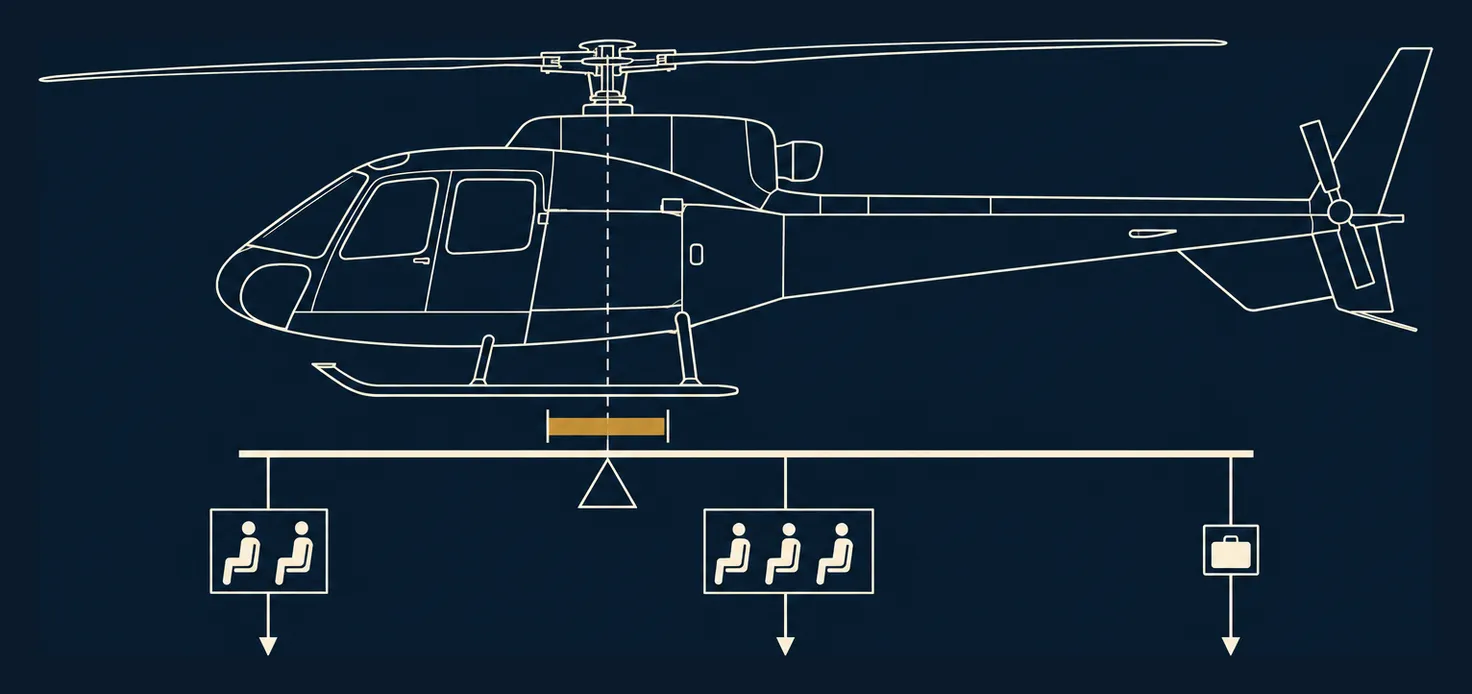
Position matters as much as weight. The effect of any item on balance is its weight multiplied by its distance from a reference point, a figure called its moment. A 40-pound bag in an aft compartment near the tailboom pulls the balance point aft far more than the same bag carried close to the rotor mast, and a heavy item at the very front pushes it forward in the same way. That is why crews sometimes:
- Put the heaviest bag in a forward locker and the lighter ones aft.
- Move a bag from one side of the aircraft to the other.
- Assign seats, placing a heavier passenger in front or balancing the two sides of the rear cabin.
- Leave a light bag behind even though the hold has room, because it would sit too far aft.
The pilot runs this calculation before every flight, and it only works if the inputs are right.
What the regulations require of the operator
A helicopter charter operates under Part 135, the FAA rules for on-demand commercial flights. Of the many sections in Part 135, three touch luggage directly:
| Rule | What it requires | Where it shows up for you |
|---|---|---|
| 14 CFR 135.63(c) | For multiengine aircraft, a load manifest before each takeoff: passenger count, loaded weight, maximum allowable takeoff weight, and center of gravity limits and position (or confirmation that an approved loading schedule keeps it within limits). The pilot carries a copy to the destination. | On a twin, your weights go on paper before every leg. |
| 14 CFR 135.185 | For multiengine aircraft, an empty weight and center of gravity calculated from an actual weighing within the preceding 36 calendar months, unless the aircraft is new or runs under an approved weight and balance system. | On a twin, the aircraft’s own weight in the arithmetic comes from a scale. |
| 14 CFR 135.209(b) | Helicopters under visual flight rules carry fuel to the first landing plus at least 20 minutes. | Fuel for the reserve is weight that bags cannot use. |
The load manifest rule names multiengine aircraft. A single-engine helicopter still has to fly within its weight and balance limits, and the pilot works through them before flight whether or not a manifest is required. Expect the same questions on a light single as on a twin.
Why the crew may put your bags on a scale
Many operators weigh bags, and some ask to weigh passengers, at check-in. It can feel intrusive on an executive trip. It exists because estimates are usually wrong in the same direction.
Packed luggage is almost always heavier than its owner guesses. A soft duffel that “weighs nothing” carries shoes, a laptop, chargers and a bottle of something from the trip. Across four passengers, those underestimates add up to a meaningful share of a light helicopter’s margin. On an aircraft that small, one person’s figure is a large part of the total, so many helicopter operators work from actual weights rather than averages.
What to expect:
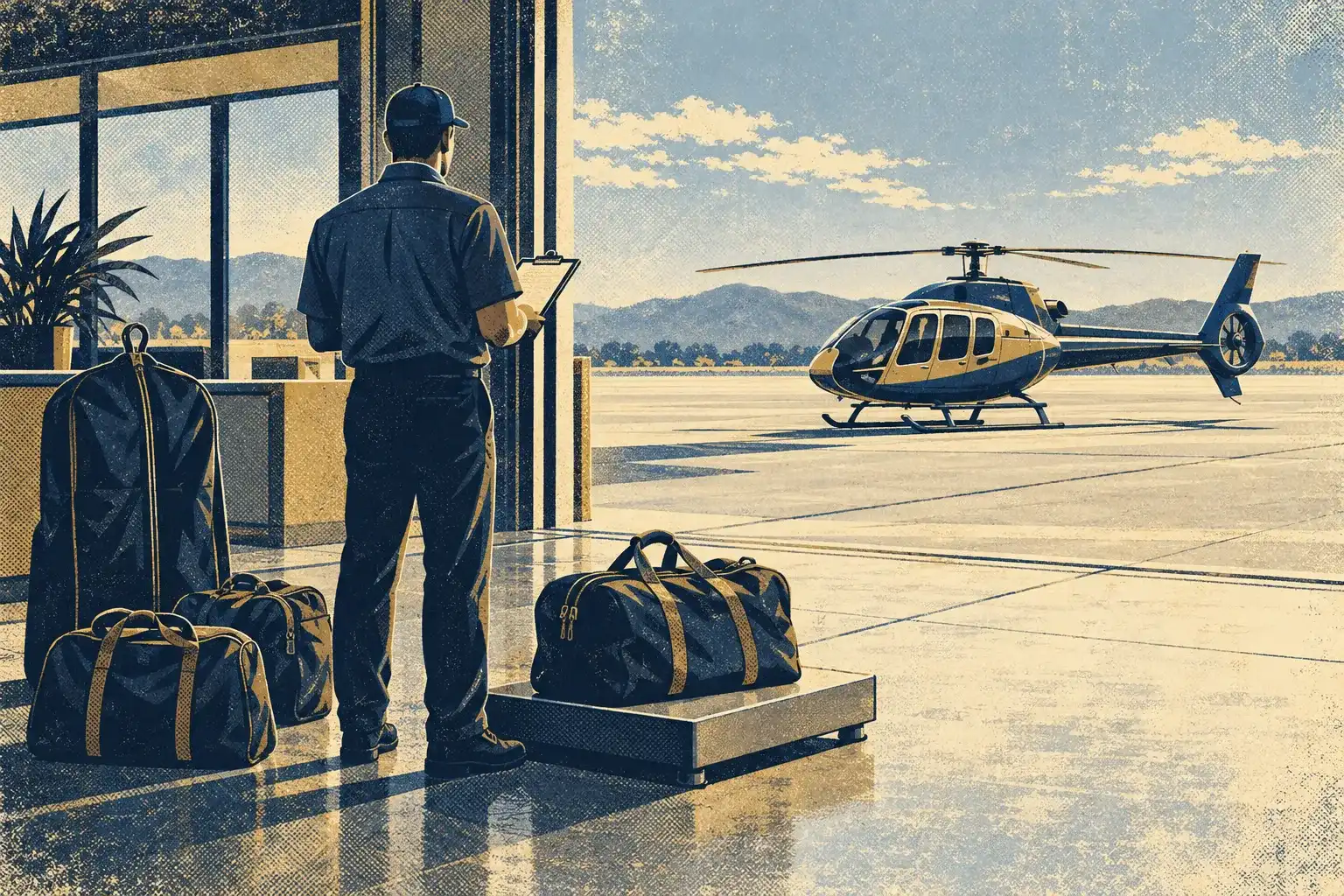
- A floor scale in the FBO or at the heliport. Bags go on one at a time, and the crew writes each figure down.
- A private question about passenger weight, usually at booking. Some operators confirm it with a scale on the day, handled discreetly.
- A revised plan if the numbers moved. If the bags come in heavier than the booking said, the pilot may move a bag, hold one back, or change the fuel plan.
If a principal would rather not be weighed on the day, give an honest figure at booking. A wrong number puts the aircraft outside its limits no matter whose it is.
Volume: when the hold fills before the weight runs out
The hold sets how many bags fly, separately from how many pounds. A light twin with three passengers may have hundreds of pounds of payload to spare and still refuse a fourth hard-shell case because nothing that shape fits through the door.
Each compartment has a door opening, an interior shape and a placarded weight limit, and many light helicopters split their space into several smaller lockers rather than one bay. Two aircraft in the same class can arrange it very differently: the Bell 407 and Airbus H125 use one aft bay and three separate holds. A curved, irregular hold also favors soft duffels over hard-shell cases.
For planning, the useful rule is simpler: send dimensions as well as weights. A packed bag’s three measurements, including wheels and handles, let the operator check the door and the space before the day. A cubic-foot figure from a brochure cannot tell you whether a 30-inch case clears a small door.
A checklist for coordinating weights before flight day
Send this in the first inquiry, and again with any change. It turns the question “how much can we bring?” into one the operator can answer precisely.

| Send | Why the operator needs it |
|---|---|
| Each passenger’s actual weight, including clothing | The biggest input to the weight budget and to seating for balance |
| Every bag, counted, including totes and camera bags | Every item needs a place in a compartment or a restrained spot in the cabin |
| Each bag’s type (soft or hard) and packed dimensions | Checks the door opening and the shape of the hold |
| Each bag’s packed weight, from a bathroom scale | Checks the budget and each compartment’s placarded limit |
| Anything unusual: golf clubs, instrument cases, batteries, sample cases | Long, rigid or hazardous items need a plan before the day |
| The full routing, including any return leg with extra shopping or samples | Fuel for each leg changes the allowance for that leg |
| Your preferred departure time, and whether it can move | A cooler time can restore lost payload |
Then ask two questions: what the aircraft on the quote can carry in bags for this party on this route, and what the plan is if the numbers change on the day. Put both answers into your planning checklist next to the passenger list and the route.
On a multi-city roadshow, run the numbers per leg. The payload on the first short hop tells you nothing about the long third leg with a full tank.
When a helicopter is the wrong answer for the luggage
Some trips carry more weight than any sensible helicopter plan absorbs. A helicopter is usually the wrong tool for the bags, though often still the right tool for the people, when:
- A full light single faces a long leg on a hot day. The fuel needed leaves little or nothing for bags, and a fuel stop costs the time you were buying.
- The group travels with heavy equipment. Trade-show kits, sample cases and production gear are heavy for their size and often rigid. A courier van usually carries them better.
- Everyone brings a week of luggage. Full-size checked cases on a family trip exceed both the volume and the weight a light helicopter offers for a full cabin.
- The departure is a high-elevation airport in summer. Thin, warm air cuts performance, and the payload can shrink sharply after midmorning.
The common answer is a split: the people fly, and the bags leave by road an hour or two earlier. For an airport transfer, the car that would have carried everyone often already exists. A larger class is the other answer, and the class step is one of the main cost drivers on a quote.
Frequently Asked Questions
What is the luggage limit on a private helicopter?
There is no single limit. The allowance is whatever payload remains after the aircraft, pilot and fuel, capped by each compartment’s placarded weight and by what fits through the doors. The operator calculates it from your passenger weights, bag details and route.
Why does the operator need to know how much each passenger weighs?
Passengers are the largest part of the payload, and their seats affect the aircraft’s balance. On a small helicopter an error of a few pounds per person adds up quickly, so many operators work from actual weights rather than averages.
Can the operator carry less fuel so we can bring more bags?
Sometimes. Fuel can be planned closer to the leg’s needs, or the flight can stop to refuel. The required reserve always stays aboard, and a fuel stop adds ground time. The pilot decides what is safe for the day’s weather and route.
Why would the pilot leave a bag behind when there is still space in the hold?
Either the aircraft has reached its weight limit for the day’s conditions, or the bag would sit where it moves the center of gravity too far. Space in the hold does not mean weight or balance margin remains.
Does a bigger helicopter solve the luggage problem?
Usually, at a cost. A light twin or medium twin has more payload and larger holds, costs more per hour, and may need to fly further to reach you. Sending bags by road is often simpler and cheaper.
Will the answer change on the day of the flight?
It can. Heat, altitude and wind reduce what the aircraft can lift, and bags packed heavier than declared change the numbers. Give accurate figures and a margin, and ask the operator in advance what the fallback is.
Glossary
- Maximum takeoff weight
- The heaviest the aircraft may be at takeoff, including the aircraft itself, fuel, crew, passengers and bags.
- Empty weight
- What the helicopter weighs as equipped, before pilot, passengers, bags and usable fuel are added.
- Useful load
- Maximum takeoff weight minus empty weight: the pounds available for pilot, fuel, passengers and bags combined.
- Payload
- The part of the useful load left for passengers and their luggage once pilot and fuel are counted.
- Center of gravity
- The balance point of the loaded aircraft. It must fall within a set range for the pilot to keep full control.
- Center of gravity range
- The fore-and-aft (and on many types, side-to-side) limits within which the loaded balance point must sit.
- Moment
- An item’s weight multiplied by its distance from a reference point. It measures how much that item shifts the aircraft’s balance.
- Placarded limit
- A maximum weight marked on or near a baggage compartment, which the crew must not exceed.
- Load manifest
- A record prepared before each takeoff on multiengine Part 135 aircraft, listing passengers, loaded weight, weight limits and balance.
- Fuel reserve
- Fuel carried beyond what the leg needs. Helicopters under visual flight rules must carry at least 20 minutes’ worth at normal cruise.
- Jet A
- The kerosene-based fuel burned by turbine helicopters, roughly 6.7 pounds per US gallon.
- Density altitude
- How high the air “feels” to the rotor and engine once heat and elevation are accounted for. Higher density altitude means less lifting performance.
- Part 135
- The FAA rules for on-demand commercial operators. A helicopter charter flies under this part.
- Light single
- The smallest common charter class: one turbine engine, a small cabin and the tightest weight margin.
- Light twin
- A two-engine class a step above the light single, with more payload and locker space.
- Medium twin
- A larger two-engine class with a bigger cabin and hold, used when a group brings real luggage.
- FBO
- Fixed-base operator. The private aviation terminal on an airport, where bags are weighed and handed to the crew.