Baggage · September 23, 2026 · 15 minute read
Softluggagevshard-shellbagsonahelicoptercharter
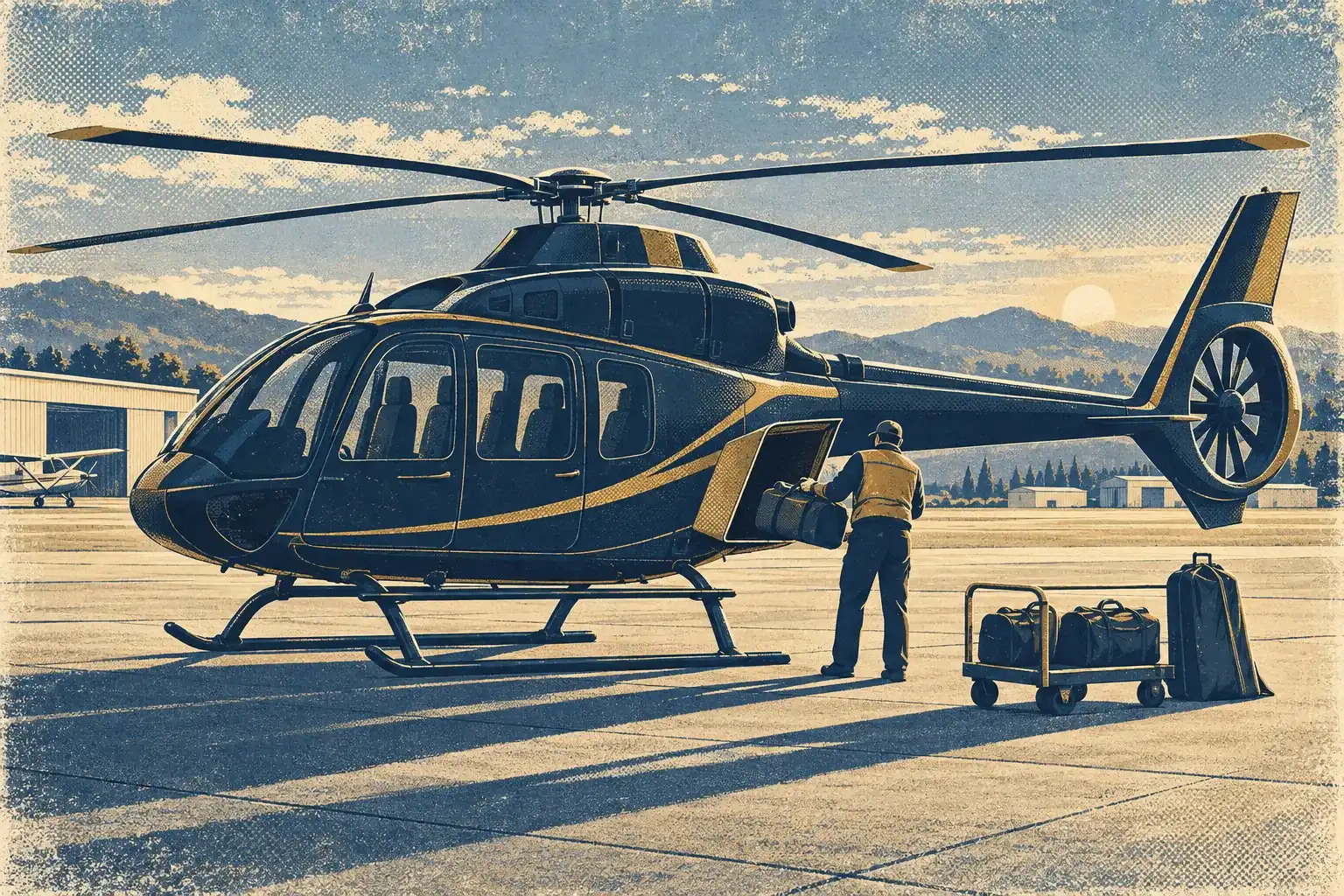
Pack soft. A helicopter baggage hold is small, often irregular in shape, and reached through a door smaller than the space behind it. A soft duffel bends through that door and fills the corners. A hard-shell suitcase of the same volume often does neither, so it rides in a car instead. Tell the operator every bag’s type and weight when you first inquire.
Why the hold on a helicopter is shaped the way it is
An airliner’s cargo hold is a long tube with a flat floor and a door sized for a baggage cart. A helicopter’s hold is whatever space the airframe leaves over once the designers have placed the cabin, the engine, the fuel, the transmission, and the tailboom. That space is rarely a clean box.
On many light singles the baggage compartment sits behind the cabin, where the fuselage begins to narrow toward the tail. Some types use one bay with its own door. Others split the space into several smaller lockers on the sides and at the rear, each with its own door and its own weight limit. The Bell 407 and Airbus H125 comparison shows both approaches side by side: one aft bay on the 407, three separate holds on the H125. Neither layout wins for every load, and your bags have to suit whichever one you are sent.
The door is the first filter. On many types it is noticeably smaller than the bay behind it, and a bag that would sit comfortably inside still has to pass through the opening, often at an angle.
Inside, the walls follow the airframe. Where the fuselage curves or tapers, so does the compartment, and the rounded or sloping corners can only be filled by a bag that changes shape. The floor has its own limit too: every compartment carries a placarded maximum weight, and many also cap how much load any one area of the floor can take.
The medium twins used for larger groups have more generous holds, and luggage stops being the usual dealbreaker there. The shape still matters. A bigger bay with a small door still rejects a bag that cannot bend. Luggage capacity rises with each helicopter class, and seats and bags trade against each other inside a fixed weight budget.
What a hard-shell case does in a helicopter hold
Hard-shell luggage is designed to protect its contents in a baggage system that throws it around. A helicopter hold is loaded by hand, one bag at a time, by a pilot or line crew who can see where everything goes. The protection you paid for has little to do on a ten-minute transfer, and the rigidity works against you.
A rigid rectangle placed in a space with sloping or curved walls leaves wedges of empty space at every corner. Those gaps cannot be filled by the next hard case, only by something soft. Two hard cases that together hold less than the bay’s rated volume can still leave no room for a third bag.
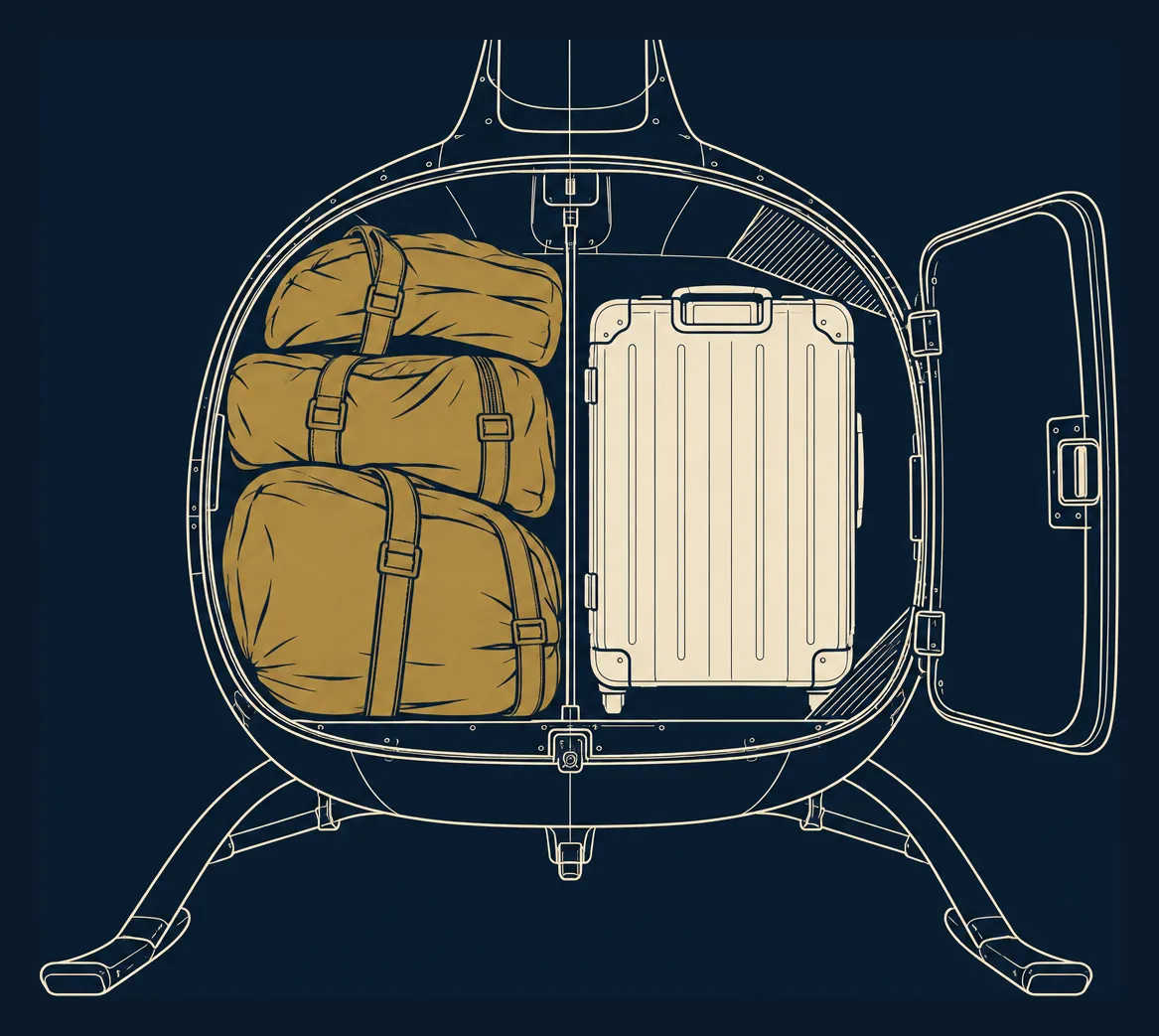
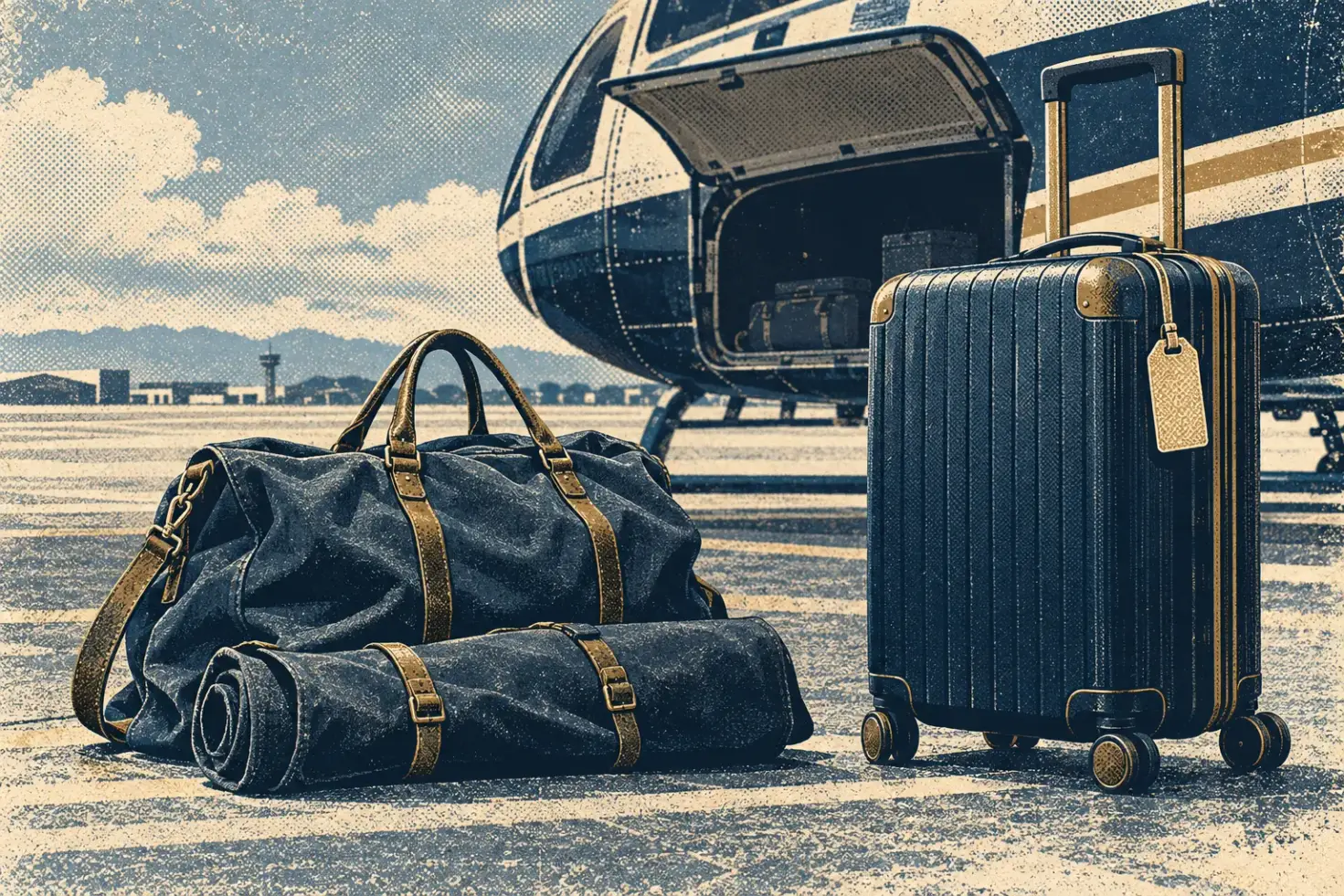
Getting it aboard is harder too. A soft bag of the same capacity can be flattened or folded to fit an opening. A hard case has one set of dimensions, and if the longest two are larger than the door, the answer is no. Measure the case, including wheels and handles, not the figure printed on the label.
Crews do not force a bag, either. A rigid case wedged against a door frame can stop the latch from closing securely, and an unlatched baggage door is a serious hazard in flight. A pilot who cannot close and latch the door with confidence will pull the bag back out.
Rigidity also costs weight. A hard shell with four swivel wheels and a telescoping handle weighs more empty than a canvas duffel. In a light helicopter, where people, fuel, and bags all share one weight limit, a few extra pounds per case across a party of four adds up.
A hard case that clears these hurdles still flies. Describe it ahead of time, or you find out on the ramp.
Which bags pack best
The bags that work best bend and weigh little empty. Each should also be small enough for one person to place by hand.
| Bag type | How it behaves in a helicopter hold | Verdict |
|---|---|---|
| Soft duffel, no frame | Compresses through the door and fills curved corners | The default choice |
| Soft duffel with wheels | Packs well, but the wheel frame is rigid and adds weight | Good, if the frame is short |
| Soft garment bag | Folds flat along the floor or over other bags | Good; ask the crew to lay it on top |
| Backpack or tote | Small, soft, often kept at your feet if the operator allows it | Good for what you need in flight |
| Soft-sided carry-on roller | Semi-rigid; fits many holds whole | Acceptable; say it is a roller |
| Hard-shell carry-on | One fixed shape; fits some holds, not others | Ask first, with dimensions |
| Hard-shell full-size checked case | Often larger than the door or the space | Plan on a car for it |
| Rigid equipment or instrument case | Fixed shape, often heavy for its size | Discuss separately, before booking |
A few practical rules from the ramp:
- Several small bags beat one large one. Two medium duffels can be tucked into two different gaps. One large bag needs one large gap, and the hold may not have it.
- Wheels and handles are rigid. A soft bag with a long telescoping handle behaves partly like a hard case. A short frame, or no frame, packs better.
- Pack each bag so it closes easily. A duffel crammed to bursting loses the flexibility that made it useful.
- Keep your in-flight items separate. Medication, a phone, documents, and anything you need at the other end in the first minutes belong in a small bag you carry, subject to the operator’s rules on what rides in the cabin.
- Label the outside. On a multi-stop day, the crew unloads by memory and by what you tell them. A plain tag with your name helps.
If you are buying a bag for a helicopter trip, buy a soft duffel of moderate size, which also travels well by jet or car.
How much luggage to plan for
No single number is right for every helicopter. Baggage volume, door size, compartment weight limits, and the aircraft’s total payload all vary by model and by the day’s conditions. The only reliable figure is the one the operator gives you for the aircraft on your quote.
What stays constant is how to plan:
- Count the bags. Every bag, including the tote and the camera bag, since they all have to go somewhere.
- Describe each one. Soft or hard, rough dimensions packed, and weight. A bathroom scale is good enough.
- Give passenger weights honestly. The operator needs them to calculate the load. Understating by a few pounds per person adds up in a four-seat aircraft.
- Ask what the aircraft can take. Ask how many bags of your type fit and what weight limit applies to the hold, then trust the answer over any figure you found elsewhere.
- Leave a margin for the day. Heat, altitude, and fuel for a longer leg all reduce what the aircraft can lift. A load that fits on a cool morning may not fit on a hot afternoon.
The luggage count belongs in the first inquiry, next to the passenger count and the route. The Charter Planning Checklist puts bags in the same stage as people for that reason: the operator chooses the aircraft from both.
Weight, balance, and where the bag rides
Every helicopter has a maximum takeoff weight, and people, fuel, and baggage all share it. Every helicopter also has a center of gravity range, and where heavy items sit affects whether the aircraft stays inside it. The FAA’s Helicopter Flying Handbook explains why both limits matter to the pilot before every flight.
For luggage, this means the crew may load bags in an order or a location you would not have chosen. A heavy duffel may go in a forward locker rather than the aft bay. A bag may move from one side to the other to keep the load even. On a light single with passengers of very different weights, the crew may also assign seats. The pilot is working the load numbers the aircraft requires, however neatly you packed.
Weight also explains why a bag that fits can still stay behind. If the hold has room but the aircraft is at its weight limit for the day’s fuel and passengers, the extra bag goes by car. That is more likely in hot weather and at high elevation, where the air gives the rotor less to work with.
Can a bag ride in the cabin?
Sometimes, within federal rules and the operator’s own procedures. 14 CFR 135.87 governs cargo and carry-on baggage on Part 135 flights, the rules a helicopter charter operates under. A bag must ride in an approved rack, bin, or compartment, be secured by an approved means, or meet a list of conditions. Those conditions include being restrained so it cannot move in turbulence, packaged so it cannot injure anyone, kept within the seat and floor load limits, kept clear of exits and the aisle, and not carried directly above seated passengers.
In practice, operators differ. Some allow a small bag at your feet. Some will belt a bag into an empty seat. Some keep all luggage in the hold. Each of those choices sits within the rule, and the operator’s own procedures decide which one applies to your flight. If your plan depends on putting a bag in a spare seat, say so before booking, because the bag takes a seat a passenger could use and still counts against the weight limit.
A loose bag in a helicopter cabin is a hazard in turbulence and in an emergency. Crews take this seriously, and they will ask you to hand over a bag you thought you would hold.
Batteries, liquids, and other items the crew will ask about
Hazardous materials rules apply on a helicopter charter just as they do on an airline. The FAA’s PackSafe guidance on lithium batteries says spare lithium batteries and power banks must travel in carry-on baggage only, kept with the passenger in the cabin, with their terminals protected from short circuit. That guidance is written for airline passengers, but the concern it addresses applies to any aircraft, and on a helicopter with an external hold that nobody can reach in flight, it matters more.
Tell the crew if a bag holds spare camera batteries, a power bank, or electronic equipment with large batteries. They will tell you where it rides. The same goes for aerosols, fuel for camping stoves, firearms, and anything else you would declare to an airline. Each operator has a written policy, and the crew will follow it.
What happens on the ramp when a bag does not fit
The crew tries once, carefully. If a bag will not go through the door, will not fit the space, or would take the aircraft over its weight limit, it does not fly. The usual options, roughly in the order they come up:
- Rearrange. Soft bags can often be repacked or repositioned to make room. Taking a jacket or a pair of shoes out of a duffel and carrying it can be enough.
- Split the load. Some items move to a smaller bag you carry, if the operator allows it.
- Send the bag by car. A driver takes the bag to the destination. On an airport transfer the car is often already there, since it brought you or your bags to the FBO.
- Hold it at the FBO. If you are coming back through the same airport, the bag can wait at the fixed-base operator for your return.
- Upgrade the aircraft. If a larger helicopter is available, the operator may offer it. That costs more and takes time to arrange.
- Leave a passenger behind or reschedule. This is rare, and it happens mostly on a full light single.
Every one of these is easier to arrange the day before than on the ramp. If you arrive at a private jet to helicopter transfer with bags packed for the jet’s hold, the transfer can stall while someone finds a car. A helicopter often cannot take bags that a jet’s cargo hold carried easily.
When a helicopter is the wrong answer for your luggage
Some trips carry more luggage than any sensible helicopter plan will absorb. In these cases, send the bags by road and fly the people, or drive the whole way:
- A family week away with full-size checked cases. On a weekend getaway the helicopter flies the people and a light bag each. The rest travels by car, or ships ahead to the house or hotel.
- Oversized sports equipment. Golf clubs can work with the right bag and aircraft, a question with its own answer in golf clubs on a helicopter charter. Surfboards, bike boxes, and long ski bags often outgrow the holds on light singles and light twins.
- Production or trade-show cases. Rigid, heavy, and often numerous. A courier van at the destination is usually the better answer.
- Six people with real luggage in a light single. Neither the seats nor the hold exist for it. Book a larger class or split the group.
A common plan is a driver who leaves an hour ahead with the bags while you fly, at a small cost next to the flight itself.
Frequently Asked Questions
Can I bring a hard-shell suitcase on a helicopter charter?
Sometimes. It has to pass through the baggage door, fit the space, and keep the aircraft within its weight limits. A hard carry-on often works. A full-size hard checked case often does not. Send the operator the case’s packed dimensions and weight before you book.
What is the best luggage for a helicopter flight?
A soft duffel of moderate size, with no frame or only a short one. It bends through small doors, fills irregular corners, and weighs little empty. Several smaller soft bags pack better than one large one.
How much luggage can I bring on a helicopter charter?
It depends on the aircraft, the passenger load, and the day’s conditions. Give the operator a full count with each bag’s type, size, and weight, and ask what the aircraft on your quote can carry. That answer is the only reliable one.
Can I keep my bag with me in the cabin?
Only if the operator’s procedures allow it and the bag can be restrained as 14 CFR 135.87 requires. Some operators allow a small bag at your feet or belt a bag into an empty seat. Others keep everything in the hold.
What happens if my bag does not fit?
The crew will not force it. The bag is repacked, sent by car, held at the FBO, or moved to a larger aircraft if one is available. Describing your bags when you book avoids nearly all of these outcomes.
Where do my power bank and spare camera batteries go?
Usually with you in the cabin, following FAA PackSafe guidance for spare lithium batteries, with the terminals protected. Tell the crew they are there; they decide where the bag rides.
Glossary
- Baggage compartment
- The enclosed space for luggage, usually behind or beside the cabin and reached through its own external door.
- Hard-shell luggage
- A suitcase with a rigid outer shell that keeps a fixed shape, usually with wheels and a telescoping handle.
- Soft duffel
- A frameless or lightly framed fabric bag that changes shape to fit the space around it.
- Placarded limit
- A maximum weight or load marked on or near a compartment, which the crew must not exceed.
- Payload
- The weight of people, bags, and cargo an aircraft can carry after fuel and the aircraft itself are accounted for.
- Maximum takeoff weight
- The heaviest the aircraft may be at takeoff, including the aircraft, fuel, people, and luggage.
- Center of gravity
- The balance point of the loaded aircraft. It must stay within a set range, which is why the crew decides where heavy bags ride.
- Part 135
- The FAA rules for on-demand commercial operators. A helicopter charter flies under this part.
- Tailboom
- The narrow structure running aft from the cabin to the tail rotor.
- Light single
- The smallest common charter class: one turbine engine, a small cabin, and a tight baggage hold.
- Light twin
- A two-engine class a step above the light single, with more locker space but still a finite hold.
- Medium twin
- A larger two-engine class with a bigger cabin and hold, used when a group brings real luggage.
- FBO
- Fixed-base operator. The private aviation terminal on an airport, where bags are handed to the crew and can be held for your return.
- Power bank
- A portable battery charger containing a lithium battery, treated as a spare battery under FAA hazardous materials guidance.