

Jet Connections · September 15, 2026 · 7 minute read
Tarmactransfers:privatejettohelicopterattheFBO
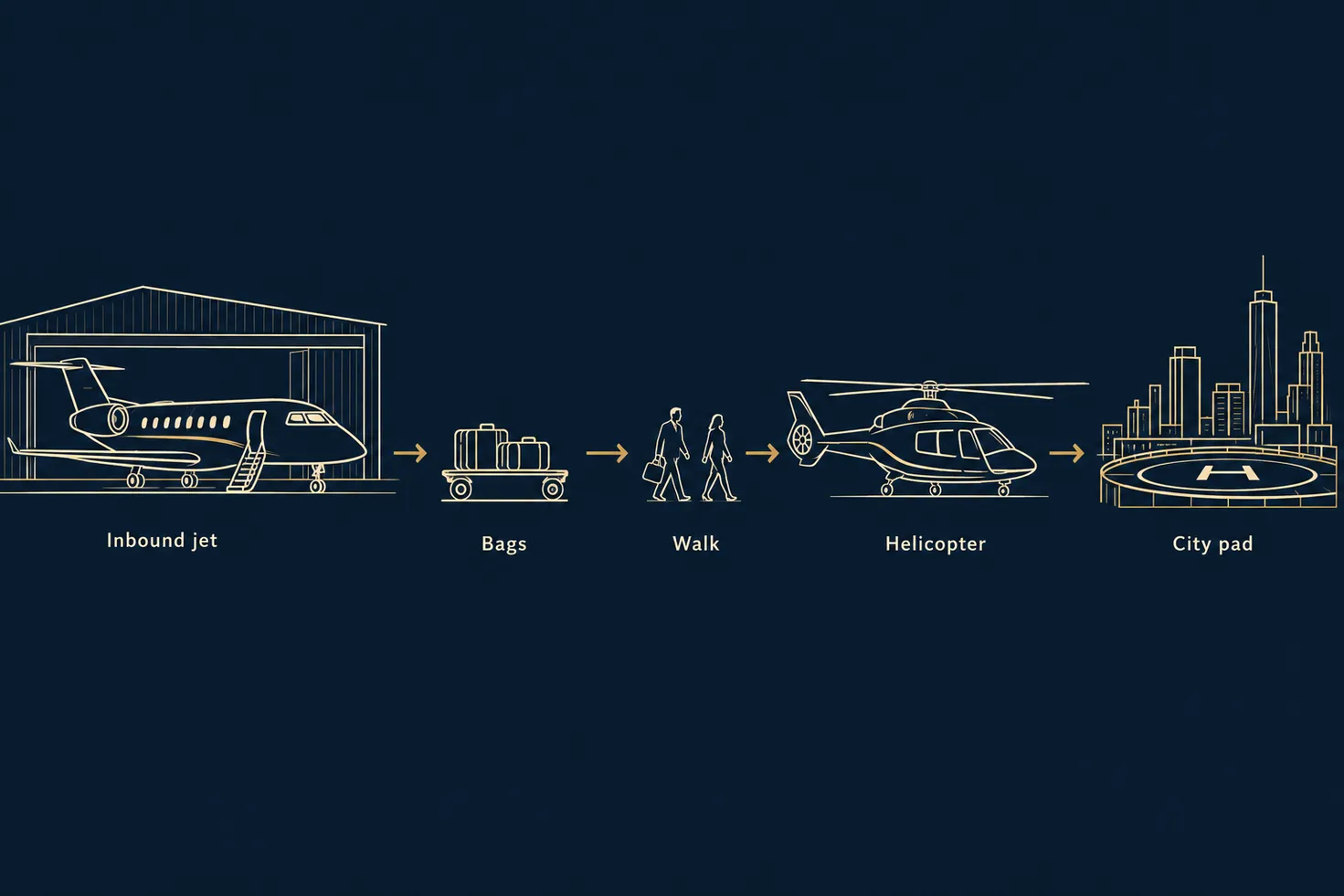
A tarmac transfer is an airside handoff at the FBO. The jet shuts down, bags move on the ramp, you walk or ride a cart to the helicopter, and you never enter the airline terminal. It works when both operators, the FBO, and the arrival time actually line up. The reason you would book an airport hop at all is on Airport Transfers. This page is the ramp choreography.
What airside means here
General aviation at most US airports lives at a fixed-base operator, the private terminal on the field. Passengers arriving on a Part 135 jet are already on the airport’s non-airline side. The helicopter, if the FBO will host it, waits on that same ramp or an adjacent pad.
You are not clearing TSA the way an airline connecting passenger does. You still show government ID when the FBO or the crew asks for it. Ramp access is controlled. Drivers and assistants who do not have a gate pass wait in the lobby, not on the paint.
Do not assume every FBO will allow a live helicopter next to a parked jet. Some fields separate rotor and fixed-wing parking. Some will not hot-load. The operator who holds the helicopter asks the FBO, not the other way around.
Minute by minute
The useful sequence starts before the jet leaves its origin, not when it lands.
- Tail number and ETA. The helicopter operator tracks the inbound aircraft. You send the actual tail, not “the Gulfstream,” and you update it if the airplane changes. A fifteen-minute staging window is typical: the helicopter is on the field, crew at the aircraft, before the jet’s door opens.
- Shutdown. Jet engines stop. The FBO marshalls as they always do. Nobody walks toward a helicopter with rotors turning until the crew says so. If the helicopter is still inbound, passengers wait in the FBO, not on the ramp.
- Bags. FBO line staff or the helicopter crew move luggage from the jet hold to the helicopter bay. This is the step that fails when the jet was packed like a cargo airplane. Soft bags and a realistic count belong in the manifest before either aircraft moves. Weight and volume limits do not reset because the bags already flew.
- Passenger path. Short walk or golf cart, depending on how the FBO laid out the ramp. Headsets go on before the helicopter lifts. The briefing is short because the next landing is often ten minutes away.
- Lift. The helicopter leaves. The jet may stay overnight or depart empty. That is a separate handling ticket.
If the jet is early, the helicopter may not be there yet. If the jet is an hour late, crew duty time and the next booking start to matter. Build a ground fallback the way you would for any charter, as in Weather, Delays and Scheduling.
What the assistant sends
One email, early, beats three phone calls on the day. The helicopter operator needs:
- Full legal names as they appear on ID, passenger count, and honest body weights
- Bag count and type (soft duffels vs hard cases vs golf)
- Inbound tail number, origin, and the FBO name on the arrival field (Atlantic, Signature, Meridian, Jet Aviation, and the rest: use the actual FBO, not the airport code alone)
- Mobile numbers for the principal, the traveling assistant if any, and the driver who will meet at the far end
- The destination landing site: which Manhattan public heliport, which estate, which second airport
REAL ID or a passport is the usual identity document for this kind of flight. Confirm what the operator wants before anyone leaves for the field.
The Charter Planning Checklist is the longer sequence. The list above is the tarmac-specific addendum.
Where this is common
The pattern shows up wherever private jets already concentrate and the city or coast is a bad drive from the field:
- Teterboro (TEB), White Plains (HPN), and the New York metro heliports on the other end
- Van Nuys (VNY) and Santa Monica (SMO) toward the Westside or a coastal pad
- Opa-locka (OPF) and Fort Lauderdale Executive (FXE) toward Miami, the beaches, or a further Florida field
No operator names belong here. The FBO brand on the field changes by lease. What does not change is the need to name the FBO in the handling request.
If the far end is a published heliport rather than another FBO, look it up before you promise a rooftop. Manhattan’s public-use options are visible on the New York metro Atlas page (52 facilities within 25 miles, three of them public use). The Atlas does not list every ad-hoc estate pad. For those, read helicopter landing permissions on private property.
Discretion on the ramp is a procedure, not a mood. VIP and Discreet Travel covers who is told, and who is not, on that kind of movement.

How it fails
The FBO will not take the helicopter. Ask early. A jet-friendly ramp is not automatically rotor-friendly.
The jet swapped tails. Tracking the wrong airplane stages the helicopter for a ghost.
Bags from the hold will not fit. The helicopter is smaller than the cabin you just left. Offload to a chase car, or say so the day before so the operator can send a larger class.
Weather on the rotorcraft side. The jet may have flown an instrument approach the helicopter will not make to an off-airport pad, or even to a city heliport in low scud. Have a car at the FBO.
Duty time. A long inbound delay can strand the helicopter crew against their duty day. That is a federal clock, not a courtesy.
When the handoff is the wrong tool, you deplane at the FBO and drive. That is still a successful jet arrival. It is just not a tarmac transfer.
Frequently Asked Questions
Do I go through the airline terminal?
Not on a typical GA-to-GA handoff. You stay on the FBO side. If anyone arrived on an airline flight, they still have to get from the terminal to the FBO first, which is the ordinary airport-transfer problem, not a tarmac transfer.
How much notice does the helicopter need?
Enough to be in position about fifteen minutes before the door opens, plus however long the aircraft needs to reach that field from its base. Same-day is possible in busy corridors and foolish as a plan for a board meeting.
Can the helicopter wait on the ramp with rotors turning?
Only if the FBO and the operator allow it. Many will not. Budget a shutdown and a short start cycle.
Who moves the bags?
FBO line staff, the helicopter crew, or both. Put a count in writing so nobody is guessing at the jet door.
What ID do passengers need?
Government photo ID, typically REAL ID or a passport. Ask the operator. Do not send anyone to the ramp with a gym membership card.
Glossary
- FBO
- Fixed-base operator. The private aviation terminal on an airport: ramp, lounge, fuel, handling.
- Airside
- The secure part of the airport beyond the public terminal, including GA ramps. A tarmac transfer is designed to stay here.
- Ramp
- The paved apron where aircraft park and passengers walk. Also called the tarmac in passenger language.
- Handling
- The FBO’s ground service: parking, baggage, cars, a room to wait.
- Part 135
- The FAA rules for on-demand commercial operators. Both the jet and the helicopter, if they are charters, run under this part.
- PIC
- Pilot in command. Final authority on whether the helicopter lifts, waits, or you go to a car.
- Tail number
- The aircraft registration (N-number in the US). The identifier the helicopter operator tracks, not the model name.