
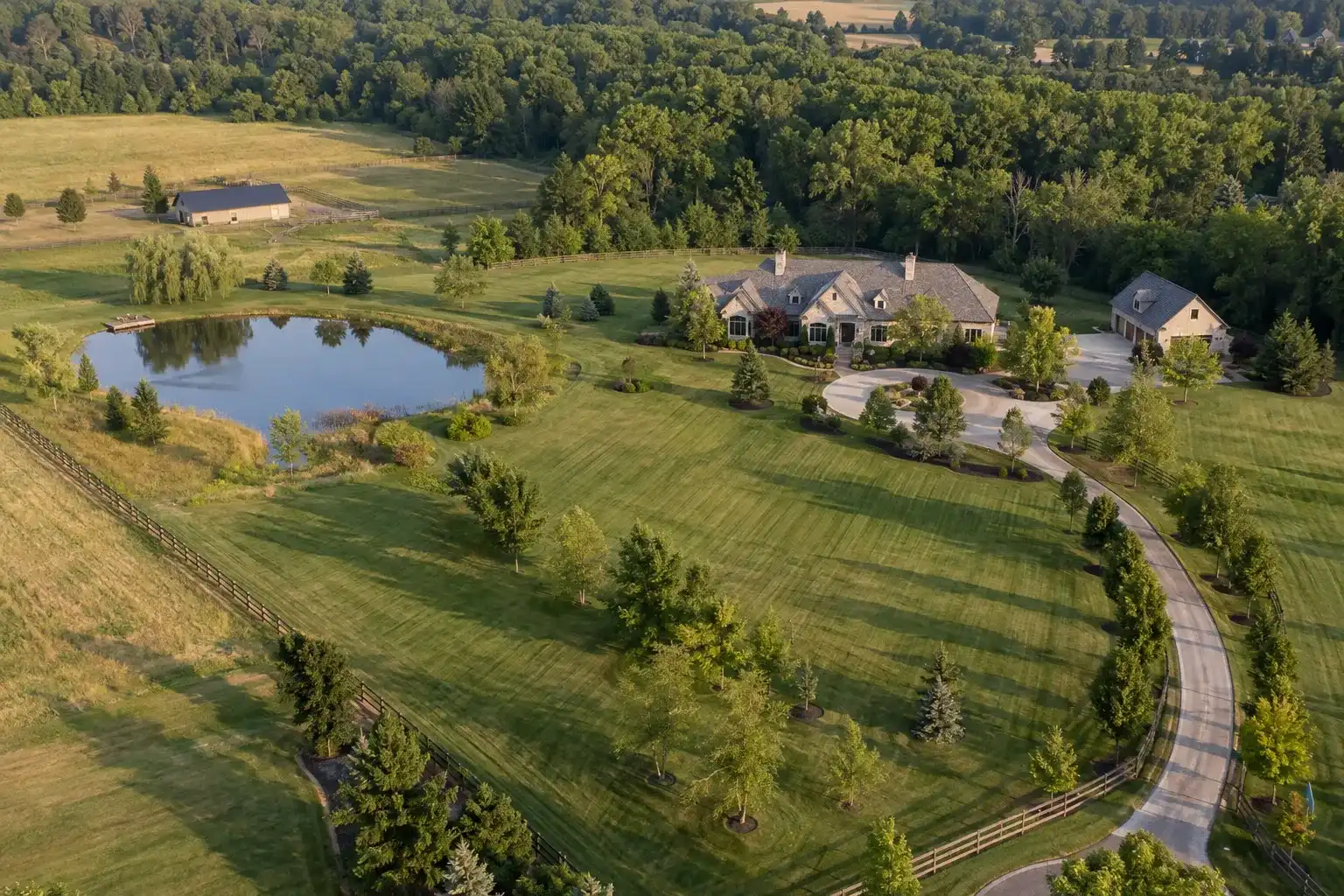
Landing Zones · September 15, 2026 · 13 minute read
Helicopterlandingpermissionsonprivateproperty
Federal aviation rules rarely forbid a helicopter from landing off an airport. What actually decides a private-property landing is a stack of local zoning, the owner’s written permission, and whether a Part 135 operator will accept the site. The Heliport Atlas shows nearby registered pads. It does not list lawns, pastures, or driveway circles, and it cannot prove a backyard is legal.
The three-tier permission ladder
Treat the question as three separate approvals, not one federal stamp.
Federal airspace. 14 CFR 91.119 sets minimum safe altitudes, then carves out helicopters. Except when necessary for takeoff or landing, an airplane over a congested area stays 1,000 feet above the highest obstacle within 2,000 feet, and 500 feet above the surface elsewhere. Paragraph (d) lets a helicopter operate below those (b) and (c) minimums if the flight is conducted without hazard to people or property on the surface, and if the pilot follows any helicopter routes or altitudes the FAA has prescribed for that place. That is why a charter can, in principle, descend onto a field that is not an airport. It is an operating rule, not a landing permit.
The charter certificate. The flight you are buying is commercial on-demand work. The operator holds operational control under FAR Part 135, which is the customer’s-side frame in FAR Part 135 for Charter Customers. The certificate holder decides whether the site is acceptable under its operations specifications, insurance, and the pilot in command’s judgment. Owner permission does not override that.
State and local land use. Whether you may establish or use a private landing site on a given parcel is a zoning and ordinance question. Some counties treat occasional landings as accessory to the property. Some require a special-use permit. Some ban private helipads outright, or restrict hours, frequency, or setbacks from lot lines. Municipal noise rules and “fly neighborly” expectations sit here too. There is no single nationwide private-landing permit. If your planner emails “the FAA said we can,” they have only cleared the first tier.
The five landing contexts (public heliport, FBO, private heliport, private property, off-airport site) are mapped in Heliports and Landing Zones. This article is the private-property rung of that ladder.
Written permission is necessary, not sufficient
If you do not own the ground, you need the owner. If you do own it, you still need whatever the jurisdiction requires, and you still need the operator to say yes.
Put the permission in writing before the aircraft is positioned. A useful letter or email states:
- The property address and a description of the landing area (lawn west of the barn, meadow inside the tree line, and so on)
- The date or date window, and whether this is a one-time arrival or a round trip
- Who is authorizing it, with title (owner, trustee, property manager with authority)
- That the operator may conduct a site review, including a ground visit
- Any limits the owner cares about: hours, number of movements, which approach path to avoid
Operators often ask to be named as additional insured on a property policy for the day, or they bring their own certificate of insurance for the owner to hold. Neither document is a landing approval. They allocate risk after the site has already been accepted.
A verbal “sure, land on the south lawn” is how event days go wrong. The person who said it may not control the property, the neighbors may not have been told, and the operator has nothing to show a local official who appears after the fact.
What the operator still checks
Once the paper is in hand, the site still has to fly. The review is the same practical list used for any off-airport landing, written as a checklist on the landing-zones resource. For a private parcel, the items that kill trips most often are:
Wires. Approach and departure paths, not just the grass you can see from the kitchen. Power, phone, and unmarked guy wires are the hazard pilots worry about because they disappear against terrain and sky. A site that looks open from the patio can be unusable from the air.
Surface and slope. Firm enough to take the aircraft’s weight. Dust, pea gravel, wood chips, and dry silt become projectiles in rotor wash. A slope that feels mild when you walk it can sit outside the aircraft flight manual’s landing limit.
Touchdown area and obstacles. Trees, poles, fences, light standards, buildings, and parked vehicles. The larger the helicopter, the more room the pilot will want around it. Designed heliports follow FAA Advisory Circular AC 150/5390-2 for touchdown size and approach surfaces. An ad-hoc lawn is not a designed heliport. The operator applies company minimums, not a backyard version of that circular. Do not treat a round number you saw on a forum as the legal size of your landing zone.
Crowd and debris control. Rotor wash will move tents, umbrellas, tablecloths, lightweight furniture, and unsecured decorations. Someone on the ground has to hold a perimeter before, during, and after the landing. Pets and livestock belong inside or well away.
Night. Off-airport landings after dark are a different product. Lighting, obstacle marking, and the operator’s night minimums often make a site that works at 4 p.m. a no at 8 p.m. Plan the arrival in daylight unless the operator has already accepted a night landing at that exact place.
The pilot in command has final authority on the day. A site that passed a photo review in March can fail in August after the trees leaf out, or after a rain turns the meadow soft.
What to send for the site review
Operators would rather see the ground than guess from a pin on a map. A complete packet, sent with the first serious inquiry, looks like this:
- Street address plus a lat/long for the intended touchdown, taken from the actual lawn, not the front gate
- Recent ground photos in four directions from the center of the landing area, plus one looking straight up for wires
- A satellite screenshot with the intended approach and the wires you know about marked
- Surface: grass, gravel, dirt, snow, and whether it was wet in the last 24 hours
- Known obstacles: fence height, tree line, nearby buildings, pool, tents if an event
- Who will control the crowd, and a mobile number that will answer an hour before landing
- Local rule status, if you already asked the county or the HOA
If the operator still wants a ground visit, budget that as part of planning, not as an insult. A light single on a familiar ranch is a different review from a medium twin into a suburban estate the company has never seen.
One-time landing versus a private helipad
A one-off arrival and a constructed private helipad are different projects.
A one-time landing uses existing ground, written permission, and the operator’s minimums. No pavement is required if the surface will take the aircraft. Many estate and ranch jobs stay in this category for years.
A private helipad, the kind that shows up later in the FAA register, is a facility: design, marking, lighting if you want night, and whatever local land-use process applies. AC 150/5390-2 is the design language for that facility. Once it is built and registered, it can appear in the Atlas on a later NASR cycle. Until then it is still an off-register site, even if you poured concrete.
If your office is trying to “get our campus in the database,” that is a facilities project with a consultant and a local permit path. It is not something a charter coordinator can do in a week so Friday’s landing looks official.

Hazards that do not show up on a plat
Downwash is not a courtesy issue. It is a debris and injury issue. Dry soil becomes a brown-out. A trampoline, a pool cover, or a stack of rental chairs becomes a projectile. Brief the ground party the way you would brief a construction site: heads down or inside, no phones held up at the skids, wait for the crew’s signal before anyone walks out.
Noise carries farther than the property line. One inconsiderate arrival can turn a tolerant road into organized complaints, which is how local bans get written. Tell adjacent owners before the day. Choose an approach over open ground, water, or commercial land when the operator has a choice. Do not schedule a practice run “just to see.”
Temporary flight restrictions around stadium events, disaster response, and VIP movements can close otherwise usable sites on short notice. That is a scheduling fact, covered with weather in Weather, Delays and Scheduling.
How the Heliport Atlas helps, and what it cannot show
The Atlas is the national list of operational heliports and helipads in the FAA register. Use it when the honest question is “if this lawn does not work, where else can we put down within a short ground ride?”
What it contains, stated exactly:
- Every operational heliport and helipad in the current FAA National Airspace System Resource file. Closed facilities are removed.
- It does not cover airports. In Hawaii and much of Alaska, the helicopter flying happens from airports, which are a separate facility class.
- It does not list unregistered private or ad-hoc landing sites. Those sites can be lawful. They simply appear on no national list.
- Only 56 facilities in the United States are designated public use. The rest are private use and need the owner’s prior permission even when they are in the register.
- Hospital and medical pads are the largest category. They exist for air ambulance work. A charter flight does not land on one.
For a Texas ranch, open the Texas Atlas page, search the county, and look at corporate or private pads within a realistic drive. If a registered private-use pad sits on a neighboring property, that pad still needs that owner’s permission. If nothing registered is close, you are back to an off-register LZ and the checklist above.
The 56 public-use sites are listed, with contacts, at Public-Use Heliports in the US. Metro pages measure outward from a city center, which is how the question is usually asked: Houston, Los Angeles, New York.
Answering “does the Atlas have every helipad in the US” with a flat yes or a flat no is wrong. It has every operational FAA-registered heliport. Your backyard is not in that file.

Temporary event landings
Weddings, fundraisers, and estate parties are the bookings that turn a lawn into a one-day landing zone. The legal ladder does not change because the occasion is happy. You still need owner permission, local rules, and an operator who will accept the site.
What does change is the ground picture: tents, guest parking, catering tents, lighting truss, and a crowd that wants to watch. Downwash security has to be in the event plan, not improvised when the aircraft is five minutes out. If the operator asks for a site visit the week before, that is the job, not a delay.
A dedicated event-landing article will cover wedding-planner mechanics. Until then, treat the event as a private-property landing with worse debris and more spectators.
Hotel and resort pads are a different case. Those are usually arranged operator-to-property, and the property’s own rules govern. That coordination lives on Hotel Transfers.
When the honest answer is a registered pad and a car
A helicopter is the wrong landing tool when:
- Local ordinances forbid private landings, or the permit window will not open in time
- The only open ground sits under wires, on a slope, or too close to neighbors who will not accept the noise
- The arrival is after dark and the site has no lighting the operator will accept
- The aircraft class needed for the passenger count will not fit the clearing you actually have
In those cases, find the nearest usable registered facility in the Atlas, land there, and finish on the ground. That is still a charter. It is just not a backyard arrival. The Charter Planning Checklist is where landing-site questions get asked in sequence, before anyone is standing in a field with a phone.
Frequently Asked Questions
Can a charter helicopter land in my backyard?
Sometimes. Federal rules do not generally forbid it. Local zoning, your written permission (or the owner’s), and the operator’s site review do. Many backyards fail on wires, size, slope, or neighbors.
Do I need an FAA permit to land on my own land?
You do not get a federal landing permit for a one-off private-property arrival. You still operate under 14 CFR 91.119 and, for the charter, Part 135. Local government may require its own permit or may prohibit the landing.
Is a registered helipad on the Atlas the same as permission?
No. A private-use listing means the facility exists in the FAA register and still needs the owner’s prior permission. Public-use listings are the exception, and there are only 56 of them in the country.
How large does the landing area need to be?
It depends on the helicopter and the operator’s minimums. Designed heliports follow AC 150/5390-2. An ad-hoc site is judged by the pilot and the company, not by a number copied from a forum. Ask the operator for the aircraft they intend to send, then size the site to that.
Can the Atlas prove my property is legal to land on?
No. The Atlas does not list unregistered sites and does not interpret zoning. Use it to find registered alternatives and to see what already exists in the county.
Who can overrule a landing on the day?
The pilot in command. Weather, a new obstacle, a crowd that will not move, or a surface that went soft after rain are all enough.
Glossary
- Part 135
- The FAA rules for on-demand commercial air carriers. A charter you buy from an operator runs under this part, not as a private airplane ride.
- 14 CFR 91.119
- The federal minimum-safe-altitude rule, including the helicopter exception that allows operations below the usual airplane minimums when the landing can be made without hazard to people or property on the surface.
- Operational control
- The certificate holder’s legal responsibility for initiating, conducting, and terminating a flight. On a Part 135 charter, that sits with the operator, not with the passenger or the property owner.
- LZ
- Landing zone. Informal term for the piece of ground the helicopter will use, whether or not it is a published heliport.
- PPR
- Prior permission required. Standard on private-use heliports: you do not arrive unannounced even if the pad is in the national register.
- NASR
- National Airspace System Resource, the FAA dataset behind the Heliport Atlas.
- Public-use vs private-use
- Public-use facilities are open to general traffic under published conditions. Private-use facilities, which are most US heliports, require the owner’s permission.
- PIC
- Pilot in command. The crew member with final authority over the aircraft, including whether a site is acceptable on the day.