
Baggage · October 7, 2026 · 13 minute read
Flyingwithskisandsnowboardsonahelicoptercharter
You can take skis or a snowboard on a helicopter charter if the assigned aircraft has an approved place to carry your packed equipment. That may be a baggage compartment, an approved external basket or suitable cabin stowage. Send the operator the bag’s packed dimensions and weight before booking. A seat for you does not guarantee space for your skis, and there is no universal ski-length allowance.
A resort transfer starts with the gear list
A helicopter can be one leg of a winter trip: from an arrival airport to another airport or an authorized landing site nearer your accommodation. Your equipment has to make the same journey. That sounds obvious until the helicopter is selected by passenger count alone and a long ski bag turns up beside four travelers and their weekend luggage.
Give the operator the sports-equipment list with the route. Include every ski bag, board bag and boot bag, as well as ordinary luggage. Specify whether one ski bag holds one pair or the whole family’s equipment. A large padded bag with several pairs inside is a different load from one slim sleeve.
Ask where the equipment will ride on the particular aircraft. “We take skis” is a useful opening answer, but you still need confirmation for your bag and your group. The Charter Planning Checklist puts passenger weights and baggage in the initial inquiry because they affect aircraft selection before anyone reaches the ramp.
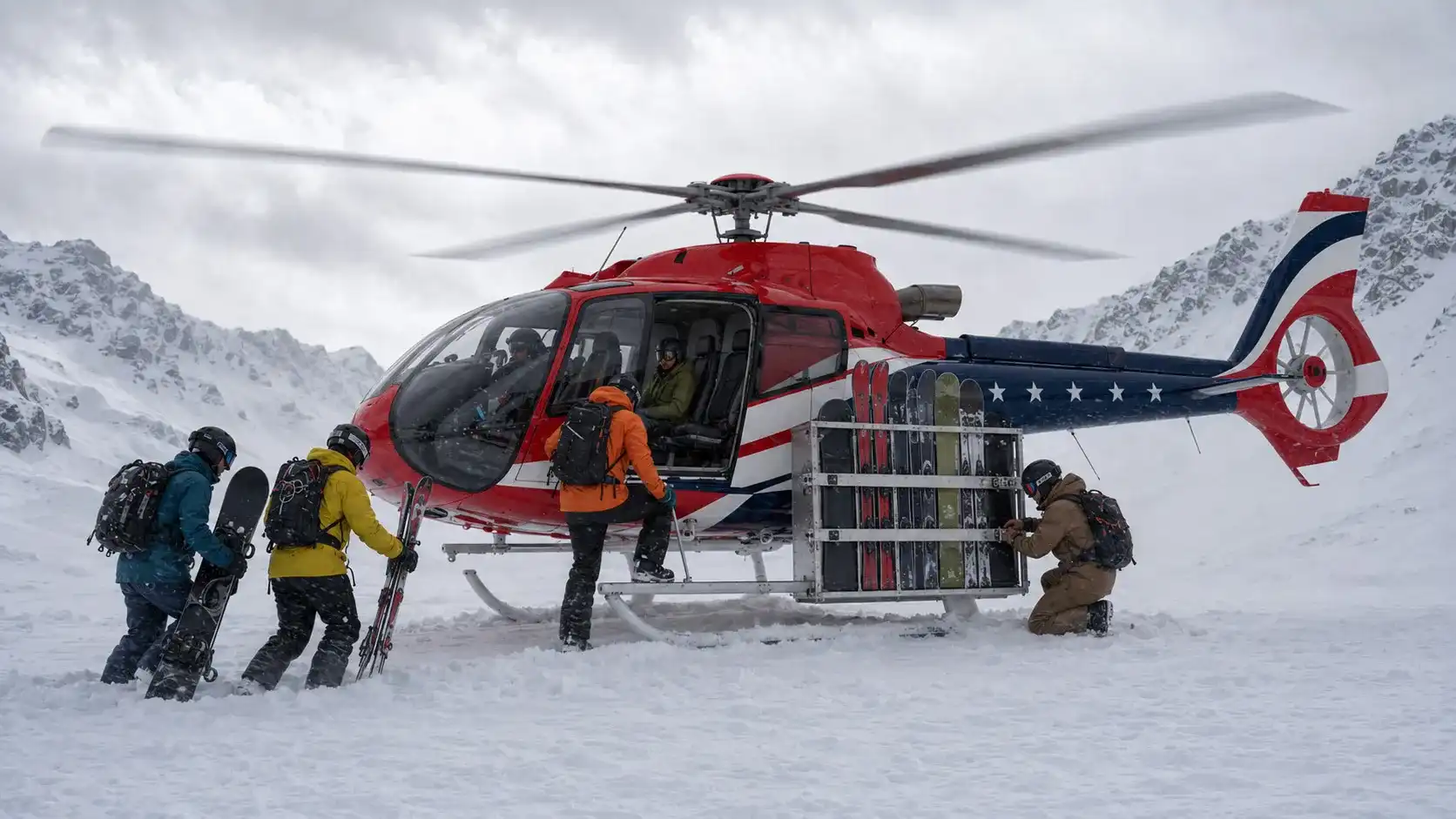
An airport-to-resort transfer also differs from heliskiing, where the flight puts a ski party into terrain for a guided descent. A helicopter equipped for that work may have a dedicated rack. An aircraft used for executive transfers may have an entirely different baggage arrangement. A photograph of skis carried on one model tells you little about what another aircraft can accept.
Measure the packed bag, including the awkward parts
The length printed on a ski is only one dimension. The operator needs the outside length of the packed bag, its widest point and its depth. Include rigid end caps or wheels. On a snowboard, bindings may determine the bag’s depth even though the board itself is thin.
Measure after packing. A bag advertised for a certain ski length may extend beyond the tips, and a double bag bulges once you add poles or clothing. Send a photograph beside a tape measure if the shape is hard to describe. It helps the crew judge the load without treating the bag manufacturer’s capacity label as an aircraft limit.
For example, a pair of skis marked 180 cm and a pair marked 200 cm do not establish two helicopter baggage categories. Either pair may be packed into a bag longer than the skis. These are examples of equipment length, not flight allowances. Acceptance still depends on the actual bag, its loading path and the aircraft’s approved stowage.
A long compartment is not automatically an easy fit. The bag must pass through its door and turn into its final position without being forced against the airframe. Internal volume also says nothing about whether the bag can lie at the required angle or whether the latch will close.
The ordinary luggage limits still apply. A long bag can fit physically and exceed a compartment’s weight limit. It can also consume space needed for the other passengers’ bags. Give the crew both measurements and weight; one cannot substitute for the other.
Where skis can ride: the hold, a basket or the cabin
There are several possible arrangements. None is a promise based on aircraft size alone.
| Arrangement | What you need confirmed | What can stop the plan |
|---|---|---|
| Enclosed baggage compartment | The packed bag passes through the opening, fits inside and stays within loading limits | A short door opening, restricted turning space or other luggage |
| Approved external ski basket or rack | It is installed on the assigned aircraft, and your equipment fits its approved cargo envelope | Equipment configuration, load limits or a flight restriction |
| Cabin cargo stowage | The operator has a compliant location and restraint arrangement for this bag | Obstructed exits, inadequate restraint or lost passenger seating |
| Separate ground transport | A driver can collect the equipment and deliver it where you need it | An unclear handoff or a delivery time that misses your plans |
The helicopter class comparison is a starting point for selecting cabin and baggage capacity. It cannot tell you whether a particular ski bag fits a particular aircraft. Two helicopters of the same model can have different interiors or installed equipment.
If the group needs all the seats, say so. A solution that uses an empty seat for secured cargo may disappear when another passenger joins. Equally, selecting a larger helicopter solely for ski length is premature until the operator checks its door and hold. Ask for an accepted loading arrangement, not just a larger model name.
An external basket is aircraft equipment, not an improvised roof rack
An approved ski basket attaches to the aircraft under a specific installation approval. Its operating limits travel with it. The crew must use the approved configuration and loading instructions, even if a different arrangement looks tidy from the ground.
The FAA’s AC 133-1B guidance on external cargo racks explains the distinction that matters for a passenger charter: an approved rack or basket can operate under Part 135 when cargo stays within the cargo envelope defined by the approved Rotorcraft Flight Manual Supplement. That supplement adds the instructions and limits for installed equipment to the helicopter’s flight manual. External carriage does not automatically make a fixed basket a sling-load operation.
For a concrete example, DART’s AS350 left-hand ski basket lists an FAA installation approval and a 300 lb load capacity. The listed basket weight is 78.3 lb. Those are separate figures: the installation itself adds weight before your gear goes aboard. The product page also lists the installation as VFR only, meaning it is restricted to flight under visual flight rules.
A catalog’s outside dimensions do not establish the usable space for your packed bag. Nor does the basket’s load rating establish how much equipment your flight can carry with its passengers and required fuel. Ask the operator to confirm the bag against the installed basket’s approved limits. Let the crew decide how the load is placed and secured.
That VFR restriction is worth raising on a winter transfer. Ask whether the planned aircraft and basket configuration can fly the intended route under the expected conditions, and what happens if the weather changes. Do this before relying on an instrument-capable helicopter as your fallback.
Can you put skis inside the passenger cabin?
U.S. Part 135 baggage rules do not contain a blanket ban on skis. They do prohibit treating a long bag as something a passenger can simply hold wherever it fits. Section 135.87 requires an approved stowage or securing arrangement, or compliance with its listed cargo conditions. Those include appropriate restraint and keeping required exits and aisles clear.
The practical question is whether the operator can carry your equipment in a compliant arrangement while everyone has the required seating. A ski bag laid across laps, leaned against a door or slid loose between seats has not answered that question. A passenger’s promise to hold it still does not establish approved restraint.
Ask about the whole packed bag. Sharp edges and protruding poles affect packaging, and the bag must remain secure throughout the flight. The crew also needs access to emergency equipment. An empty seat nearby does not by itself authorize loading skis into it.
If the operator allows cabin carriage, have it confirm the arrangement before the trip. Keep that confirmation with the baggage list and request a fresh check if the aircraft changes. The same rules explain why soft duffels are easier to accommodate than rigid cases, but flexibility will not make a two-meter item fit every cabin.
Pack for loading, not for a generous airline allowance
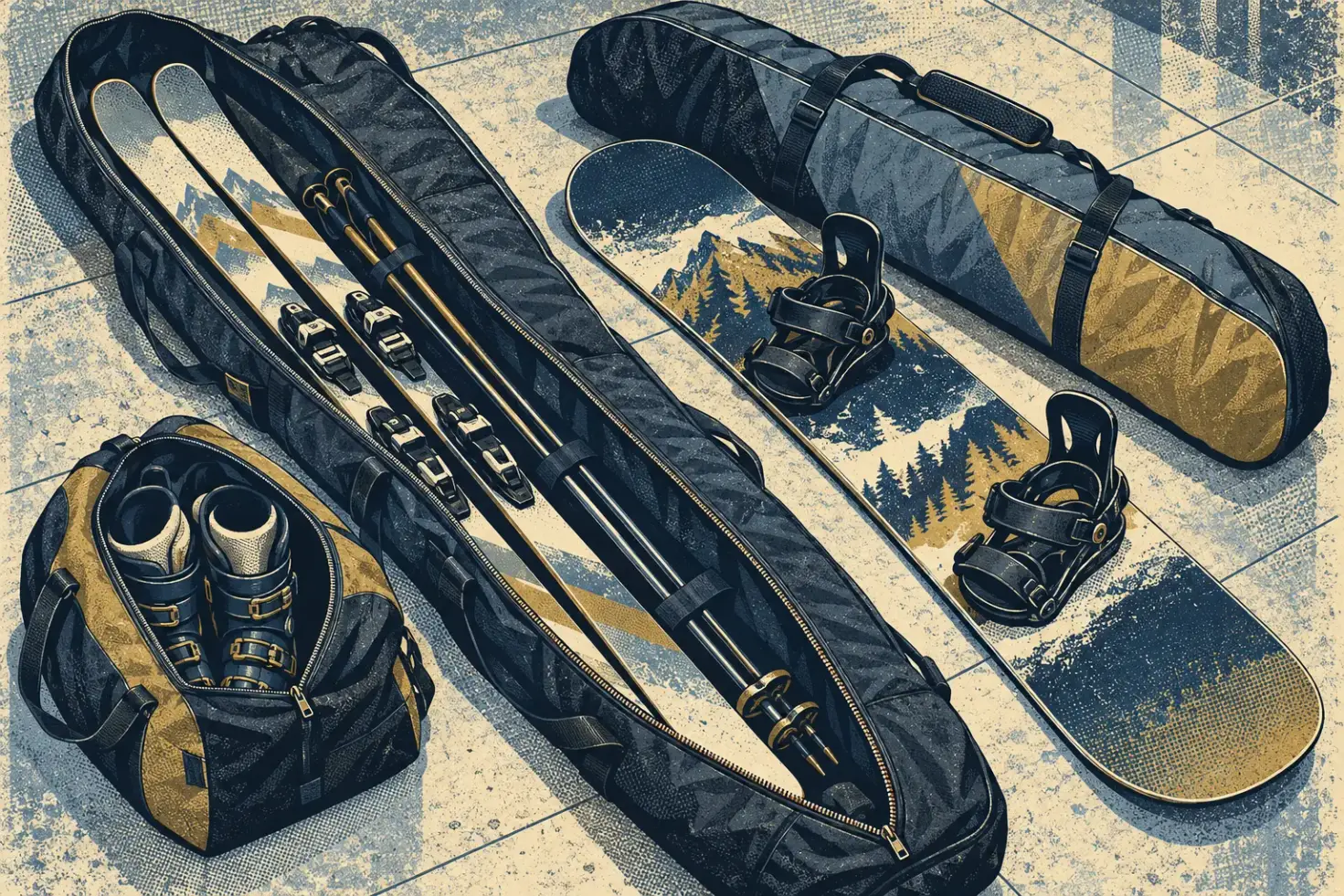
Use the packing method the operator accepts. A soft padded ski bag can be easier to handle than a rigid travel case, but the basket or rack may call for a particular arrangement. Do not remove protective packaging or separate items on the ramp merely because you think it will help.
Keep loose straps contained. Put poles inside the accepted bag rather than arriving with them loose in one hand. Ask whether boots should travel separately; dividing a load may help placement, while adding another bag also adds another item the crew must stow. Weigh the resulting bags again.
Snowboards deserve their own description. State whether the bindings remain mounted, whether the bag holds more than one board and whether boots are packed with it. If an operator proposes removing bindings, confirm that this actually solves the fit problem before dismantling your equipment. Bring what you need to reassemble it at the destination, and include that kit in the baggage count.
Avoid filling unused corners of a ski bag with the rest of your wardrobe until the crew accepts the finished load. A slim bag may become too bulky for its assigned space. The same problem arises with golf-club travel bags: a long item can be manageable until the protective case and extra contents turn it into a much larger piece of luggage.
Cold air helps performance; winter still limits the flight
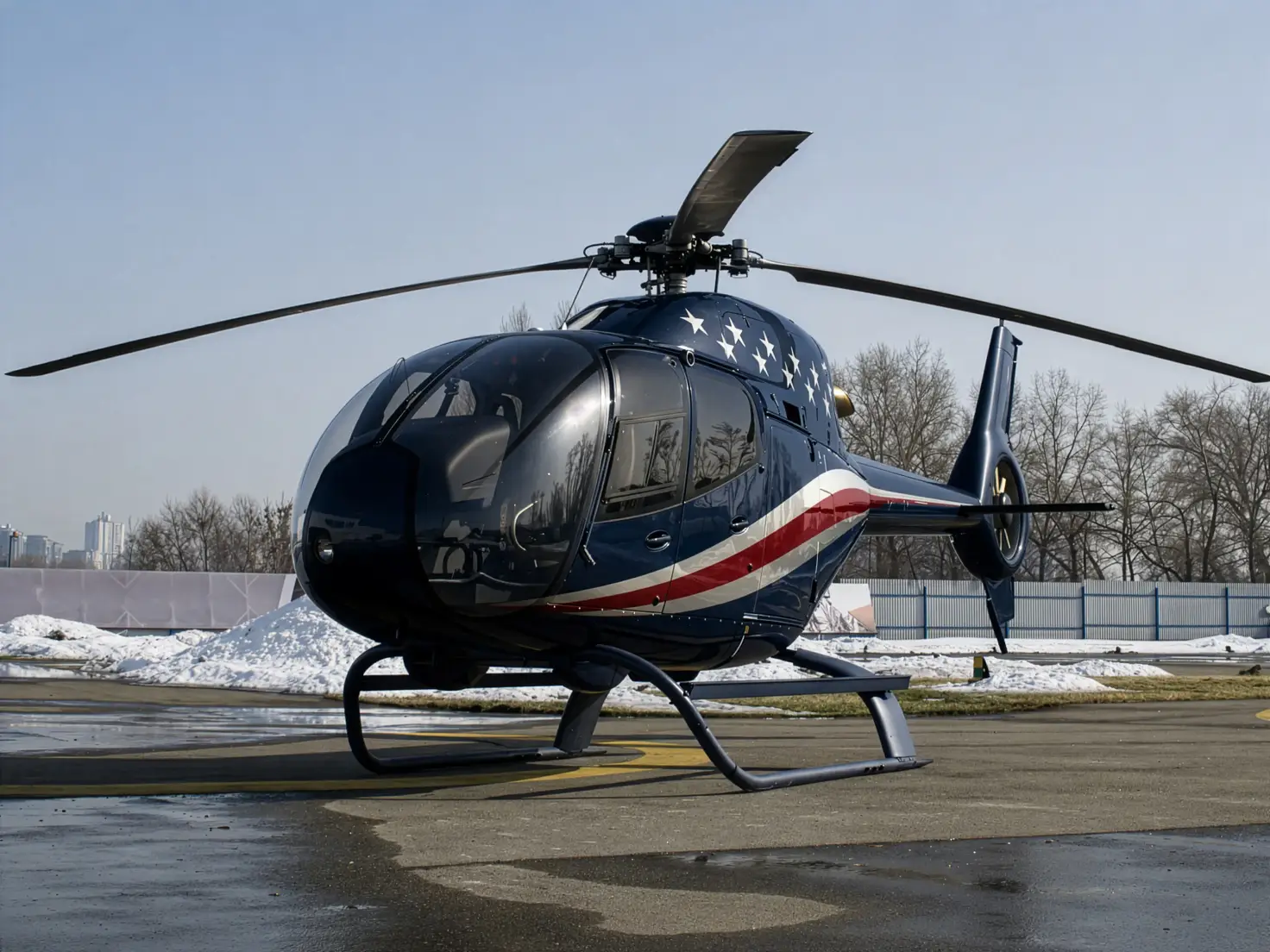
Cold air is denser than warm air at the same pressure. That generally helps helicopter performance, as the FAA’s Helicopter Flying Handbook explains. It does not give every winter flight surplus payload. Elevation still matters, and the pilot must calculate performance for the departure and destination with the actual aircraft and load.
Icing is a separate problem. Section 135.227 prohibits takeoff with frost, ice or snow on specified aircraft surfaces and equipment, including rotor blades. Its helicopter icing requirements also depend on the flight conditions and installed protection. Cold air alone says nothing about approval to fly in icing.
For a Colorado mountain transfer, ask where the helicopter will actually land and how you reach the accommodation from there. A hotel name in an itinerary is not evidence of an authorized landing site. Keep the airport or landing-site transfer and the final road leg explicit.
Protect the trip with a workable alternative. Agree on the decision point for switching to a car, who arranges it and where the sports equipment goes if the flight is delayed. Weather and scheduling belong in the same conversation as the ski bag, especially if you have a lesson or a return airline flight to reach.
Let the crew handle long equipment on the ramp
Follow the crew’s boarding instructions and hand over the gear where directed. The FAA handbook warns passengers to carry tools and equipment horizontally below waist level around a helicopter and never upright or over a shoulder. A ski or pole held vertically can reach a rotor’s space even when the person carrying it stays low.
Tell the crew if you need help with a long or heavy bag. Do not retrieve an item from a rack, walk around the tail or duck under a rotor to save time. If an item slips or blows away, stop and alert the crew. Their briefing determines the approach path and when anyone may move near the aircraft.
At an airport transfer, arrange the equipment handoff with the private aviation terminal, also called the fixed-base operator or FBO. A driver can meet the bags there without passengers carrying them across an unfamiliar ramp. At the other end, confirm who receives them so they do not wait unattended while everyone follows the hotel car.
When sending the skis by road is the better plan
If the sports gear determines a substantially different aircraft choice, compare the whole journey with a car carrying the equipment. You may prefer to fly with a small overnight bag while the ski bags go separately. Renting skis or boards at the destination is another option when bringing your own equipment is less important than keeping the transfer simple.
Separate transport needs a real handoff. Confirm collection time and the delivery address, then name the person who receives the bags. Keep your arrival plans realistic if the road vehicle may reach the accommodation after you. A bag that arrives tomorrow is no help for an afternoon on the mountain.
Recheck the return flight too. If your group changes, or someone buys equipment during the trip, the outbound baggage confirmation no longer describes the return load. The operator needs the revised dimensions and weights before selecting the return aircraft.
Frequently Asked Questions
Can you take skis on a helicopter charter?
Yes, when the assigned aircraft has an approved way to carry them and the packed gear fits within its limits. Confirm the complete bag with the operator before booking. Passenger seating alone does not establish ski capacity.
What is the maximum ski length for a helicopter?
There is no universal maximum. Measure the packed bag rather than quoting only the ski length. The operator checks it against the actual loading opening, stowage space or installed basket’s approved cargo envelope.
Can a snowboard travel with its bindings attached?
It may, if the packed board fits the accepted arrangement. Give the operator the bag’s depth with bindings fitted. Removing bindings can change that dimension, but do so only after confirming what the aircraft needs.
Are skis illegal in the passenger cabin?
There is no blanket ski ban in Part 135. Cargo and baggage must meet section 135.87, and the operator must accept a compliant location and restraint arrangement. Loose skis across passengers or against an exit are not a workable plan.
Does a ski basket mean the helicopter can fly through winter weather?
No. Equipment approvals can carry flight restrictions. DART’s cited AS350 basket installation is listed as VFR only. Ask about the aircraft’s installed configuration and the weather plan for your specific route.
What if the skis do not fit when we arrive?
They cannot fly in an unapproved arrangement. Agree in advance on ground transport or another accepted aircraft arrangement. Repacking helps only if the crew confirms that the resulting load fits and can be secured.
Glossary
- Part 135
- The FAA rules governing on-demand commercial helicopter charters and certain other commercial flights.
- Approved stowage
- A baggage location or securing arrangement accepted under the applicable aircraft and operating requirements.
- Cargo envelope
- The limits defining the cargo a rack or basket may carry under its approved flight-manual supplement.
- Rotorcraft Flight Manual Supplement
- Approved instructions and limitations added to the aircraft’s flight manual for an installation or modification.
- Supplemental Type Certificate (STC)
- An approval for a change to an aircraft’s original type design, such as a particular cargo-basket installation.
- VFR
- Visual flight rules. The flight must meet the applicable visibility and cloud-clearance requirements and any further operating limits.
- Payload
- The weight available for passengers and cargo after accounting for the aircraft, installed equipment and required fuel.
- Density altitude
- Pressure altitude adjusted for temperature. It helps describe the air’s effect on aircraft performance; colder air generally lowers it.
- FBO
- Fixed-base operator, the private aviation terminal or service provider at an airport where passengers and baggage may meet the crew.