Pets · September 28, 2026 · 18 minute read
Flyingwithadogonahelicopter:hearing,restraintandtheramp
Yes, you can usually fly with your dog on a private helicopter charter, provided you ask first and the operator agrees. Each operator writes its own pet policy. The dog needs hearing protection it already tolerates and a restraint the crew approves, usually a crate strapped to the floor. Declare its real weight, and board with the rotor stopped. A small, calm dog on a short hop is easy. A large, anxious dog on a long, hot flight in a light single often is not.
Who decides whether the dog flies
The operator decides, and then the pilot decides again on the day. No section of Part 135, the federal rule set for on-demand charter, is written about dogs. What the rules do cover is anything loose in a cabin. Under 14 CFR 135.87, cargo and carry-on baggage must ride in an approved rack, bin or compartment, be secured by an approved means, or be tied down so it cannot shift in normal flight and ground conditions. Cargo carried that last way also must not block an exit or overload a seat or the floor. Operators generally treat a crated dog like any other item in the cabin, and those requirements are the ones your crate has to meet.
That leaves a lot to company policy, and policies vary. Some operators fly dogs routinely for clients with second homes. Others accept only small dogs in a carrier. A few say no to animals altogether, often because an aircraft doubles as an executive shuttle the next morning and a client down the line is allergic. None of those answers is wrong, and none of them can be negotiated on the ramp.
So the dog goes in the first message, alongside the passenger count and the bags. On your charter planning checklist, give the dog its own line under special items: breed, weight, crate dimensions, temperament, and whether it has flown before.
On the day, the pilot in command still has the final word. A dog that is frantic on the lawn, a crate that will not seat properly, or a heat index that makes a closed cabin unkind are all reasons a pilot can decline, and you want a pilot who will.
How loud a helicopter cabin is for a dog
Loud enough that almost every passenger in a charter helicopter wears a headset or ear protection. Turbine whine, transmission noise and rotor slap fill the cabin for the whole flight. Your dog sits in the same noise without choosing it, and dogs hear a wider range of frequencies than people do. The high-pitched turbine and gearbox sounds that you hear as a background whine are part of what the dog hears too.
Canine hearing protection exists for exactly this: padded earmuffs sized for dogs, held on by adjustable straps around the head and throat. Owners who take dogs in small planes and boats already use them. They only work if the dog keeps them on, so the job starts at home, weeks before the trip:
- Let the dog sniff the muffs and get a treat for it. Put them away.
- Hold them against the head for a few seconds, then treat. Build to a minute.
- Fasten them loosely indoors for short sessions, then on walks, then in the car.
- Fit them properly the day before the flight and check the dog can pant and drink with them on.
A dog meeting earmuffs for the first time on the ramp will spend the flight trying to scrape them off against the crate door. Ask your vet whether ear protection suits your dog’s ears and coat, and ask before you improvise with cotton or foam plugs, which can end up where they should not be.
Noise is also why a helicopter is harder on some dogs than a car. You cannot reassure a dog over the cabin noise, and your voice is going through your own headset rather than into the dog’s ear. A familiar blanket and your hand on the crate help more than talking.
Crate, harness or lap: how the dog rides
The crew chooses the restraint that fits their aircraft and procedures. Expect one of these, roughly in the order operators prefer them.
| Restraint | Where it rides | Suits | What to confirm with the operator |
|---|---|---|---|
| Hard-sided crate strapped to floor tie-downs | Cabin floor, sometimes a seat removed | Medium and large dogs, and any dog the crew wants fully contained | Crate dimensions against the door opening and floor space, and where the tie-down points are |
| Soft carrier on a seat or the floor, belted or strapped | Passenger seat or at your feet | Small dogs | Whether the carrier counts as carry-on and where it must sit for takeoff and landing |
| Crash-tested harness tethered to a seat belt or anchor | Its own seat | Small to medium calm dogs, if the operator allows it | Tether length, so the dog cannot reach the front seats, a door handle or the pilot |
| Loose on a lap or on the floor | Nowhere | Nothing | Nothing. Expect a no, and it is the right answer |
Why a loose dog is a hard no: in a light helicopter the front passenger seat sits beside the pilot’s controls, and many cabins are one open space. A startled 30-pound dog that climbs forward can put a paw on a control, a door handle or a person at the worst possible moment. In a single-pilot aircraft nobody else is there to manage it.
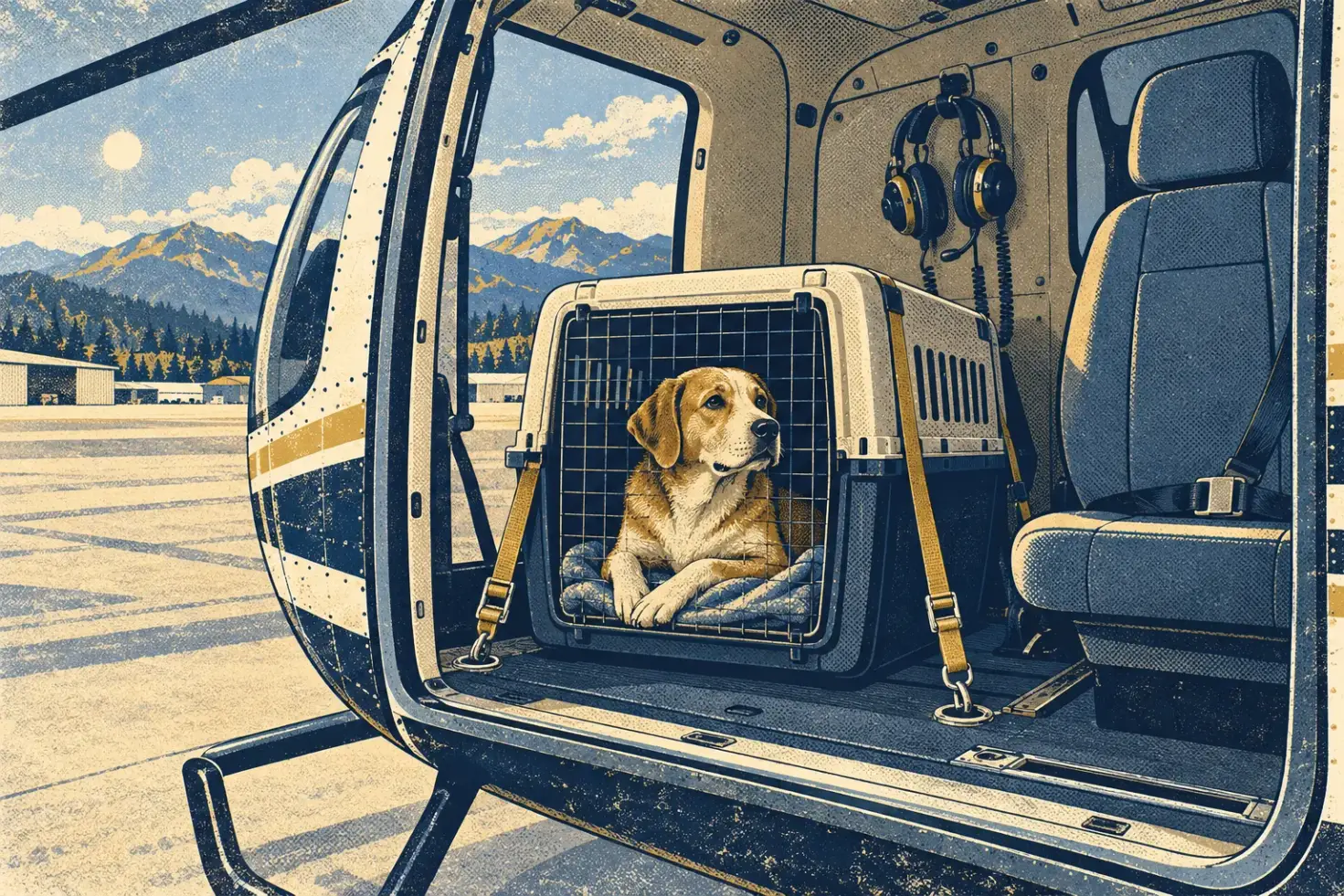
Bring the crate the dog already sleeps in, if its size works. A crate from the car that the dog knows beats a new airline crate that it does not. Line it with an absorbent pad and a familiar blanket, fix a water bowl that clips to the door, and leave the leash and harness on the dog so you can take it out on landing without a scramble.
Ask one more question: will the crate go through the door? Helicopter cabin doors are smaller than they look in photos, and a large wire crate that fits an SUV hatch can be too tall for a light single’s rear door. Measure the crate assembled, send the dimensions, and let the operator check them against the actual aircraft.
The baggage bay is for bags
On some light helicopters, the only space big enough for a large crate is the external baggage compartment. Decline it. That bay is designed for luggage. You cannot count on ventilation or temperature control there, nobody can see or hear the dog during the flight, and nobody can get to it until the rotor stops. If the crate will not fit in the cabin with the dog inside, the answer is a larger aircraft, fewer passengers or bags, or a different way to move the dog.
Your dog counts as payload
A helicopter lifts one total weight, shared by fuel, people, bags and anything else on board, and the pilot runs a weight and balance calculation for every flight. Your dog is part of that sum, and so is its crate. A large dog in a hard crate can weigh as much as a small adult passenger, and it sits wherever the crate fits, which may not be where the balance wants it.
Give the operator real numbers: the dog’s weight from the last vet visit, the crate’s weight, and the food and gear bag. Rounded-down weights help nobody, and the crew will weigh things on the ramp if the numbers look off. On a hot day or at a mountain destination, where thinner air cuts what the aircraft can lift, the dog may be the reason the crew leaves a bag behind or asks for a larger class. A light single fills up quickly, and the helicopter class comparison sets out what the next class up changes. The same arithmetic applies to your luggage, which is why soft luggage beats hard-shell bags when a crate is already taking floor space.
Boarding around a turning rotor
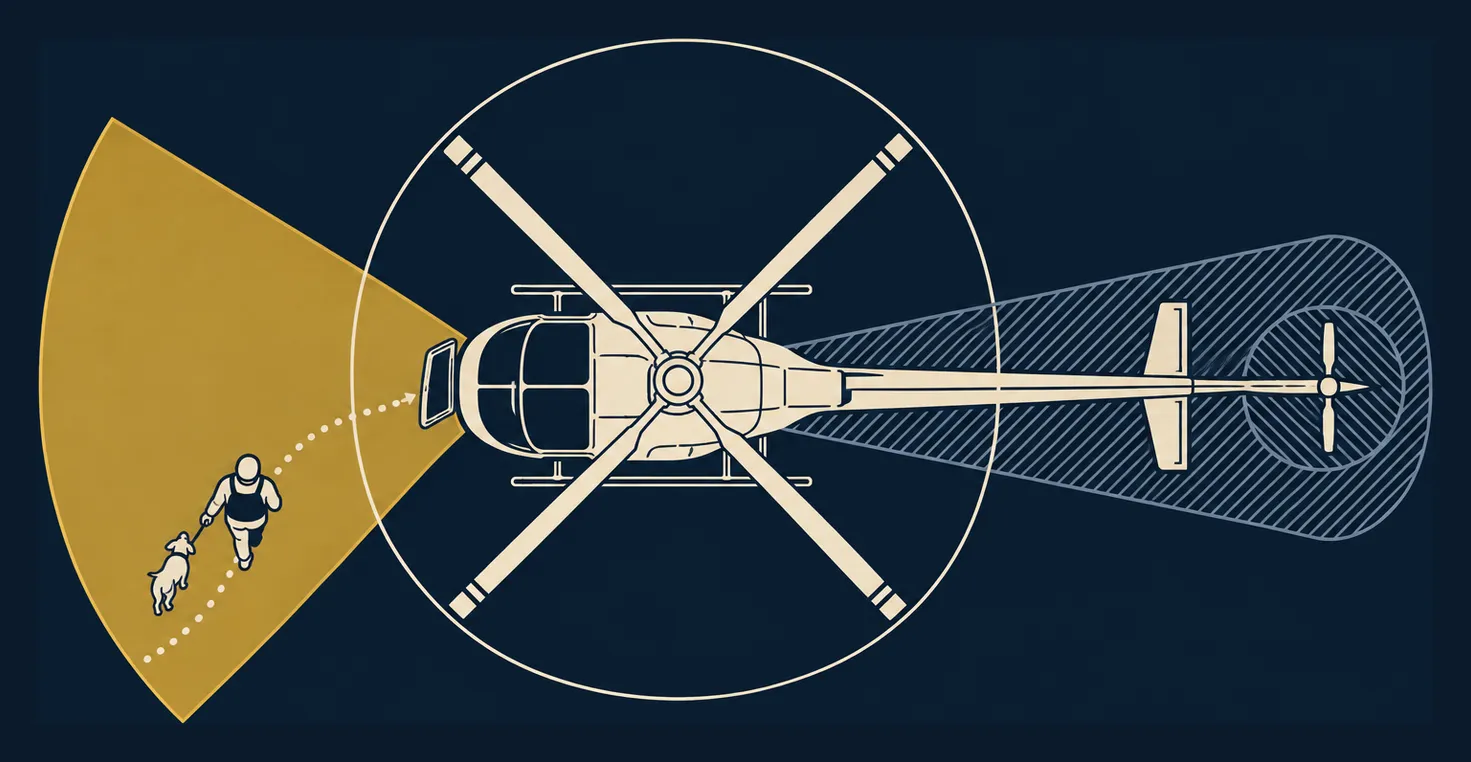
The ramp is the riskiest part of the trip for a dog. A running helicopter blows air hard enough to move chairs and loose gear, it is louder outside than in, and the tail rotor at the back spins so fast it is close to invisible. A dog that bolts on a long leash can run straight into the one part of the aircraft nobody should approach.
The simplest fix is to ask for a shut-down boarding: the pilot stops the engine and the rotor before the dog comes near, you load and secure the crate at your own pace, and the pilot starts up once everyone is strapped in. It costs a few minutes. Boarding with the rotor turning, called hot loading, is common with people aboard, but with a dog aboard it is the operator’s call, and a shut-down boarding is a reasonable thing to request when you book.
If the rotor is turning, follow the same rules the crew gives every passenger, tightened for a dog:
- Wait until the pilot or ground crew signals you to approach.
- Approach from the front or front quarter, where the pilot can see you. Never walk toward or around the tail.
- Keep the dog on a short, fixed leash on the side away from the aircraft, or carry it if it is small, or carry it crated.
- Keep hats, blankets and loose dog gear in your hands or in a bag. Rotor wash will take them.
- Do the same in reverse on landing. The dog stays secured until the crew says you can leave the aircraft, and it stays on the leash until you are clear of the landing area.
The FAA’s Helicopter Flying Handbook is written for pilots, but its guidance on ground safety around a running helicopter is the reason your crew is so particular about where you walk.
The day of the flight
Most of what makes a dog’s first flight go well happens before you reach the aircraft.
Talk to your vet first. Motion sickness, anxiety, a heart or breathing condition, old age, and a flat-faced breed that struggles in heat are all worth raising. If the vet suggests medication for nausea or anxiety, try it at home well before the flight so you know how your dog reacts. Sedation is a vet’s decision, not yours or the operator’s, and many vets avoid it for travel because it can affect balance and breathing.
Walk the dog, then walk it again. Long exercise before the drive to the aircraft and a last chance to relieve itself right before boarding. Many dogs travel better on a light meal a few hours ahead than on a full stomach. Ask your vet what suits yours.
Keep the cabin cool. A helicopter parked in the sun with the doors closed heats up quickly. Ask the crew to keep the doors open or the aircraft shaded until you board, and do not load the dog early and leave it waiting in a closed cabin.
Pack a small dog bag. Water, a collapsible bowl, a towel, waste bags, a spare leash, and any medication. It all counts toward the weight you declare.
Keep the flight short, or plan a stop. A 30-minute hop to a lake house is a manageable first flight for a calm dog. A longer trip with a fuel stop gives the dog a break, but an airport ramp is a working area. Ask the operator whether the stop is at an FBO with somewhere suitable to walk a leashed dog, and whether there will be time.
Plan for mess. Operators clean aircraft between trips, and a dog that sheds heavily or gets sick can mean extra cleaning. Ask whether cleaning is charged separately, and bring a seat cover or blanket if the dog rides on a seat.
Papers for crossing state lines
A helicopter crossing a state line carries the same animal health rules as a car. Each state sets its own entry requirements for dogs. Many ask for a current rabies vaccination and, depending on the state, a certificate of veterinary inspection issued by an accredited vet within a set number of days before travel. Check the destination state’s rules with its state veterinarian’s office, and carry the rabies certificate and any health certificate in the dog bag.
Hawaii is the strict exception. It is the only rabies-free state, and the Hawaii Department of Agriculture’s Animal Quarantine Branch quarantines arriving dogs unless they qualify in advance for direct release, a process that takes at least four months for an adult dog with one prior rabies vaccination. A charter on Maui or Kauai does not change any of that. The dog’s status is settled by its arrival in the state.
Service dogs are a separate question under federal disability rules for air carriers. If your dog is a trained service animal, say so at the first inquiry and ask the operator what it needs from you.
Where you meet the helicopter matters more with a dog
A dog that walks from your car across a quiet private lawn to a shut-down helicopter has an easier time than one led through a busy airport ramp, past idling jets and fuel trucks. When you have a choice of pickup, weigh the dog in it.
Some second homes with a helicopter pad are registered with the FAA. The Heliport Atlas lists the 5,675 operational heliports in the FAA register (NASR cycle effective 3 September 2026). Of those, 145 are resort, ranch or private-estate pads, and 1,914 are corporate or private pads. You can search by state or town to see what sits near your destination and read the facility’s recorded details before you ask about it. Only 56 facilities are public use, listed at Public-Use Heliports in the US. Every other pad is private, so landing there needs the owner’s permission first.
Know the Atlas’s limits before you rely on it:
- It lists operational FAA-registered heliports only.
- It does not include airports, where most operators base their aircraft and most FBOs sit.
- It does not list unregistered landing sites, and a lawn at a private home can be a lawful landing site without appearing on any national list. For that case, work through the landing permissions on private property before the date is set.
- Hospital and medical pads, the largest category at 2,970, are for air ambulance work. They are never a charter answer, dog or no dog.
Whatever the site, keep the dog indoors or on a leash well away from the landing area while the aircraft arrives. Rotor wash on a lawn picks up grit, twigs and loose gear, and a dog that runs out to greet the helicopter is exactly what the pilot is watching for on final approach. A good landing area has someone responsible for keeping people and pets clear; the other things it needs are set out under heliports and landing zones.
When the dog should go by car
Sometimes the right answer is for the dog to go by road while you fly.

- The dog is anxious in the car. A dog that pants, drools or panics on a highway drive will usually find a helicopter harder, not easier.
- The dog is large and the aircraft is a light single. A big crate, two passengers and a weekend of bags can exceed what the cabin holds or the aircraft lifts. Moving up a class may solve it; driving the dog may be simpler.
- The flight is long or the day is hot. Heat on the ramp and a closed cabin are hard on dogs, and hardest on flat-faced breeds.
- There are several dogs. Two crates can take the space and weight of two passengers.
- The operator says no. Take it gracefully and ask whether a different aircraft or a different day would change the answer.
Plenty of families split the trip: people fly, and the dog rides up with whoever drives the car full of groceries. Timing a Friday departure and packing for a long weekend work the same way as on any weekend getaway by helicopter.
Frequently Asked Questions
Can dogs fly on private helicopters?
Often, yes. There is no federal rule written specifically for dogs on charter helicopters, so each operator sets its own policy. Many accept a calm, declared dog in a secured crate or carrier. Some accept only small dogs, and some accept none. Ask when you first inquire, never on the day.
Do dogs need hearing protection in a helicopter?
It is strongly advisable. The cabin is loud enough that almost everyone on board wears a headset or ear protection, and dogs hear a wider range of frequencies than people do. Padded canine earmuffs work well if the dog has been trained to wear them at home in the weeks before the flight.
Can my dog sit on my lap during the flight?
Expect a no. A loose dog can reach the front seats, the controls or a door handle if something startles it. Operators want a crate strapped down, a carrier secured to a seat or the floor, or, for some small dogs, a harness tethered to a seat.
Can a dog ride in the helicopter’s baggage compartment?
Decline it even if it is offered. External baggage bays are built for luggage, with no reliable ventilation or temperature control, and nobody can check on the dog until after landing. If the crate does not fit in the cabin, change the aircraft or move the dog by road.
Does my dog’s weight matter?
Yes. The dog, its crate and its gear are part of the weight and balance calculation for every flight. Give the operator real weights. On a hot day or at high elevation, a large dog can be the reason a bag stays behind or a larger aircraft is needed.
What paperwork does a dog need to fly between states?
The same as by car. The destination state sets the rules, commonly a current rabies vaccination and sometimes a certificate of veterinary inspection issued shortly before travel. Hawaii runs its own rabies quarantine program, and qualifying for direct release takes months of preparation.
Glossary
- Part 135
- The FAA rules for on-demand commercial operators. A helicopter charter flies under this part, and the operator’s own policies, including its pet policy, sit on top of it.
- Pilot in command
- The pilot responsible for the flight. That pilot can decline to carry any passenger, animal or item they judge unsafe on the day.
- Weight and balance
- The pilot’s calculation of the aircraft’s total weight and where that weight sits, done for every flight. Passengers, bags, fuel, the dog and its crate are all part of it.
- Light single
- The smallest common charter class: one turbine engine, typically three to five passenger seats, and limited cabin and baggage space.
- Tie-down
- A fitting on the cabin floor or in a compartment where straps anchor cargo, including a dog’s crate, so it cannot shift.
- Rotor wash
- The strong downward and outward blast of air from a helicopter’s main rotor, enough to lift grit, loose gear and light objects near the landing area.
- Tail rotor
- The small rotor at the end of the tailboom. It spins fast enough to be nearly invisible and is the most dangerous part of a running helicopter for anyone on the ground.
- Hot loading
- Boarding passengers or loading items while the engine runs and the rotor turns. A shut-down boarding stops both first.
- FBO
- Fixed-base operator. The private aviation terminal at an airport, where many charter flights begin, end or stop for fuel.
- Certificate of veterinary inspection
- A health certificate issued by an accredited veterinarian, required by some states for dogs entering from elsewhere.
- Public use
- A heliport open to general traffic under published conditions. Most US heliports are private use and need the owner’s permission.
- NASR
- National Airspace System Resource, the FAA dataset behind the Heliport Atlas.