

Billing · September 16, 2026 · 16 minute read
Helicopterstandbyrates:howwaittimeisbilled
When a charter helicopter waits on the ground for you between legs, the operator bills that time in one of three ways: as a standby charge, often quoted separately and at a lower hourly figure than flight time, as part of a daily minimum, or inside a flat day rate. Past a certain wait, flying the aircraft home and back costs less. The crew’s federal duty day sets the hard limit on any wait.
What counts as standby time
Standby is the stretch when your helicopter is shut down at a landing site or nearby airport and its crew is committed to your next leg. You are in a meeting, at lunch, on the course, or at a plant tour. The aircraft is doing nothing, and nobody else can book it.
Three other charges sit close to standby on a quote, and it helps to keep them apart:
- Positioning legs. Empty flights to reach you and to go home afterward. Those are flight time, billed at the flight rate, and they stack with the other charges on a charter bill.
- Daily minimums. A floor on billable flight hours for any day the aircraft is yours. A minimum can swallow standby entirely, or sit beside it.
- Weather holds. Ground time forced by ceilings, visibility, or storms. Some operators treat it as standby, some absorb part of it, and the written policy decides which.
Standby differs from flight time because the aircraft is not running. With the engine shut down, it builds no flight hours and no engine time, and those two numbers drive much of an operator’s maintenance cost. That is why standby gets its own line, while the crew’s day and the lost bookings keep costing the operator money.
Why an idle helicopter still costs money
An operator with one aircraft committed to you all day has given up every other booking that aircraft could have flown. That lost booking is the core of a standby charge, and it explains why the charge exists even when the helicopter sits on a quiet ramp and burns nothing.
The crew is the second cost. A pilot holding the aircraft for your return is on the job: checking weather, coordinating the next landing site, arranging fuel, keeping a phone on. That person is paid for the day and is using up a duty window that federal rules cap.
The third cost is the place it waits. Airports, FBOs, and heliports commonly charge for ramp parking and handling, and those fees usually pass through to you. A city pad that tolerates a quick drop-off may charge heavily for a long stay, or refuse one outright.
The three ways a quote handles waiting
Operators package ground time differently, and the same itinerary can look expensive on one quote and cheap on another only because of packaging. The shapes below are the common ones. Your quote may blend them.
| Structure | How it appears | Where it bites | What to ask |
|---|---|---|---|
| Standby charge | A separate hourly or per-increment line for ground time, sometimes with a short free window first | Long, open-ended waits, such as a meeting with no firm end | When does the clock start, what is the billing increment, and is there a daily cap? |
| Daily minimum | Ground time is not billed separately, but the day bills at least a set number of flight hours | Short flights with long stays, where you fly little and hold the aircraft all day | How many hours is the minimum, and does standby count toward it or sit on top of it? |
| Day rate | One figure for the aircraft and crew for the day, with flight time billed on top or included up to a limit | Days that end early, since the full day is already committed | What does the day rate include, and what happens past the included flight time? |
Two quotes built on different shapes cannot be compared line by line. Rebuild each into flight time, positioning, standby, fees, and crew expenses for your actual itinerary, then compare totals. A quote with a lower standby figure and a large daily minimum can cost more on a short-hop day than a quote with a higher standby figure and no minimum.
Ask, too, when a standby clock starts: at engine shutdown, at your scheduled landing time, or at the end of a free window. A 20-minute difference repeated across four stops adds up on an invoice.
Wait or send the helicopter home
The decision is a comparison between two numbers you can read off your own quote.
Waiting costs the hours on the ground, times the standby rate, after any free window, plus parking and handling at the waiting location.
Sending it home costs the flight time from your location back to base and out again, times the flight rate, plus a second set of landing fees when it returns.
Divide the flight rate by the standby rate. The result tells you how many hours of waiting one hour of flying buys. If your quote puts standby at a quarter of the flight rate, one flight hour buys four standby hours. With a base 30 minutes away, the empty round trip is one flight hour, so waiting is cheaper for any stay under about four hours. With a base 10 minutes away, the round trip is 20 minutes of flight, and the break-even drops to a little over an hour. Use the rates on your own quote, since they differ by operator, aircraft class, and market.
The arithmetic is only half the decision. The other half is what can go wrong:
- Weather can close the door behind the aircraft. A helicopter that leaves in clear air may not get back through a line of low cloud that forms at 3 p.m. A waiting aircraft is already on your side of it.
- The return landing may not be guaranteed. A busy city heliport or a hosted private pad may not have a second slot at the time you need.
- Going home can double as a fuel stop. If the waiting site has no fuel, the operator may send the aircraft to refuel anyway, and a short round trip to base costs little extra.
- Duty time keeps running either way. Flying home does not stop the crew’s clock. Positioning flights are flight time and count against the crew’s limits.
For a two-hour lunch 10 minutes from base, sending the aircraft home can make sense. For a two-hour meeting 40 minutes from base, with low cloud forecast for the afternoon, the waiting aircraft is the safer buy.
The crew duty day sets the ceiling
Every Part 135 wait ends at a federal limit. For unscheduled operations flown by one- or two-pilot crews, 14 CFR 135.267 limits flight time in any 24 consecutive hours to 8 hours for a single pilot and 10 hours for a two-pilot crew. It also requires at least 10 consecutive hours of rest in the 24 hours before the planned end of the assignment. Paragraph (c) describes a regularly assigned duty period of no more than 14 hours, bracketed by rest periods of at least 10 hours. In practice, operators plan your whole day inside a 14-hour window that starts when the crew reports.
The report time is the part planners miss. A crew that must preflight, fuel, and fly a positioning leg before a 7:00 pickup may report at 6:00 or earlier. Count 14 hours from there, and the latest the crew can finish is 20:00. A dinner that ends at 21:00 does not fit, however patient you are willing to be.
Standby does not stop that clock. The rest the rule requires is time free of duty, and 14 CFR 135.263 bars the operator from assigning any duty during a required rest period. A pilot who must stay near the aircraft and be ready when you call is on duty. A six-hour wait in the middle of the day is six hours of that window gone.
Section 135.263 also says that transportation the operator requires and provides to move a crew back to its home station, when that travel is not local in character, does not count as rest. A long ride home that the operator requires and arranges eats into the crew’s rest rather than counting toward it.
When weather or other factors outside anyone’s control push a crew past its daily flight-time limit, 135.267(e) requires a longer rest before the next assignment: 11, 12, or 16 consecutive hours, depending on how far over the crew went. A long, delayed day can therefore push back tomorrow morning’s pickup.

Operators have two ways to stretch a day, and both cost more. A second crew can drive or fly in to take over the aircraft for the evening legs. A two-pilot crew raises the flight-time limit, which helps a day with a lot of flying, but it does not make the 14-hour window longer. Ask which option the operator has before you build a schedule that depends on one.
Build the day backward from the appointments that cannot move, the way a multi-city roadshow fits several stops inside that window. The same method works for a single long wait.
When the wait becomes an overnight
Once a schedule runs past the crew’s day, the helicopter either goes home and comes back, or stays with you overnight. Both have a cost, and neither is a standby question anymore.
An overnight stay adds crew lodging and meals, usually passed through to you, and parking or hangar space for the aircraft. The 10-hour rest also sets the earliest time the crew can report the next morning. If they finish at 21:00, a 6:00 report is not possible.
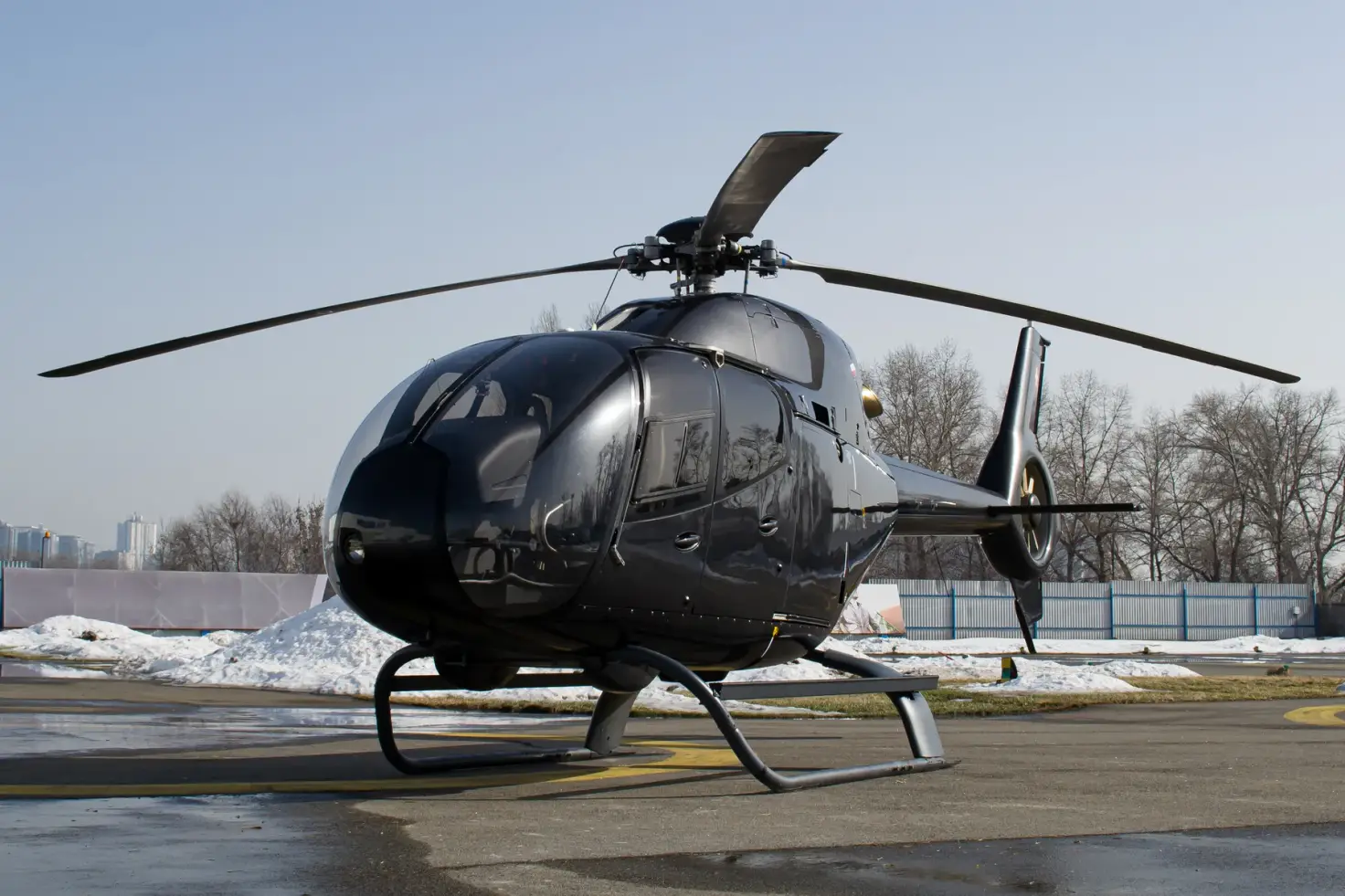
Parking outside is not free of risk either. Wind, snow, and frost all affect a helicopter left on the ramp overnight, and a crew may need time in the morning to clear the aircraft before it can fly. In winter mountain country, that time comes out of your schedule.
Returning home and flying back the next day costs two positioning round trips but spares the crew expenses. Whether that math works depends on the distance to base, which is why an operator based near your overnight point often quotes the whole trip lower.
Leisure trips follow the same logic. A golf day at a resort a short flight from base often works better with a drop-off and a later pickup than with an aircraft waiting through 18 holes. How much the bags weigh on those two flights is its own question, answered in golf clubs on a helicopter charter.
Where the helicopter waits
The aircraft can only wait where someone lets it. That limit changes the quote more often than people expect.
A private estate or corporate pad may take the drop-off but not a four-hour stay. A downtown heliport may limit parking or charge heavily for it. When the landing site will not host the wait, the helicopter repositions to a nearby airport and comes back for you. Those two short hops are flight time.

The Heliport Atlas helps you find a nearby place for the aircraft to wait. It maps the 5,675 operational heliports in the FAA register (NASR cycle effective 3 September 2026), and each facility’s record shows whether the FAA lists a landing fee for that pad. Only 56 of those facilities are public use, listed with contacts at Public-Use Heliports in the US. Every other registered pad is private use and needs the owner’s permission, for a landing or for a long stay.
The coverage has hard edges. The Atlas lists operational FAA-registered heliports only. It does not include airports, which is where most long waits actually happen, and it does not list unregistered landing sites. Hospital and medical pads, the largest category in the file, serve air ambulance work and are not a place for a charter to land or wait.
In a dense metro, the Atlas makes the pattern clear. The New York metro page shows 52 registered facilities within 25 miles and only three of them public use. A Manhattan meeting often means a drop at one of those public pads and a wait at an FBO across the river. On a tight day, a jet arrival at that FBO can follow the choreography in tarmac transfers. If the plan is to wait on someone’s lawn, the permission questions in landing permissions on private property apply to the stay as much as to the landing.
Weather holds and who pays for them
A weather hold looks like standby on the ramp and is handled differently on the invoice. The crew is waiting for ceilings to lift or a cell to pass, and your meeting may be finished.
Operators write these policies in different ways. Some bill weather holds as standby from the first minute, some after a set time, and some absorb them up to a limit. Get the policy in writing with the quote. The go and no-go call on a weather-prone day belongs to the pilot, and the Aviation Weather Center shows you the same ceilings, visibility, and forecasts the crew is reading.
When the hold runs long, the duty clock decides the outcome. A crew that waited out a morning of fog has less day left for your evening leg. Keep a car on standby for the last leg of a weather-prone day.
Reading the standby line on a quote
Before you accept, get answers to these, in writing where possible:
- Is standby billed separately, inside a daily minimum, or inside a day rate?
- When does the standby clock start, and in what increment does it bill?
- Is there a free window before standby begins, and a cap per day?
- Where will the aircraft wait, and are parking and handling fees included or estimated?
- Is the landing site willing to host the wait, or will the aircraft reposition?
- What is the crew’s planned report time, and what is the latest finish the operator will accept?
- How are weather holds billed?
- At what point does the operator recommend sending the aircraft home instead?
Pay attention to how the operator answers the last question. A plain answer that earns them less money says something about how they will run the rest of the trip. Ask the standby questions alongside the rest of your planning checklist, and check the operator’s certificate and crew rules against what Part 135 requires.
When waiting is the wrong answer
A waiting helicopter is a poor buy in several common situations:
- The meeting has no end time. Negotiations, depositions, and board sessions that run long turn standby into an open bill and eat the crew’s day. A drop-off and a car home, or a pickup booked for a fixed later time, is more honest.
- The base is close. When the empty round trip is short, sending the aircraft home almost always wins.
- The day will exceed the duty window. No standby arrangement fixes a schedule that needs the crew for 16 hours. Split the trip across two crews, stay overnight, or drive one direction.
- Ground travel is short. If the return trip by car is under an hour and traffic is predictable, the helicopter’s return leg may not justify a long wait at all.
- Event exits are unpredictable. Stadium and concert departures can close to aircraft or clog the pad, and a waiting helicopter may sit grounded behind a temporary flight restriction until the crowd clears. Plan a stadium or concert exit with a car in reserve, since one flight out and a car home often serves you better there.
Frequently Asked Questions
How much does helicopter standby time cost?
It depends on the operator, the aircraft class, and the market, and it is quoted as its own figure, part of a daily minimum, or part of a day rate. Standby is commonly priced below the flight rate because the aircraft is shut down. Ask for the standby figure, the billing increment, and any daily cap in writing.
Is it cheaper to have the helicopter wait or come back later?
Divide the flight rate by the standby rate to see how many waiting hours one flight hour buys, then compare that with the empty round trip to base. Short waits far from base favor waiting. Long waits close to base favor sending the aircraft home.
How long can a charter helicopter wait for me?
Only as long as the crew’s duty day allows. 14 CFR 135.267 requires at least 10 consecutive hours of rest in the 24 hours before a crew’s assignment ends, so in practice operators plan the day inside a window of about 14 hours from the crew’s report time. Ground waiting counts inside that window.
Does the pilot get to rest while I am in my meeting?
Not in the regulatory sense. Required rest is time free of duty. A pilot who must stay with the aircraft and be ready for your call is still working, even while sitting in an FBO lounge.
Do I pay standby when weather keeps the helicopter on the ground?
That depends on the operator’s written weather policy. Some bill it as standby, some absorb it for a set period. Get the policy with the quote, before the day.
Can the helicopter wait at the heliport where it dropped me?
Only if the facility allows it. Many private pads and busy city heliports will not host a long stay, so the aircraft repositions to a nearby airport and returns, which adds flight time.
Glossary
- Standby
- Ground time with the aircraft shut down and the crew committed to your next leg, billed under the quote’s standby terms.
- Positioning leg
- An empty flight to bring the aircraft to your pickup or back to base. Billed as flight time.
- Daily minimum
- The least flight time an operator bills for any day the aircraft is committed to you, whether or not you fly it.
- Day rate
- A single figure for the aircraft and crew for a day, with flight time billed on top or included up to a limit.
- Flight time
- Time the aircraft is operating for flight, measured by the operator’s billing convention. It is also the figure the FAA limits for each crewmember.
- Duty period
- The span a crewmember is working for the operator, from report time to release, including ground waiting.
- Rest period
- Time free of all duty. Part 135 requires at least 10 consecutive hours of it in the 24 hours before the planned end of a crew’s assignment.
- Part 135
- The FAA rules for on-demand commercial operators. A helicopter charter runs under this part.
- FBO
- Fixed-base operator. The private aviation terminal on an airport, where a helicopter often parks during a long wait.
- Public use
- A heliport open to general traffic under published conditions. Most US heliports are private use and need the owner’s permission.
- Temporary flight restriction
- A short-term FAA airspace closure, used around stadium events and other activity, that can block a helicopter’s departure.